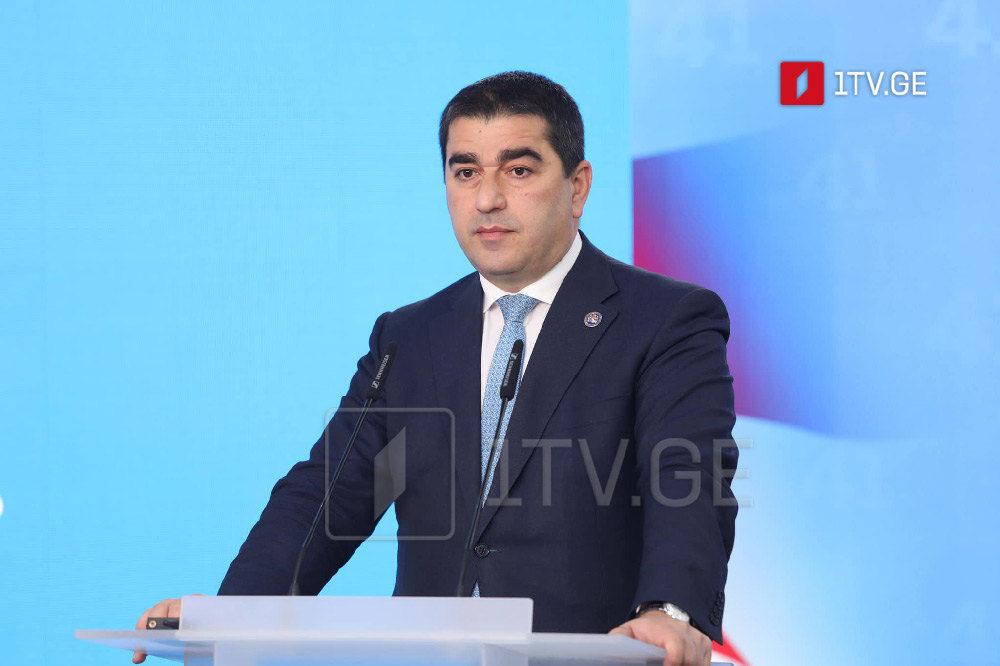
“On the third anniversary of the Ukraine war, Georgian government can look Georgian people in the eye and say we have been true to our values, principles, and beliefs. This is why Georgian Dream was re-elected for the fourth time last October,” the Georgian Parliament Speaker Shalva Papuashvili wrote on social media.
“The national interest remains, as it should be, the guiding principle of the Georgian government. It includes safeguarding of our independence and sovereignty, unification of the country, and sustaining our people’s welfare, and serves as the cornerstone of our foreign policy. This understanding of the national interest was key to every decision since before and after the war started in Ukraine, exactly three years ago.
Let us follow the key events of past few years to understand how our national interest shaped Georgia’s course. Even before Russia invaded Ukraine, Georgian Parliament passed a resolution on Ukraine, which spoke of the ‘inadmissibility of war’ and called on all governments to abstain from escalation. That Resolution, from over three years ago, echoes what the US Administration now offers as the cornerstone for peace.
After the war started, Georgian government offered full solidarity to the Ukrainian people:
– By co-sponsoring and joining every international political or legal document condemning the Russian aggression;
– By safeguarding the non-evasion of the international sanctions on Russia;
– By offering humanitarian aid to Ukraine;
– By sheltering tens of thousands of Ukrainian refugees, in addition to over 300,000 of our own internally displaced persons from the occupied territories.
Despite pressure, however, we did not impose bilateral sanctions on Russia, or restrict the land or air movement because such escalation would not have been even noticeable for Russia but would have caused economic collapse for Georgia and triggered a new war, in absence of any international security support or economic safeguards for Georgia.
Despite our active solidarity with Ukraine, the reciprocal actions by the Zelenskyy Administration were incomprehensible. Only a week after the start of the war, Ukrainian government recalled its ambassador from Georgia, and Zelenskyy himself addressed the protesting crowd in front of Georgian Parliament, tweeting that the people of Georgia were ‘better than the government’, thus clearly encouraging the protest against the authorities in Tbilisi. Ukrainian officials, including the President’s national security adviser, openly called on Georgians to overtake Abkhazia and Tskhinvali Region by force. The radical opposition and their affiliated NGOs declared ‘the bombs were better than the shame they had to endure’, because of the Georgian government’s policies.
The reaction from some Western capitals was not any better either. Despite the decade-long policy of ‘strategic patience’, which the Western countries had strongly suggested to Georgia, suddenly, our government was pushed to adopt an aggressive stance towards Russia, despite the lethal danger of the repeat aggression. This was happening without even a hint of either security guarantees or, at least, economic solidarity in case of escalation,” he wrote.
According to Papuashvili, since the first days of the Ukraine war, Georgia had “to endure the domestic and international pressures to get in conflict with Russia in one or other form.”
“In summer 2022, Georgia was refused the EU candidate country status, despite the fact that we were always forerunners in the Eastern Partnership format, by all EU indicators, and still remain such in many aspects among all EU candidate nations. This decision triggered protests by the radical opposition parties and the foreign-funded NGOs;
In spring 2023 and then, again, in 2024, under the pretext of protesting the adoption of the Law on the Transparency of Foreign Influence, Georgia’s radical opposition and the foreign-funded NGOs were directed to stage violent demonstrations against the authorities, and a vicious international campaign for discrediting the Georgian government started;
After the Parliamentary elections of October 2024, the radical opposition refused to enter the Parliament under the pretext that elections were rigged, despite the fact that the OSCE/ODIHR final report did not suggest anything to that effect. The protests against the government became increasingly more violent, but the reaction from some of Western governments to these protests were staggering, calling them ‘peaceful’ and the Georgian government’s legitimate reaction to them ‘violent’.
Despite this permanent pressure, both from the domestic radicals as well as their foreign patrons, Georgian government steered the country around the landmines. We now know that the only landmark that helped us to direct our country in the right direction was our belief in our people’s wisdom and our commitment to the national interest.
In March 2009, only a few months after the Russian invasion of Georgia, US Secretary of State Hilary Clinton presented her Russian counterpart Sergey Lavrov with a symbolic button of the ‘reset’. The following year, US and other Western military, including the Ukrainian armed forces, participated in the celebration of the Victory Day parade in Moscow. Georgia was left out in the cold. The West barely noticed this abomination but it gave an important lesson to Georgia.
When Georgian Dream won elections in October 2012, the new Georgian government started carving out space for preserving Georgia’s sovereignty and, increasingly, succeeded in safeguarding its national interests. The national interest was put ahead of any false philosophy of cosmopolitan solidarity, which we had already experienced during the decades of the Soviet occupation, when Georgia’s national aspirations were suppressed in the name of the ‘proletarian solidarity of the Communist international’. Similarly, in the last few years, we were pushed to subject our national interest to the ambiguous demands of the new pseudo-liberal international.
This is not going to happen any time soon, not under the Georgian Dream’s watch,” he added.