


Lelo’s Gegelia: Diverse EU integration concepts are well-established; Papuashvili should read academic literature and stop hysterical outbursts
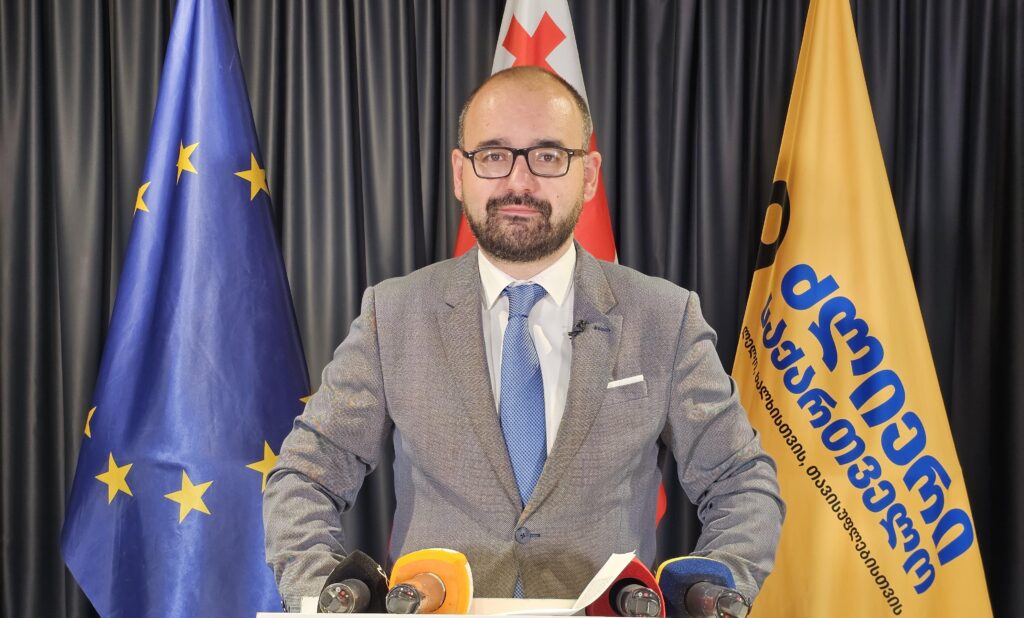
“Russia’s directive to this regime is becoming increasingly clear: Georgia’s European integration must be halted entirely, and even what currently remains as a flimsy piece of paper must be formally revoked,” stated Grigol Gegelia, a member of the Lelo-Strong Georgia coalition.
According to Gegelia, various ideas regarding accession models have existed within the European Union for years.
“For years, the EU has debated various accession formats and models. These include ‘multi-speed’ integration and models based on an applicant’s pace of development. Rather than categorising nations, these diverse frameworks aim to provide aspiring member states with viable pathways to join. This is in our interest as well. I would advise [Parliament Speaker Shalva] Papuashvili to familiarise himself with the academic literature on this matter, including the writings of Professor James Bellamy, so he might feel less compelled to issue the kind of hysterical statement he made today.
Russia is frustrated by its setbacks in Armenia, Moldova, Romania and Hungary. Consequently, Russia’s directive to this regime is becoming increasingly clear: Georgia’s European integration must be halted entirely, and even what currently remains as a flimsy piece of paper must be formally revoked,” Gegelia said.
As Grigol Gegelia noted, vast developmental disparities exist even among current EU member states.
“Not every country shares the same pace of integration, economic reality, regional development, and so forth; the disproportion between states is incredibly high. There is a huge disparity in development not just among aspiring nations, but within the European Union itself. Western Europe has one dynamic, Eastern Europe another, and so on. Therefore, the types of models being discussed now have been under consideration for years. There is nothing original about this. What actually worries Papuashvili is something else; he is anxious about carrying out Russia’s instructions, and Russia’s directive is that Georgia must not join the European Union at all, as either a first-tier or a second-tier member.
Joining the EU does not mean pursuing a uniform policy on absolutely everything. There are certain areas, first and foremost, foreign and security policy, where European Union members must have a common policy. That is one clear expression of unity. Beyond that, there are various policy areas where EU states often have quite distinct approaches, operating under a sort of principle of devolution. The framework for local and national decision-making remains resilient. Every Georgian who truly cares about peace, security, prosperity, and the chance of a normal life must stand up and reject this Georgian Dream regime,” Gegelia noted.
The EU Commissioner for Enlargement, Marta Kos, confirmed to journalists in Luxembourg ahead of the EU Foreign Ministers’ meeting that new EU members would have their veto rights restricted. In response to Marta Kos’s comments, Gegelia pointed out that decisions on such matters are taken by the European Council, not the European Commissioner.
“Marta Kos represents the executive branch. She is the European Commissioner for Enlargement. Decisions on these types of matters are made by the European Council, which comprises prime ministers, presidents, or foreign ministers, predominantly prime ministers. It is the political decision-making body. A European Commissioner cannot and does not make this kind of decision; she can deliberate on a specific preferential model that might be under consideration. Apparently, it is being considered. But the main point lies elsewhere. Whether Ukraine and Moldova get in through one route, a second, or a third, we will not get in at all until we rid ourselves of ‘the GDs’ and consign them to the political dustbin. That is the difference,” Gegelia stated.
For context, the Speaker of the Parliament, Shalva Papuashvili, wrote on social media: “The European Union has always been a rules-based project, which implies that all members are equal before these rules. Brussels’ idea to segregate countries by rights radically alters this fundamental principle of the EU, turning it from a union of equal nations into a union of ‘first-class’ and ‘second-class’ nations.”