


President Kavelashvili: U.S. Embassy urged against Transparency Law adoption, threatening with ‘Russian’ label and subsequent mobilization
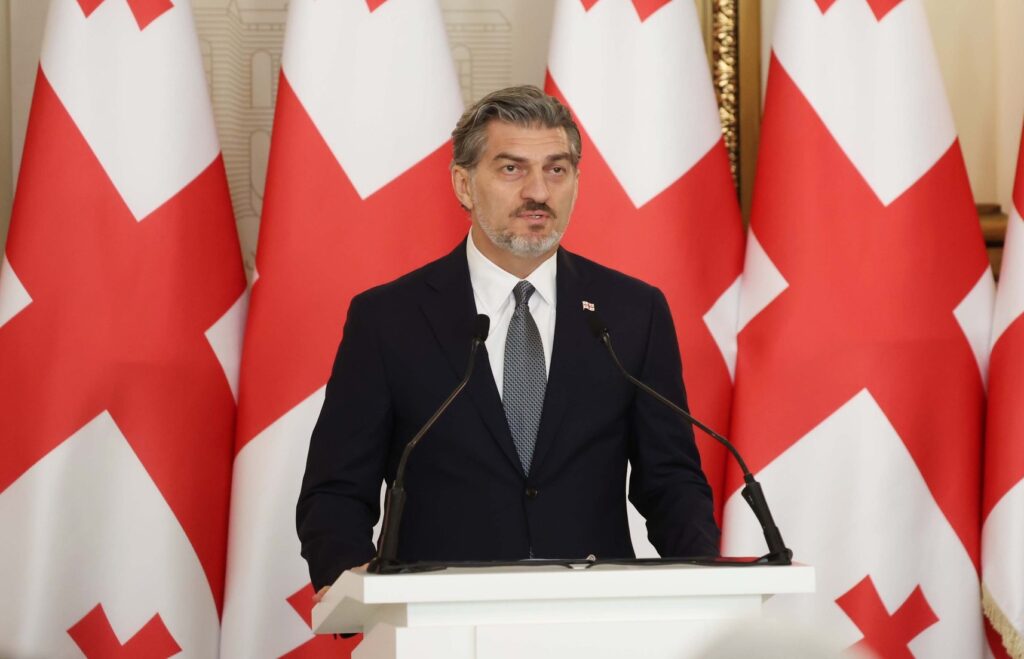
“We regarded USAID and NED as partners and simply asked them to clarify what it meant when the non-governmental organisations they funded announced a change of government and the establishment of a technical government,” stated Georgian President Mikheil Kavelashvili during the GPB First Channel programme Actual Topic with Maka Tsintsadze.
According to the President, during the process of drafting the Transparency Law, the government held consultations to ensure the law would not be burdensome or overly complex, aiming for a straightforward process. The focus was on transparency in financial flows rather than banning individuals or organisations.
“Before the law was introduced, there was a call, a message from a representative of the U.S. Embassy in Georgia, stating it was an instruction not to pass the law. They warned that if it was adopted, it would be labelled as ‘Russian’ and mobilisation would ensue. This was a direct message to the government. It is a well-known fact, and even Madam Kelly Degnan (former U.S. Ambassador to Georgia) could not conceal this, openly declaring that the law was unacceptable to them. I was genuinely astonished. What does it mean to call it Russian? Do we, as lawmakers, have no right to initiate legislation? The reaction was to threaten resistance, to unite all groups against us,” Kavelashvili explained.
He went on to say that during a briefing on the draft law, it became evident that it had already been evaluated as akin to Russian legislation.
“They demanded we withdraw it, claiming it was a Russian law and that strong resistance would follow. Do you understand what we’re dealing with?” he asked.
President Kavelashvili emphasised that such a reaction was part of a deliberate directive.
“People who are philosophers, lecturers, professors, teachers, those who educate were put in a position where they called on young people not to read, review, or even touch the law. Can any of the protesters, public figures, experts, or media outlets explain what was unacceptable about it? These individuals consider themselves knowledgeable, educated, free-thinking, and rational. Yet they urged others not to engage with the law critically. We are talking about a law, about discussion, about asking questions. Some of their representatives even see themselves as philosophers, teaching Hegel and Kant, promoting critical thinking to students.”
He added that these individuals were so disorganised that they were even discouraged from asking questions.
“You shouldn’t ask questions; you shouldn’t engage in discussion. Go into details and scrutinize to understand what is written there. Young people should be encouraged to sit down, discuss, and judge what is acceptable and what is not,” Kavelashvili concluded.