


PM Kobakhidze unveils university reforms: One city, one faculty principle and professor salaries above GEL 10,000
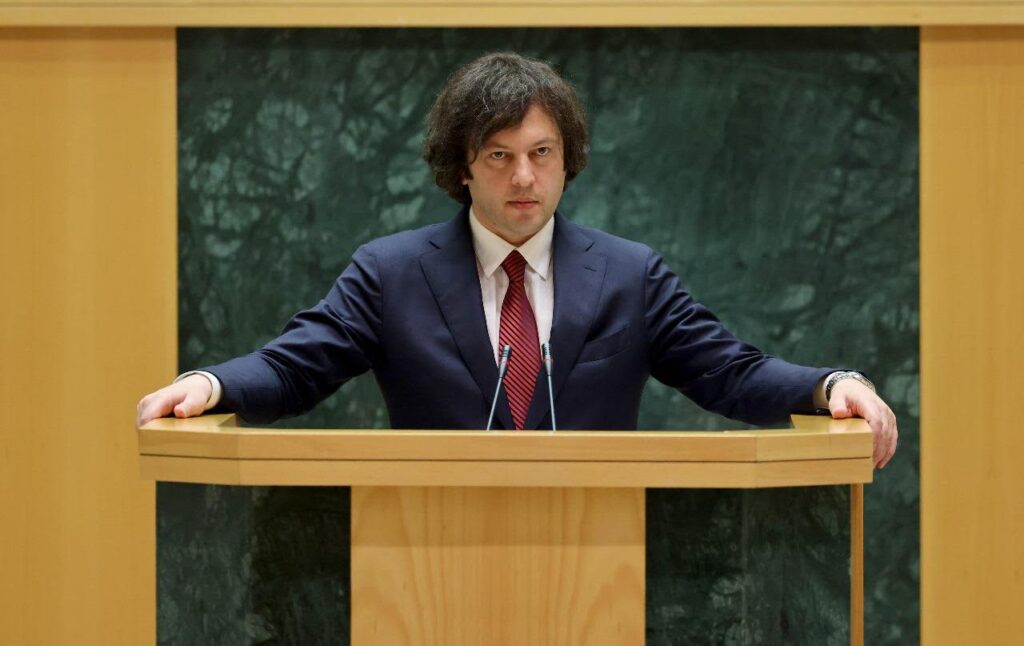
Prime Minister Irakli Kobakhidze has elaborated on radical reforms to Georgia’s higher education system during a Parliamentary interpellation hearing, proposing to consolidate university faculties, shorten degree programmes, and dramatically increase academic salaries whilst reducing foreign student numbers at state medical universities.
System Consolidation: “One City, One Faculty”
Speaking in Parliament, Kobakhidze identified the suboptimal use of resources and quality inequality amongst universities as one of the most pressing challenges facing Georgian higher education.
“To enable the optimal use of both infrastructure and human resources, a specific principle must be introduced into the higher education system: one city, one faculty,” the Prime Minister stated.
According to Kobakhidze, this applies primarily to Tbilisi, as state universities in other cities lack the resources to maintain more than one faculty.
“In Tbilisi, we have an over-fragmented system, which ultimately results in overall higher education quality being low and unsatisfactory,” he explained.
He cited law faculties as an example: “The law faculty operates in four different universities in Tbilisi. In one case, the standard is average, in the second, below average, in the third, below below average, and in the fourth, even lower. This is today’s reality, whilst optimisation would enable us to ensure, very quickly, in the medium term, even within a four-year perspective, substantially the same quality and standard of legal education in Tbilisi as exists in developed states such as Germany, Great Britain and so forth.”
Shorter Degrees: 3+1+1 System
The government proposes adopting a 3+1+1 system: three years for a bachelor’s degree and one year for a master’s, with an optional extended two-year master’s programme for students pursuing academic careers.
“We want to introduce the 3+1+1 system. Essentially 3+1, three years bachelor’s, one year master’s, and in cases where a student wishes to continue academic activity, for example, in a doctoral programme or further study later on, there will be an extended two-year master’s programme, which the relevant student must complete. This is a decision taken in accordance with international practice and requirements,” Kobakhidze stated.
He insisted that three years would be sufficient for law students to cover all essential subjects plus up to 10 elective courses according to their specialisation, with similar arrangements possible for economics, social sciences, humanities and other fields.
This change would have an additional benefit, according to the Prime Minister: “Approximately 30,000 people will be added to the workforce in our country when students finish their studies one year earlier. In other words, 30,000 more young people, personnel, and workforce will join our labour market.”
He noted that whilst unemployment remains a problem, many sectors already face labour shortages.
“If you listen to, for example, business association presentations, they list labour shortage as one of their top three problems, and the second is skilled labour deficit, which is a separate problem.”
Professor Salaries to Exceed GEL 10,000
Kobakhidze announced plans to establish a core of full-time professors at state universities, offering significantly improved working conditions and remuneration.
“We believe that personnel policy must be reviewed and a core must be created in state universities in the form of full-time professors. This is fundamentally important, and they must have appropriate working conditions and high remuneration. We believe that a full-time full professor’s remuneration should exceed 10,000 lari take-home pay.”
He explained that current salaries of GEL 2,000-3,000 at Tbilisi State University make it difficult to attract qualified economists, lawyers or other specialists to work full-time.
“Therefore, it often happens that people work elsewhere and work in the academic sphere, in state universities, on a part-time basis. In such conditions, the system cannot develop and stands still.”
The government also intends to attract qualified personnel from abroad, particularly retired professionals who could teach for seven to ten years or longer in areas experiencing shortages, such as technology and technical fields.
Medical University Reforms
Addressing what he termed a challenge at the state medical university, Kobakhidze proposed limiting foreign student intake to private institutions only.
“Today, the ratio of Georgian and foreign students at state medical universities is roughly 50/50. Consequently, what happens is that the infrastructure created by the state, intended to train doctors for our system, has half its capacity devoted to foreign students. Accordingly, this infrastructure is unavailable to potential future Georgian doctors.”
He acknowledged this would result in approximately 80 million lari in lost revenue for the medical university, of which 5 million would be compensated, with the remainder redistributed to private universities.
“What will be the medical university’s loss and what needs to be compensated, we must compensate, and the resources exist for this.”
The Prime Minister emphasised that the main objective is to maximise the standard of education at the medical university and ensure it primarily serves Georgian students, whilst internationalisation programmes and exchange students would continue.
Funding System Overhaul
Kobakhidze criticised the current grant-based funding model as “very crude,” noting that the 2,250 lari per student has remained unchanged for years and does not account for inflation.
“Today’s approach must be reviewed. It must be assessed what needs exist in which direction, including specific specialities; needs must also be determined. For example, training a doctor may require more money than training a lawyer. Today’s model doesn’t even consider this.”
He proposed replacing the grant model with a commission-based system that would consider multiple components collectively.
Labour Market Analysis
The Prime Minister revealed that student places have never been allocated based on labour market analysis.
“Nobody has analysed in depth how many lawyers the country needs, how many economists, how many doctors, how many engineers and so forth. As a result, we find that there’s a radical discrepancy between student graduation figures and labour market demands.”
He pointed to severe shortages in technology and technical sciences alongside massive surpluses in law and economics.
“Consequently, what happens is that universities, the system graduates lawyers, but the vast majority of them find employment in completely different directions because there’s no demand in the market.”
Two ministries, Education and Economy, are now working with business associations on a comprehensive labour market analysis.
“If the public and private sectors analyse labour market demands together, naturally we’ll reach optimal indicators, and this is precisely what future student admissions to various specialities should be based on.”
Quality Control Enhancement
Addressing quality management, Kobakhidze stated that the current system is insufficiently effective and often merely formal.
“Quality control includes curricula, syllabuses, and their verification takes place, but this is essentially a formal procedure.”
He emphasised the need for the state to assume responsibility for the quality of diplomas, noting that identical qualifications issued by different universities can represent vastly varying standards of excellence.
“We believe the quality management system requires qualitative improvement and refinement.”
System Overview
The Prime Minister contextualised these reforms by noting that Georgia currently has 64 operating universities, “which in itself already indicates that the system is unhealthily formed.”
“It’s impossible, in a country of our size, given our 35-year history, for 64 universities, against a background of economic and other types of challenges, to have equally high quality ensured. This automatically means that the average quality of higher education is unsatisfactory.”
The Prime Minister highlighted youth emigration as a major challenge, noting that many students prefer to study abroad and often choose to remain there permanently.
“This process must stop, and must stop not artificially, but by increasing the quality and standard of higher education in our country.”
“It is our responsibility and obligation to pay particular attention to improving the health and quality of the higher education system and to ensure the system’s transformation in such a way that the quality of higher education in the country increases,” Kobakhidze concluded.