


Parliament Speaker: True question is not when Georgia joins EU, but what kind of Union we are entering and whether we will be equal
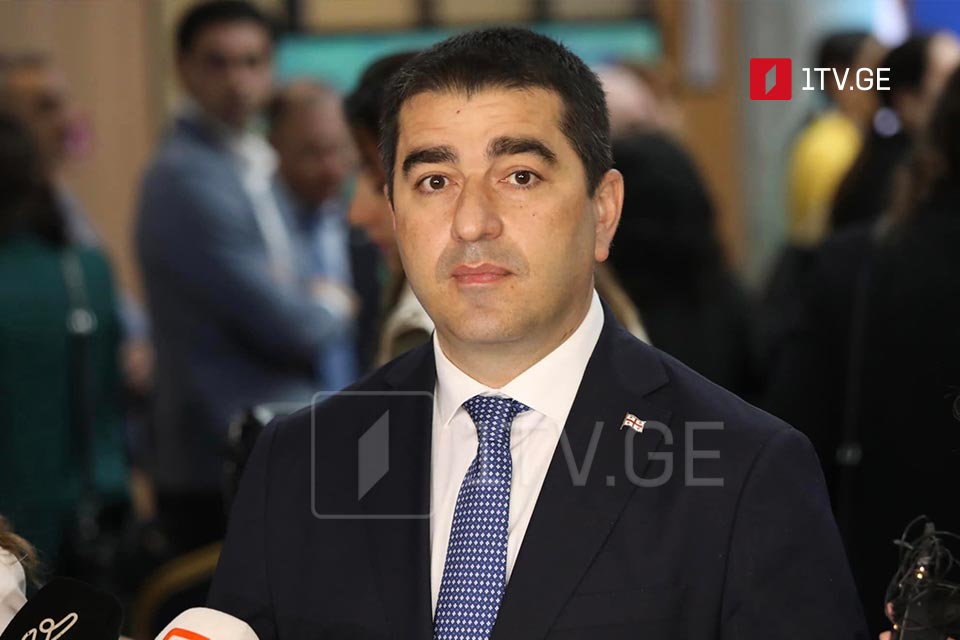
“There is a growing impression that Europe’s larger states are planning to seize control of the European Union that would pose a fundamental threat not only to Europe’s political balance and the enlargement process, but also to the very values on which the EU was founded and has operated ever since,” the Speaker of the Georgian Parliament, Shalva Papuashvili, wrote on social media.
According to Papuashvili, the German Foreign Minister has announced that twelve countries have already joined Germany’s initiative to abolish the rule of consensus-based decision-making in the EU.
Papuashvili notes that if this initiative goes ahead, the EU will almost certainly be transformed from a union of equal members into a union governed by the large states.
“Membership of the EU is not an end in itself. That is true neither for current members nor for candidate countries. Brexit was the best proof of that.
Membership is a means for a country to defend its own state interests more reliably, to expand its opportunities, and to gain influence over international decisions that it could never achieve through its own size, economic weight and political resources alone.
For small states, the principal guarantee of this opportunity is the principle of consensus.
It is precisely the rule of consensus that ensures a small country’s voice is not lost amid the interests of the large states and the arithmetic of the majority. It gives a small state the right to block decisions harmful to it and to demand that its own national interests be taken into account.
If the principle of consensus is abolished and decision-making becomes entirely dependent on the will of the large states or of stable majorities, small countries will lose this fundamental lever. They will no longer be able to defend their vital interests when those interests fail to align with the political plans of the majority.
In that case, EU membership will no longer mean sharing part of one’s sovereignty, which today is a voluntary and balanced choice made in pursuit of broader economic, political and security goals. Instead, it will mean the near-total loss of genuine sovereignty,” Papuashvili states.
According to the Speaker of Parliament, a state that can no longer block decisions harmful to itself, and that may have obligations imposed upon it against its will, gradually loses not only its freedom of decision-making but its very statehood. He says it will be transformed from an independent political entity into a small region, or province, of a far larger political system.
“For large states, such a model may well be advantageous, since their size, economic weight and political influence already secure them a significant advantage in the decision-making process. But for small countries, this would be a catastrophic change.
That is why the question will become ever more pressing: what is the point of membership, if the principal benefits and levers of membership are taken away from the outset?
EU membership matters precisely because it allows a country to support decisions that benefit it, to advance its own interests, and to halt decisions that would harm it.
Should a nation be stripped of this capacity, the European Union itself would lose its core value as a mechanism for safeguarding national interests. And with that, the political appeal and the fundamental motivation for membership disappear.
What’s more, under such conditions, remaining outside the EU might actually prove more advantageous for a small state, since it would at least retain the freedom to make independent decisions.
Nor should it be ruled out that one of the indirect aims of this discussion is precisely to halt enlargement. It is growing ever more apparent that the admission of new members into the EU, as it is currently structured, is no longer on the table.
Candidate countries are not being offered equal membership within the existing union, but rather a pre-altered system in which they will be burdened with the full obligations of membership, while their rights and levers of influence are curtailed.
That is why the key question is not simply when we will be admitted to the EU. The key question is: which EU are we being offered membership in, with what rights, and how equal a member’s status? Because membership that strips a country of its state rights, without providing the mechanisms to defend them, is not integration; it is the abolition of sovereignty…. Though it seems Jupiter is forgiven even for the abduction of Europe,” Papuashvili writes on social media.