


PM Kobakhidze details infrastructure overhaul: Mega-projects optimised as net savings and revenues surge
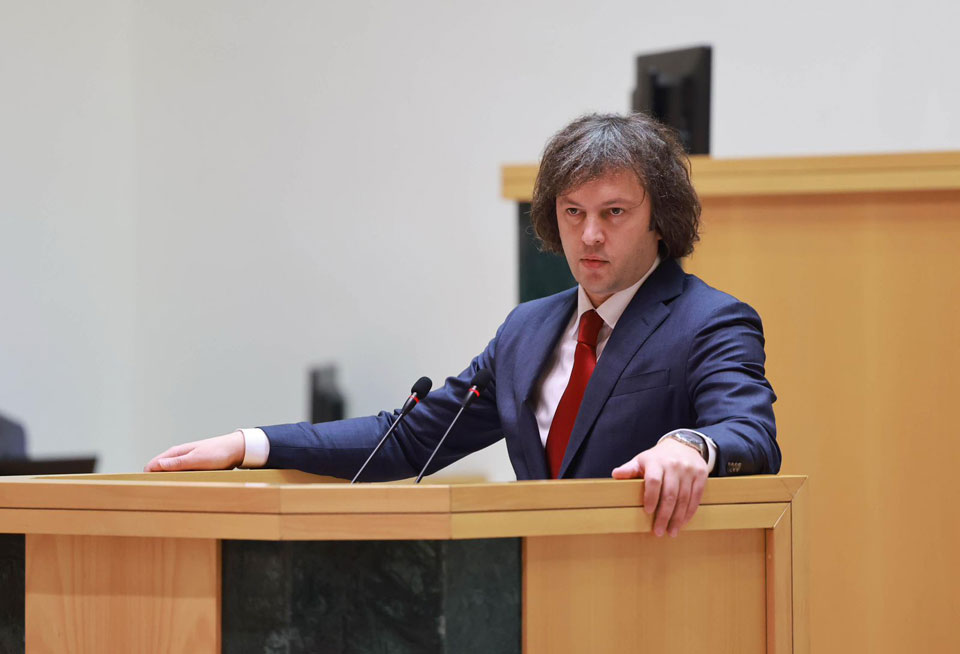
“The Government of Georgia has secured massive financial savings, boosted state enterprise revenues, and advanced key transport infrastructure following successful management optimisations and international negotiations,” Prime Minister Irakli Kobakhidze announced during his annual report to Parliament.
Anaklia Deep Sea Port contract optimised
In the annual government programme implementation report, the Prime Minister highlighted major cost-cutting success regarding the development of the Anaklia Deep Sea Port, where active marine works, including dredging and breakwater construction, are underway. Following intensive government negotiations, an initial 203.9 million dollar contract with a developing firm was optimised and downsized to 151.4 million dollars, saving the state treasury 52.5 million dollars.
“Active works are underway at the Anaklia Deep Sea Port, including dredging and breakwater construction. A specific contract worth 203.9 million dollars had been signed here with a specific company, and as a result of negotiations, we identified immense room for optimisation. The cost of this contract was reduced from approximately 204 million dollars to 151.4 million dollars, meaning we saved the country 52.5 million dollars through contract optimisation. This is yet another clear expression of our new approach,” Irakli Kobakhidze stated.
Overhaul and expansion of Georgian Railway
The Prime Minister reported an institutional turnaround at Georgian Railway, noting that net profits more than doubled from 68 million lari in 2024 to 145 million lari in 2025 following structural reforms. The adjustments included the elimination of 1,100 redundant positions, which saved 24 million lari annually, and the re-shoring of outsourced business operations, which yielded an annual benefit of 18.5 million lari. Contract revisions also generated a one-off saving of 190.4 million lari.
Looking ahead, a newly approved development plan includes the acquisition of 50 new locomotives, 1,500 freight wagons, and 10 modern passenger trains, aiming to double cargo capacity to 30 million tonnes and scale passenger transit to 5 million. Infrastructure upgrades will reduce the Tbilisi-Batumi journey from 5.5 hours to 4 hours, and railway lines to Kutaisi and Akhaltsikhe will be fully rehabilitated.
“Highly significant changes were carried out at Georgian Railway. Staff optimisation was implemented here as well, reducing a total of 1,100 positions without any negative impact on the railway; on the contrary, operational efficiency improved. This optimisation alone saves 24 million lari annually, which will be redirected entirely into the development of the railway and the economy. Furthermore, there was a highly flawed practice where specific business processes related to operations were outsourced to intermediary companies. We brought these processes back to Georgian Railway, yielding an annual saving or additional revenue of 18.5 million lari. Consequently, more than 40 million lari that was being spent incorrectly will now be reinvested into the railway’s development on an annual basis,” the Prime Minister noted.
Land transport reforms and sector optimisation
The modernisation efforts also extended to the land transport sector, where personnel and operational procurement optimisations resulted in an annual saving of 374,000 lari. The reforms aimed at eliminating middleman practices, expanding international quotas, and introducing a standardised certification process for bus terminals across the country.
“As for the land transport sector, a very important process of personnel and operational procurement optimisation was carried out here as well, saving 374,000 lari annually. The permit issuance process has become transparent and fair. The flawed practice of reselling permits was eradicated, placing 6,214 carriers on an equal footing. The right to distribute permits was revoked from four carrier associations and returned to the Land Transport Agency, putting an end to intermediary operations. Furthermore, following negotiations with partner states, permit quotas increased by 10%. Uncertified bus terminals will undergo certification, ensuring that at least one certified bus terminal operates in every municipality. Mandatory periodic technical inspections will be launched for first-category vehicles, and cargo and passenger permits with regional partner countries will be fully digitalised,” the Prime Minister stated.
Aviation boom and airport infrastructure upgrades
The civil aviation sector logged a record-breaking performance in the past year, with Georgian airports welcoming an all-time high of 8.5 million passengers. The number of operating airlines grew to 82, expanding active flight routes to 125, including new destinations such as London, Geneva, Beijing, and Shanghai. Additionally, a 5-year contract extension concluded with operators TAV and ADP at Tbilisi International Airport secured an immediate 25 million US dollar payment to the state and locked in a 150 million US dollar investment to boost capacity by 53%.
Addressing long-term transit strategy, Prime Minister Kobakhidze confirmed that preparations are moving forward for the construction of a new mega-airport in Vaziani, designed to serve 20 million passengers annually. Construction is slated to begin at the end of 2027 and conclude by late 2031, perfectly aligning with the expiration of the current airport contract.
In the domestic sector, the construction of a brand new airport in Telavi and a modern terminal at Mestia Airport will launch this October.
“Very important negotiations were held with TAV and ADP regarding Tbilisi International Airport. The contract was extended for a 5-year term, yielding an immediate 25 million US dollars in revenue for the United Airports of Georgia and securing 150 million US dollars in investment. As a result, the capacity of the current Tbilisi airport will increase by 53%, and the state’s annual revenues from Tbilisi International Airport will quadruple. We are also actively working on the construction of the new Tbilisi International Airport in Vaziani. We estimate that construction will begin at the end of next year and conclude by the end of 2031. Once the agreement with the existing airport expires, the new international airport will begin operations, serving approximately 20 million passengers,” Kobakhidze concluded.