


Parliament Speaker: By declaring Christianity the state religion, Georgia made a choice that shaped our culture, legal thought, and place in civilisation
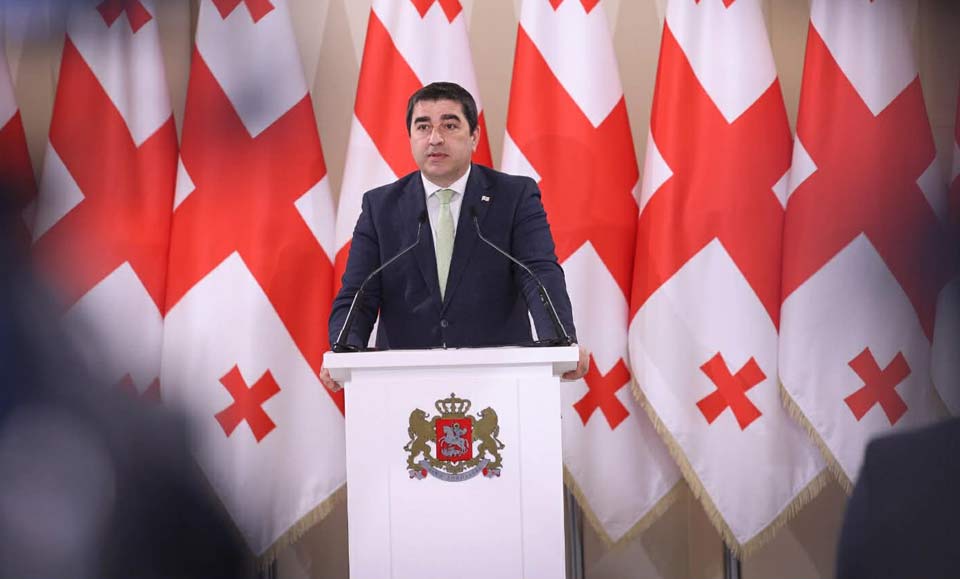
“I am delighted that the Parliament of Georgia is hosting this conference marking the 1,700th anniversary of the declaration of Christianity as our state religion,” declared Speaker of Parliament Shalva Papuashvili in his opening address to the international conference Foundations of European Civilisation and 1,700 Years of Christianity in Georgia.
The Speaker noted that Georgia endured numerous cycles of rise and fall, unity and fragmentation, and the loss and restoration of independence across the centuries. Yet, Christianity remained an unyielding anchor around which the Georgian people preserved their national identity throughout these historical shifts.
“By declaring Christianity the state religion in the fourth century, Georgia made a defining choice that shaped our culture, worldview, legal philosophy, social relations, and ultimately our place within Christian civilisation,” Mr Papuashvili stated.
“States, borders, political systems, and social orders have since transformed. Georgia has weathered periods of ascendance and decline, unity and division, and the loss and recovery of sovereignty. Yet amidst this historical flux, Christianity remained the steadfast pillar enabling our nation to safeguard its core identity,” he added.
The Speaker emphasised that marking this 1,700th anniversary cannot merely be an exercise in nostalgia:
“The true significance of a milestone emerges when it compels us to reflect on pressing modern questions. What do Christian values mean in a contemporary democratic state? What role do religious and moral insights play in politics, which must unite citizens of diverse worldviews? How should Church and state collaborate to ensure both the institutional autonomy of the state and the freedom and public role of the Church?”
“‘European parliamentarism did not emerge in a historical vacuum,'” Mr Papuashvili continued. “European political culture was forged by multiple sources—ancient philosophy, Roman law, the Christian worldview, the Enlightenment, and subsequent democratic experience. Modern European states are secular, but fully understanding European history and its values is impossible without its Christian heritage. Human dignity, personal accountability, duty to one’s neighbour, solidarity, mercy, and the sanctity of the family formed European societies for centuries and remain vital to their moral self-understanding.'”
Addressing the institutional relationship between Church and state, the Speaker cautioned against secularism that seeks to erase faith from public life:
“Separation of Church and state does not mean separating the Church from society. Today, we sometimes encounter an aggressive approach seeking to banish religion entirely, not only from the state apparatus but from the public square altogether. Yet we know that our state and society owe their very survival to faith. Indeed, Georgia’s ability in recent decades to end an era of conflicts and wars and embark on peaceful development is largely due to our faith and the Church.'”
“Severing faith from society means rejecting not only our past, but the moral and ethical foundation—the moral backbone—upon which Georgian society stands. Marginalising Christian faith from public discourse strips society of a shared moral compass, leading down a short path toward moral relativism and the breakdown of public order,'” he warned.
Turning to domestic policy and demographic trends, Mr Papuashvili stressed the critical role of family policy:
“Supporting the family is no longer merely a matter of personal morality; it is a vital pillar of demographic, economic, and social policy. Across Europe, declining birth rates, ageing populations, and mounting socioeconomic pressures weigh heavily on young families. Strong families provide an environment where children are protected, generations remain connected, and no individual faces life’s harshest moments alone. Protecting the family must not exclude anyone, and preserving tradition requires no compulsion; tradition is strongest when its vitality is proven within a free society.'”
Concluding his address, Speaker Papuashvili paid a solemn tribute to the late Catholicos-Patriarch Ilia II:
“In opening this conference, I must pay homage to our late Holy Patriarch, Ilia II. Even his passing demonstrated our nation’s remarkable unity and spiritual bond—the embodiment of the noble goal to which His Holiness dedicated his entire life in monasticism, priesthood, and the patriarchy. We were all witnesses to this miracle and transformation, learning what it means to live in the modern world while defending and revitalising immortal values: God, homeland, humanity, faith, family, labour, and devotion,” the Speaker concluded.