


Newsweek: New momentum in U.S. relations, Georgia’s Middle Corridor ambitions are boosting U.S. diplomatic and investment ties
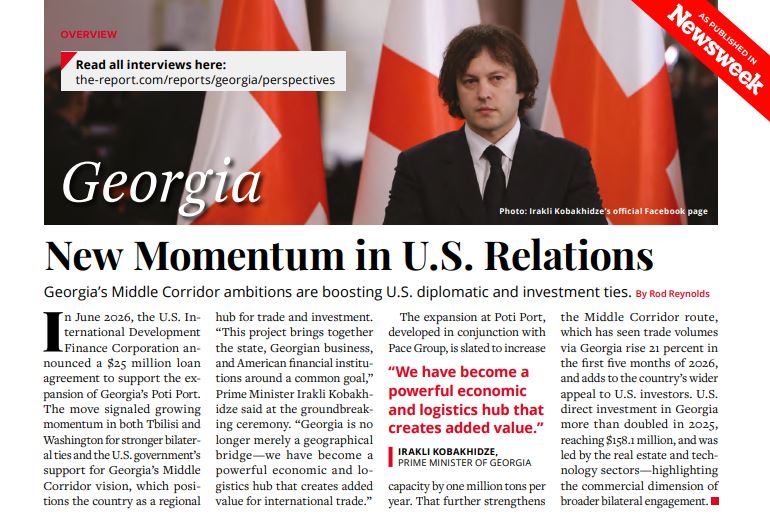
Newsweek has published an article titled “New Momentum in U.S. Relations,” highlighting Georgia’s growing ambitions to develop the Middle Corridor and deepen diplomatic and investment ties with the United States.
According to the article’s author, Rod Reynolds, “Georgia’s Middle Corridor ambitions are boosting U.S. diplomatic and investment ties.”
‘In June 2026, the U.S. International Development Finance Corporation announced a $25 million loan agreement to support the expansion of Georgia’s Poti Port. The move signaled growing momentum in both Tbilisi and Washington for stronger bilateral ties and the U.S. government’s support for Georgia’s Middle Corridor vision, which positions the country as a regional hub for trade and investment,’ the article reads.
The author also quotes Georgian Prime Minister Irakli Kobakhidze from the ceremony marking the start of construction of a new berth at the Port of Poti.
“This project brings together the state, Georgian business, and American financial institutions around a common goal,” Prime Minister Irakli Kobakhidze said at the groundbreaking ceremony. “Georgia is no longer merely a geographical bridge—we have become a powerful economic and logistics hub that creates added value for international trade.”
According to Newsweek, the Port of Poti expansion project, being implemented in partnership with Pace Group, will increase the port’s annual handling capacity by one million tons.
“The expansion at Poti Port, developed in conjunction with Pace Group, is slated to increase capacity by one million tons per year. That further strengthens the Middle Corridor route, which has seen trade volumes via Georgia rise 21 percent in the first five months of 2026, and adds to the country’s wider appeal to U.S. investors. U.S. direct investment in Georgia more than doubled in 2025, reaching $158.1 million, and was led by the real estate and technology sectors—highlighting the commercial dimension of broader bilateral engagement,’ the article reads.