


Jeffrey Sachs warns EU is playing ‘extremely dangerous game’ beyond its mission in South Caucasus
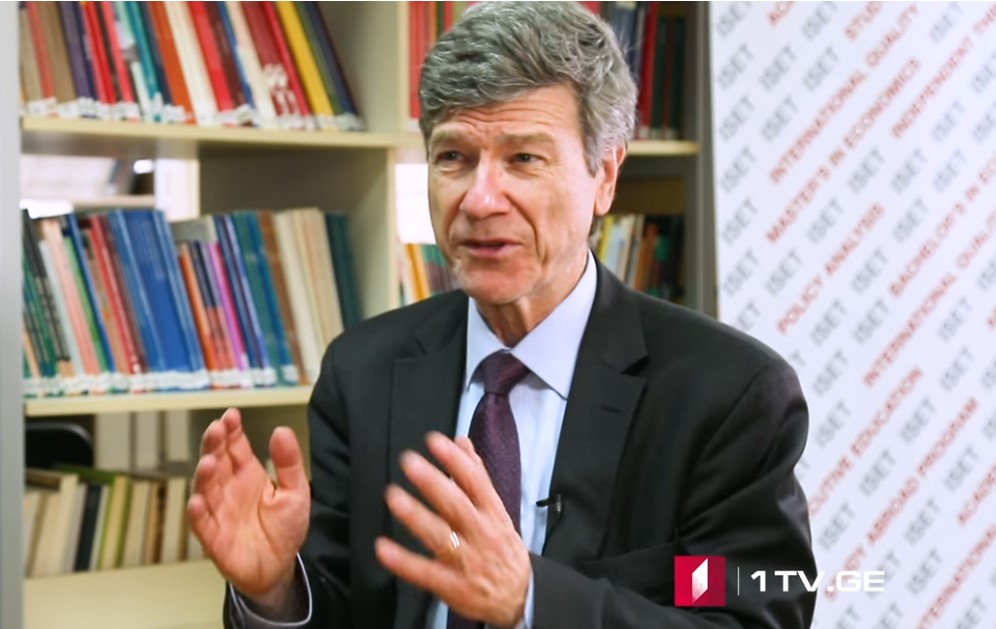
“I am deeply concerned about European meddling in the South Caucasus — and by Europe, I mean the European Union. I consider it wholly inappropriate; it is playing an extremely dangerous game, entirely at odds with the European Union’s mission,” said Jeffrey Sachs, a professor at Columbia University, during a video conference at the Tbilisi Sustainable Development Forum in Georgia.
According to Sachs, major powers should respect each other’s “red lines” not to gain control over small countries, but to act as good neighbours.
“In my reading of history, the United States had already formed this idea in the 1990s — though its roots stretch back to the Cold War origins of the 1940s. The thinking was that if the United States could establish some form of political control, and above all a military presence, in Eastern Europe and in Ukraine, this would deal a severe blow to the power of its rival — the Soviet Union until 1991, and Russia thereafter. In my understanding, Ukraine was already in the sights of American strategists in the 1940s as a potential means of weakening the Soviet Union. After 1991, Ukraine came to be viewed in explicitly strategic terms as the prize to be won — and thereby a vehicle for weakening Russia, its principal rival.
This vision was made explicit in the writings of Zbigniew Brzezinski, a major strategic thinker and, of course, the key National Security Advisor to President Carter, who became an extraordinarily influential voice in Washington throughout the 1990s. In his 1997 book, The Grand Chessboard, and in an important essay published in Foreign Affairs, Brzezinski laid out the vision of Ukraine joining NATO and thereby becoming a fundamental stepping stone of American power in Eurasia — and a fundamental diminution of Russian power in the broader region. The very name Ukraine, etymologically meaning “borderland”, underscored its strategic significance in American thinking.
Tragically, and I believe entirely avoidably, Ukraine became an open battleground and is now the site of an extraordinarily dangerous war — a war brought about in part by the coup of February 2014, which the United States actively supported, and by the policy of NATO enlargement. All of this, to my mind, illustrates the dangers of the Great Game as played between two superpowers in a contested region,” Jeffrey Sachs said.
As Sachs mentioned in the video address, maintaining an active presence in the South Caucasus is comparable to the United States having an active presence in Ukraine.
“I am sorry to say that the South Caucasus has occupied a particular place in the American imagination — which, it must be said, is not especially well-versed in geography at the best of times. The region has been seen as something of a soft underbelly of Russia, such that an active American presence in the South Caucasus was viewed in much the same way as an active American presence in Ukraine. That approach was pursued in the South Caucasus in a manner closely paralleling what was done in Ukraine. From the late 1940s onwards, covert operations drew the United States into the region, and then after 1991, through a series of colour revolutions and sustained American engagement, the idea took hold that Georgia would join NATO just as Ukraine would. In my view, this is what led to the 2008 war. But the intention to make the region a contested zone was an American design from the very beginning.
We see this pattern repeated in many parts of the world — in the Middle East, in East Asia. It is an extraordinarily dangerous game. It was already being called the Great Game some 175 years ago. But it is not a game — and it does not serve the peoples of the regions that find themselves caught between competing great powers, powers that contest their territory not out of any genuine concern for the region itself, but purely as an expression of their rivalry with one another,” Jeffrey Sachs emphasised.
He believes that the most crucial task for the world today is to prevent nuclear war between the great powers.
“Throughout history, we have known that there are solutions — political solutions, geographical solutions — the most important of which is the neutrality of regions situated between major powers. The concept of states recognised as belonging to no great power, and not to be actively contested between them, has been part of geopolitical thinking for at least two thousand years. And it has a distinguished historical record, when it is allowed to be achieved.
My favourite example of this, in the European context, is the neutrality established in Austria in 1955, promoted by the Soviet Union to demonstrate that Austria could serve as a neutral state between NATO to its west and the Warsaw Pact to its east — and that by declaring itself neutral and declining to join either alliance, it could remain safe. That decision was taken by the Austrians in 1955 together with the Soviet Union, on the understanding that neutrality would lead to the withdrawal of Soviet occupying troops. The deal was struck, neutrality was enshrined as a founding principle of the Austrian state, the Soviet troops went home — and Austria was never troubled again. It was recognised by both sides as a country whose neutrality was to be valued and respected.
That is but one of many such examples, though it is a particularly successful one. The Soviets wished it to serve as a model for a neutral Germany, which the United States never accepted. It is my belief that the Cold War could have ended in 1955 had America accepted a neutral Germany. Instead, West Germany was incorporated into NATO, and the Cold War persisted until 1989. There are lessons of prudence here that we would do well to learn.
In the world today, we have several great powers: the United States, Russia, and China. I would also argue that India qualifies as a great power — the third largest economy, a nuclear-armed state, and the world’s most populous nation,” Jeffrey Sachs has said.
Jeffrey Sachs argues that Russia has the right to oppose NATO’s presence in Ukraine and Georgia. Similarly, the United States has the right to prevent Russian military bases in Mexico, Cuba, or Canada. China, he adds, has the right to oppose U.S. arming of Taiwan.
“In any event, we have major powers and contested areas, and my view is that the first order of priority for the world is to prevent a nuclear war between the major powers, and the second is to prevent countries caught in the middle from being trapped in proxy conflicts. It is in that context that I have proposed what I call spheres of security, as opposed to spheres of influence. The doctrine of spheres of influence holds that a large country like Russia has the right to dominate the South Caucasus, or that the United States has the right to dominate the politics of Venezuela or Cuba. I disagree with that approach entirely.
What I do agree with is that Russia has the right not to have NATO in Ukraine or in Georgia; that the United States has the right not to have Russian military bases in Mexico, Cuba, or Canada; and that China has the right not to have the United States arm Taiwan. These are rights that are fundamental to global security. In essence, the major powers have the right not to have other major powers posing a threat to their security on their own borders.
I would therefore like to see regions such as the South Caucasus not become arenas of competition for NATO, for Ukraine to be a fully neutral country, and for the major powers to respect one another’s red lines — not to gain control over smaller nations, but quite the opposite: to be good neighbours to them,” Sachs has said.
He believes that small countries in regions such as the South Caucasus, situated among several regional powers, should enjoy autonomy, security, and neutrality.
“In summary, that is my view on this matter. I am deeply concerned about European meddling in the South Caucasus — and by Europe, I mean the European Union. I consider it wholly inappropriate; it is playing an extremely dangerous game, entirely at odds with the European Union’s mission. The South Caucasus, in any event, is geographically part of Asia, not Europe, lying south of the crest of the Greater Caucasus Mountains. We should not be engaging in geopolitical games. We should be focused on the well-being, peace, and economic development of this region,” Jeffrey Sachs has stressed.