


Investigation Commission: UNM government knew tensions reached peak, yet failed to evacuate civilians
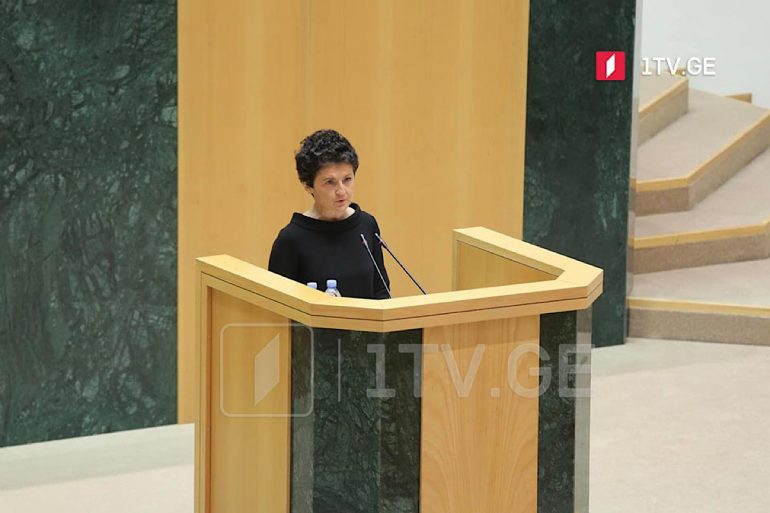
“The testimony provided by individuals questioned by the investigative commission makes it unequivocally clear that in August 2008, the Georgian army found itself embroiled in a war directed by politicians who were far removed from military affairs,” reads the conclusion of the Temporary Investigative Commission of the Parliament of Georgia, tasked with examining the activities of the regime in power from 2003–2012 and the actions of current and former officials affiliated with that regime, which was presented to Parliament by commission chairwoman Tea Tsulukiani.
According to Tea Tsulukiani, politicians’ decisions resulted in the primary military objective being assigned to the Ministry of Internal Affairs, which caused disorganisation within the defence forces and left the civilian population confused and vulnerable.
“The testimony provided by individuals questioned by the investigation commission makes it unequivocally clear that in August 2008, the Georgian army found itself embroiled in a war directed by politicians who were far removed from military affairs. These politicians, hoping for assistance from external forces whilst disregarding the opinions of Georgian military personnel, attacked the city of Tskhinvali and designated this very settlement as the primary direction of military operations. Furthermore, the investigation commission established that politicians’ decisions resulted in the primary army objective being assigned to the Ministry of Internal Affairs, which caused disorientation and disorganisation within the defence forces, whilst leaving the civilian population confused and vulnerable.
According to General Mamia Balakhadze, since units from two different systems were deployed to fulfil the objective on the primary direction, it remained unclear who was giving orders, the Ministry of Internal Affairs or the Ministry of Defence. The implementation of the plan involved formations and individuals working side by side who had received knowledge and training for completely different functions and had undergone no prior compatibility testing, nor through joint exercises.
Moreover, Mikheil Saakashvili did not allow the armed forces to operate professionally, as he delayed the commencement of operations according to the approved plan, amongst other things. Perceiving the military operations as a PR campaign, the United National Movement broadcast information about Georgian army operations on live television, providing the enemy with the means to correct their fire, something that each military person questioned by the investigation commission considered interference from behind and wholly inadmissible.
Beyond the systematic ‘exposure’ of Georgian military positions to Russia through live broadcasts in the television sphere, there was ongoing disinformation of the population remaining in the conflict zone through incompetently prepared reports and the spread of total lies claiming that Georgia’s central government was exercising effective control in the conflict zone and that international friends would not allow catastrophe in the country and would halt Russian aggression.
Furthermore, the media controlled by the United National Movement played a particularly active role in portraying the disastrously consequential lost war as a ‘victory’. These and other circumstances, taken together, resulted in a three-day war defeat, the occupation of additional territories by Russia, an increase in the number of displaced persons, unjustifiable casualties both within the armed forces and among the civilian population, and significant material losses.
As a result of the August 2008 war, 111 occupied settlements were added to the 363 settlements previously occupied by Russia in the Tskhinvali region. The Kodori Gorge, previously governed by the central government, also fell under Russian occupation.
As Pridon Zoidze, the brother of a hero of the Shindisi Battle, noted before the investigation commission, the United National Movement did not participate in the repatriation of Georgian soldiers killed in the war, and many bodies remained on the battlefield.
As is universally known, their repatriation was carried out by His All-Holiness and Beatitude Ilia II, Catholicos-Patriarch of All Georgia, Metropolitan of Mtskheta-Tbilisi, Bichvinta and Tskum-Abkhazia, after he entered the Tskhinvali region together with bishops and representatives of the Georgian Patriarchate and found the bodies of the deceased ‘orphaned,'” states the commission’s conclusion presented by Tea Tsulukiani.
Furthermore, according to the conclusion, as a result of the investigation commission’s work, it was definitively established that the United National Movement government knew, from at least the end of July 2008, that tensions in the conflict zone had reached their peak, yet took no measures to evacuate the civilian population from the war zone on time.
“Moreover, as Grigol Vashadze stated, the timely evacuation of the population was not part of the regime’s objectives. Later, MPs from the United National Movement, Giorgi Kandelaki, Davit Darchiashvili, Giorgi (Goka) Gabashvili, and Chiora Taktakishvili, along with Giorgi Targamadze from the Christian-Democratic Movement, voted in favour of Council of Europe Parliamentary Assembly Resolution N1633, thereby acknowledging the ‘bombing of Tskhinvali’ on the night of August 7-8, 2008, and groundlessly accusing their own country’s army of committing possible war crimes,” the investigation commission’s conclusion states.