


Georgia’s PM: OSCEPA resolution is part of absurd but severe campaign against Georgia over its government’s national stance
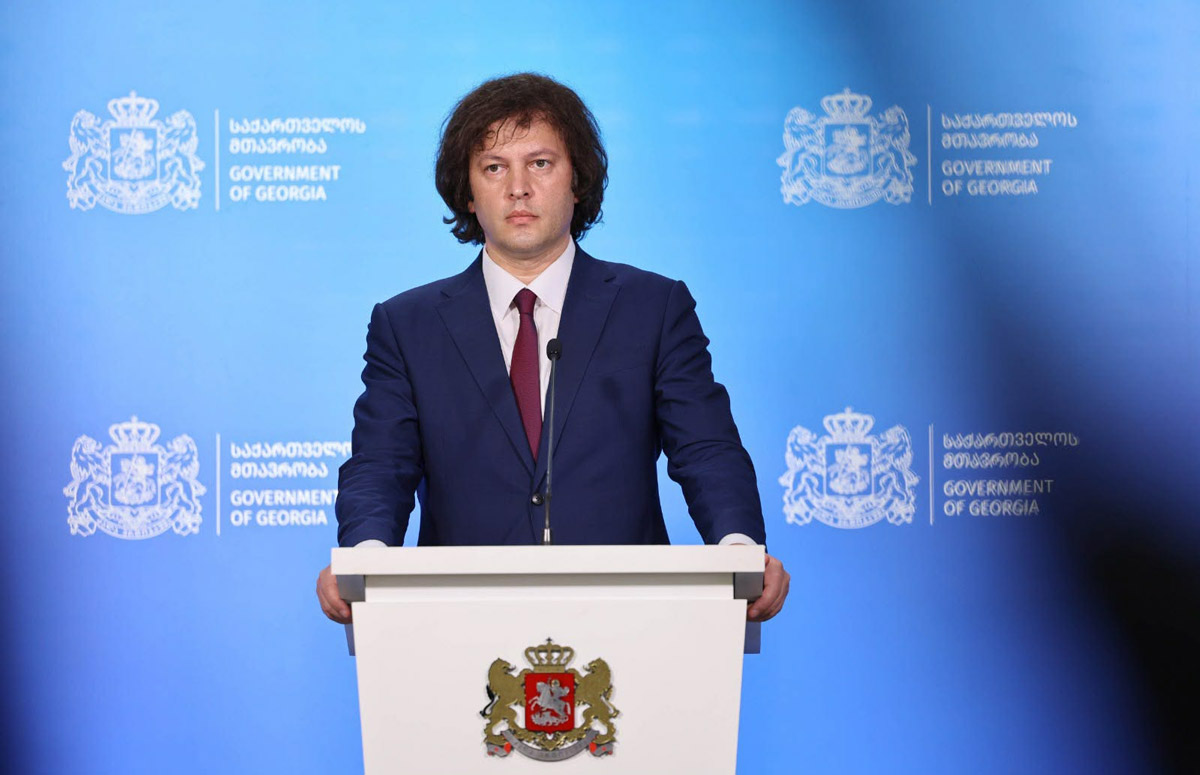
Prime Minister Irakli Kobakhidze has delivered a response to the recent resolution adopted by the OSCE Parliamentary Assembly, framing it as part of a coordinated campaign by Deep State actors to undermine Georgia’s sovereignty and force a change of government.
During a comprehensive briefing, the Head of Government defended Georgia’s democratic record and doubled down on the ruling party’s commitment to national interests.
“Today, we wish to respond once more to the resolution of the OSCE Parliamentary Assembly. There is a well-known saying: What Paul says about Peter tells us more about Paul than about Peter. This adage perfectly characterises the absurd resolution adopted a few days ago. Like other European institutions operating under informal oligarchic influences, the OSCE has now been openly drawn into a process aimed at changing the government in Georgia through unfair and shameful accusations, sanctions, and other levers of blackmail, with the ultimate goal of replacing it with an obedient agency of the Deep State,” Kobakhidze stated.
The Prime Minister drew parallels with international political discourse, citing high-profile Western figures.
“I would also like to remind you of the statements made by current US President Donald Trump and former British Prime Minister Liz Truss: ‘Either we destroy the Deep State, or the Deep State will destroy America’; ‘We want to dismantle the British Deep State, which is older and more entrenched than the American one.’
These scandalous statements, alongside public addresses by other political leaders regarding the dangers of informal oligarchic influences, dispel any question marks surrounding the undeniable influence of the Deep State,” Irakli Kobakhidze added.
The Prime Minister argued that European structures are increasingly beholden to these forces rather than their electorates, which explains the coordinated pressure on Georgia. He contrasted the current administration’s stance with the era of the United National Movement (UNM).
“In this context, it is entirely logical that European politicians are levelling accusations that Brussels, European structures as a whole, and the majority of EU member state governments are answerable not to their own electorates, but precisely to the Deep State; accordingly, the policies implemented by them are entirely tailored to informal oligarchic interests.
The influence of the Deep State in Georgia is easily identifiable. Let me remind you that when a foreign agency, the UNM regime, ruled Georgia, the country’s statehood was dismantled. Brutal authoritarianism, severe human rights violations, rigged elections, overflowing prisons, the weaponisation of the judiciary, monopolised media, and a war initiated on foreign orders and lost in two days; this is the legacy of the Deep State’s agency. Yet, Western institutions praised this regime as a ‘beacon of democracy,” he recalled.
Referencing the violent dispersal of protests on May 26, 2011, Kobakhidze noted that Western bureaucracy ‘responded without a single critical statement,’ asserting that such diplomatic hypocrisy is easily explained when diplomats serve oligarchic interests rather than their own nations.
“We all recall May 26, 2011, when the United National Movement regime encircled peaceful demonstrators and, denying them any means of exit, brutally dispersed them, killing several protesters. Back then, the Western bureaucracy failed to respond to these and other appalling government actions, not only avoiding resolutions but failing to issue even a single critical statement. Furthermore, the then-French ambassador went as far as to justify the regime. Considering that most EU ambassadors represent the Deep State rather than their own nations and citizens, the actions of these ‘diplomats’ are easily understood.
It is equally easy to explain why Georgia became the primary target of the Deep State after 2022. Georgia refused to open a second front and declined to join sanctions against Russia; in other words, it refused to act against its national interests. Unlike in 2008, Georgia did not fall for another orchestrated adventure, choosing instead to defend its sovereignty, peace, and economy,” the Prime Minister stressed.
Dismissing the OSCE resolution as ‘absurd,’ Kobakhidze highlighted internal contradictions, noting that the OSCE and ODIHR had previously assessed Georgia’s 2024 elections as highly competitive.
“The absurd yet heavy pressure initiated against our country is directly linked to the principled, national position of the Georgian government. Within this framework, every mechanism available in the Deep State’s arsenal is being weaponised against Georgia, including European institutions that were once held in high regard. The resolution passed by the OSCE Parliamentary Assembly is a direct component of this process, fully echoing the groundless allegations that a European bureaucracy, driven by informal oligarchic influences, uses to encourage radicalism and revolutionary currents in Georgia. By their calculations, this must ultimately culminate in a change of regime and the return of their own submissive proxies to power. That the allegations voiced in the resolution are groundless is evidenced by the OSCE’s own documents and declarations. The resolution adopted by the Assembly casts doubt on the legitimacy of the 2024 parliamentary elections, yet, these were the very elections that the OSCE and ODIHR themselves deemed valid and competitive,” Kobakhidze stated.
He quoted Daniel Fässler, Head of the Swiss Delegation to the OSCE PA, who described the Georgian elections as ‘perfectly organised and fair,’ though admitting the results were ‘unpleasant for quite a few European countries.’
“The reason for this displeasure is simple: the Georgian populace made an informed choice, electing a national government rather than a foreign agency. This was further validated by the 2025 local elections, where over 1.1 million voters once again placed their trust in the ruling party,” Kobakhidze added.
The Prime Minister accused European bureaucracy of turning a blind eye to severe electoral violations in other post-Soviet states while targeting Georgia, Hungary, Slovakia, and Serbia, nations whose leaders pursue ‘distinctly national policies.’
“Speaking of elections, and notwithstanding our policy of non-interference in the domestic affairs of other states, for the sake of justice, it must be noted that a glance at recent elections in some post-Soviet countries, or the difficult situation in Ukraine in this regard, easily demonstrates that the European bureaucracy, dominated by informal oligarchic influences, has a problem solely with Georgia.
Conversely, they unhesitatingly accept elections held in other nations, regardless of widespread violations or processes incompatible with democracy.
It is noteworthy that the European bureaucracy faced similar friction with Hungary under Viktor Orbán’s governance, as well as with Slovakia and Serbia, namely, countries, governments, and leaders that pursue an explicitly national political course.
This state of affairs clearly illustrates that the multiple coordinated waves of criticism aimed at Georgia are entirely disconnected from the quality of democracy or human rights. The primary grievance of the Deep State lies with the incumbent administration, which operates in line with national interests rather than informal oligarchic agendas. Consequently, since the onset of the war in Ukraine, Georgia has found itself enveloped in a firestorm of unsubstantiated criticism and fabricated allegations,” the Prime Minister has added.
The Prime Minister warned that Georgia must not fall for the “illusions” of compliance with global informal powers. He pointed to the economic and social decline of once-prosperous European nations as a cautionary tale.
“In this context, a certain segment of our citizenry may succumb to the illusion that Georgia, similar to other nations subjected to informal oligarchic influences, could comply with the Deep State’s rules of the game, thereby permanently resolving the instability in which the European bureaucracy keeps our country. Fostering this illusion is the exact objective of these informal oligarchic networks. This is an illusion whose cost is still being borne by once-prosperous European nations that failed to recognise it in time, a price that has dragged them into economic stagnation, dismantled their identity, and triggered a severe crisis of core values.
The spread of pseudo-liberal ideology, LGBT propaganda, the forced intake of migrants, the renunciation of state sovereignty, and economic stagnation represent the true price of the comfort extended by the Deep State. It is a price that has brought the European Union and individual member states to a critical impasse. Coupled with the fracturing of national, religious, and individual identity, the grim economic realities must be highlighted: as frequently stated, whereas the EU’s share of the world economy stood at 30% in 2008, today this metric has fallen below 18%,” the Prime Minister went on.
Irakli Kobakhidze issued a stark warning that yielding to external geopolitical pressures poses an existential threat to Georgia, risking the complete loss of national sovereignty.
“Accordingly, should anyone assume that the Georgian government has an alternative, and that submitting to the Deep State’s rules of the game is preferable to managing these groundless resolutions and revolutionary attempts, as the United National Movement regime and Mikheil Saakashvili himself did in their time, it must be clearly understood that such a choice could cost Georgia not only the destruction of its economy and traditional value system, but the complete forfeiture of its sovereignty.
In Georgia’s case, pursuing any political course other than an explicitly national one carries an existential threat. Deviating from a sovereign policy would place the very survival of the state in jeopardy, as further evidenced by the multiple demands to open a ‘second front’ against Georgia.
Thus, Georgia possesses no alternative to the steadfast defence of its sovereignty. It is evident that the Deep State is failing to achieve its desired objectives in Georgia through unjust resolutions, absurd declarations, or attempted revolutions, particularly as the Georgian people decisively supported Georgian Dream throughout these developments in 2024 and 2025,” Kobakhidze has said.
Concluding his address, the Prime Minister expressed confidence that international pressure would fail.
“Protests of barely a hundred people domestically and sanctions externally—at this stage, these are the sole remaining instruments the Deep State can deploy against Georgia and the Georgian public. Their failures in recent years have completely drained their capacity for triggering revolutions. Consequently, they are now using sanctions and resolutions to pressure the country, hoping to force the Georgian public off the right path.
Nevertheless, so long as the Georgian Dream government faithfully executes the mandate of the Georgian people and resolutely maintains its principled stance on defending sovereignty and implementing national policies in a highly volatile geopolitical environment, this endeavour is equally destined for failure,” the Prime Minister concluded.