


Gelati Rehabilitation Committee: Targeted attempts to mislead public are damaging unprecedented conservation process
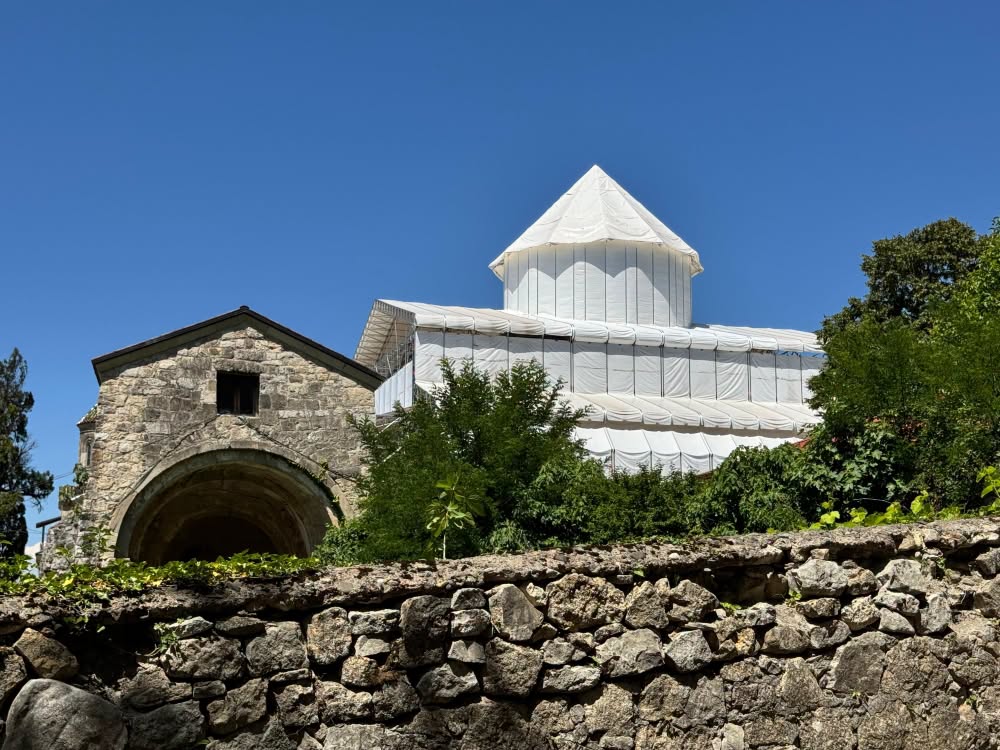
“Certain permanent groups are deliberately attempting to mislead the public, which is damaging the large-scale and unprecedented process currently underway to save the Gelati Monastery Complex,” the Temporary Committee for the Rehabilitation of Gelati said in a statement.
The committee said that, given the high level of public interest, it considered it necessary to respond to what it described as another wave of “disinformation” recently circulated on social media and in the media concerning conservation works at Gelati.
“Unfortunately, certain permanent groups are deliberately attempting to mislead the public, which is damaging the large-scale and unprecedented process aimed at saving the complex. Out of respect for the public and in order to ensure full transparency, we are providing detailed explanations regarding the allegations that have been circulated,” the committee said.
According to the committee, attempts have been made to question the appropriateness of the temporary roofing installed over the cathedral, with claims that the church is covered with so-called “cellophane.”
“The unified temporary roof over the Gelati Cathedral of the Nativity of the Virgin Mary has been one of the main direct and explicit requirements of the World Heritage Centre since 2020.
“Of the 19 project proposals submitted by Georgian specialists and one proposed by an Italian group, only the structural design developed under the leadership of the Temporary Committee for the Rehabilitation of Gelati, through the joint efforts of Georgian and German specialists, proved realistically implementable and capable of addressing all the complex challenges.
“Importantly, the completed project received the highest assessment from the World Heritage Centre,” the committee said.
The committee added that the roofing material is a high-tech PVC fabric specially manufactured in Germany for Gelati over a period of three months and fully compliant with international conservation standards.
It said that without the unified temporary roof, it would not have been possible to remove the inadequate existing roofs of the Cathedral of the Nativity of the Virgin Mary or extract the wet inert material currently being removed as part of the rehabilitation process.
The committee also rejected claims that frescoes are massively falling from the interior walls of the cathedral.
“The Temporary Committee for the Rehabilitation of Gelati declares with full responsibility that no such incidents are taking place. All critical areas in the Cathedral of the Nativity of the Virgin Mary have been stabilized, and a planned, phased conservation process is underway,” the statement said.
The committee also described as false information contained in a letter whose author identified himself as a “Gelati altar server,” saying that the individual is neither a servant at the monastery nor a member of the congregation of the clergy serving there.
The committee further addressed claims concerning the monastery’s drainage system. According to the committee, historical and archaeological evidence shows that the drainage channels dating back to the era of King David Aghmashenebeli ceased functioning in 1510, following the burning of the monastery by the Ottomans.
“This is confirmed by archaeological excavations carried out on the monastery grounds. The drainage system had been filled with soil, ash and charcoal for centuries,” the committee said.
The committee also responded to criticism of an interim report it published on the microclimate inside the monastery’s churches.
According to the committee, the report was authored by Italian professor Dario Camuffo, whom it described as a recognized pioneer in the scientific discipline of cultural heritage microclimate research.
The committee said the report’s findings should not be viewed as dangerous, noting that the climatic issue identified at Gelati Cathedral is typical of large cathedrals and has developed over centuries.
According to the explanation, during spring, as outdoor temperatures rise, the cathedral’s walls — which are approximately 170 centimeters thick — retain the cold of winter. When warmer air enters the interior, moisture can condense on the floor and lower sections of the walls, reaching approximately 70 centimeters in height.
The committee said Camuffo had proposed gradually heating the floor from the spring warming period through mid-summer, until the temperature inside the church and the outside temperature become sufficiently equal to prevent condensation.
It emphasized, however, that adjustable floor heating is currently only an initial working hypothesis requiring further detailed research and development.
“Similar technology has been successfully implemented in numerous historic churches across Europe to prevent condensation caused by temperature fluctuations,” the committee said.
The committee also rejected criticism of a memorandum signed with the Italian restoration institute Opificio delle Pietre Dure.
“The allegation that one of the world’s most authoritative restoration centers is being brought to the monument to conduct ‘experiments’ is either elementary professional ignorance or propaganda. The international term ‘Pilot restoration’ means pilot restoration, not an experiment,” the statement said.
According to the committee, pilot restoration is a standard practice in the conservation of wall paintings: before treating an entire fresco, conservation solutions and methods are tested on a small and less visible section, and only after a positive result is obtained does full-scale work begin.
The committee also criticized what it called “cynical and hypocritical” statements concerning the condition of Gelati’s unique mosaic.
It cited a 1989 report by Carlo Bakuradze, who carried out restoration work to save the mosaic depicting the Virgin Mary, according to which 85% of the mosaic composition had become detached from its substrate.
The committee said that from 1990 until the establishment of the current rehabilitation committee, no one had undertaken a study of the condition of Gelati’s unique mosaic.
It further claimed that the individuals who had led the field for years had never invited an expert to assess the condition of the mosaic, either from scaffolding or even from floor level.
According to the committee, the severity of the mosaic’s deterioration is practically identical in Carlo Bakuradze’s reports from the 1980s and in the current report by Roberto Nardi.
The committee also criticized those questioning the quality of the conservation works, pointing to the water infiltration problems that emerged at the newly constructed Bagrati Cathedral approximately one year after its construction and which, according to the committee, remain unresolved.
The Temporary Committee for the Rehabilitation of Gelati called on what it described as a group of several individuals with “specific subjective goals and objectives” to refrain from attempts to damage the reputation of conservation works being carried out under the Gelati rehabilitation program and from deliberately misleading the public.
“We call on them to return to the norms of human and professional ethics, as lies and defamation have already caused them to lose credibility on numerous occasions.
“For the public to be properly informed, we once again state with full responsibility that the conservation processes currently underway at the Gelati Monastery Complex are unprecedented in their scale, scientific depth and involvement of international experts, and comply with the highest international standards for conservation work,” the committee said.