

First Deputy Head of SSSG addresses UNGA
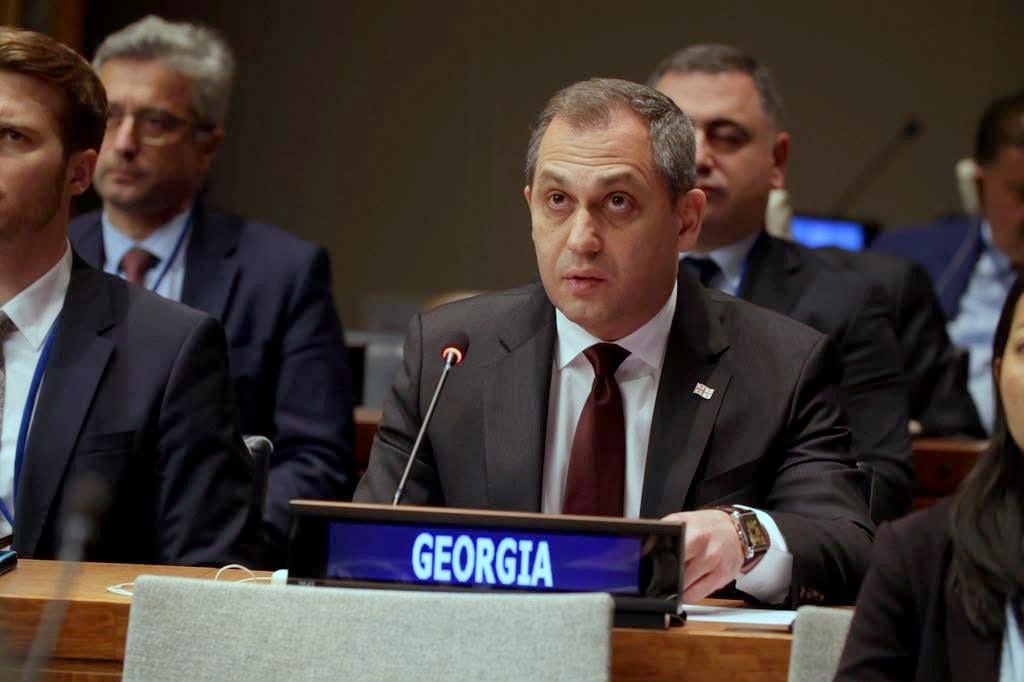
“The current international terrorism landscape continues to pose a significant threat to global peace and security, as terrorist organizations are seeking to adapt their activities to the evolving security environment,” said Lasha Maghradze, First Deputy Head of the State Security Service of Georgia (SSSG) at the Plenary Session of the United Nations General Assembly (UNGA).
According to Lasha Maghradze, rapid development and increasing accessibility of emerging technologies have widened risks of their misuse for criminal and terrorist purposes.
“Madam President, Excellencies,
At the outset, I would like to express my sincere appreciation to the President of the General Assembly for convening this important event and for the opportunity to participate in it.
I would like to express gratitude to the Permanent Missions of the Kingdom of Morocco and the Republic of Finland to the United Nations for their leadership on the ninth review of the United Nations Global Counter-Terrorism Strategy.
Madam President,
The current international terrorism landscape continues to pose a significant threat to global peace and security, as terrorist organizations are seeking to adapt their activities to the evolving security environment.
The rapid development and increasing accessibility of emerging technologies have widened the risks of their misuse for criminal and terrorist purposes.
Terrorist groups are increasingly using artificial intelligence as a tool for propaganda, recruitment and the acquisition of financial resources to support their operations.
In addition, the advancement of modern technologies makes unmanned aerial vehicles (UAVs) a significant tool for both official structural units as well as the terrorist groups. Using UAVs for terrorism purpose represents a global threat that can, in practice, affect almost all countries.
Hereby, I would like to underline that the use of so-called cryptocurrencies for the acquisition of funds by terrorist organizations and extremist groups has increased.
Consequently, we believe that one of the priority areas in counter-terrorism efforts should be minimization of the threats associated with the use of new and emerging technologies for terrorist purposes,” he said.
SSSG First Deputy Head explained that in order to effectively combat terrorism and extremism, it is particularly important for Member States to develop and implement preventive measures.
“In the processes of radicalization and recruitment of individuals, the terrorist groups rely on specific ideologies. These ideologies often encompass multifaceted narratives tailored to different segments of the population and are filled with religious, social, cultural, historical and other elements.
To this end, through the timely detection of terrorist and extremist campaigns and addressing them at an early stage, the State safeguards its citizens from being drawn into such criminal activities,” he said.
As Maghradze noted, Georgia strongly opposes any manifestation of terrorism and recognizes the threat posed by international terrorism and its emerging forms. In this context, Georgia actively cooperates with relevant international and regional organizations, as well as global partners.
“Georgia continuously implements appropriate measures to increase the level of preparedness against terrorist threats and eliminate conditions that promote the spread of terrorism. Correspondingly, the country’s resilience and capacities have been significantly enhanced, which is consistently highlighted in the relevant reports on Georgia.
Due to the effective work of the relevant State structures, no terrorist acts have been carried out on the territory of Georgia during the last 15 years and the risk of our territory being used for transit or as a rehabilitation zone has been minimized. In this context, in 2026, the State Security Service detained 7 individuals, both Georgian and foreign citizens as part of the counter-terrorism measures,” he said.
Lasha Maghradze emphasized that Georgia continues to fulfill its international obligations, including the implementation of the requirements of relevant UN Security Council resolutions and MONEYVAL recommendations, which ensures fulfilment of activities on identifying terrorist financing cases and monitoring suspicious funds entering the country.
“Having a counter-terrorism Strategy and a respectful Action Plan bears crucial importance to each and every country. Currently, Georgia is developing the new, third National Counter-Terrorism Strategy and Action Plan, which will be in full compliance with the UN Global Counter-Terrorism Strategy and its four core pillars.
In conclusion, I would like to note that, in light of the existing terrorist threats, the development of a unified approach by the United Nations Member States to addressing terrorist challenges, as well as coordinated cooperation among countries, is critically important.
We believe that, in this process, the United Nations and its relevant institutions can play a significant role,” he concluded.