


Speaker: What was defeated on October 4 was idea that government change can be achieved through violence and foreign support
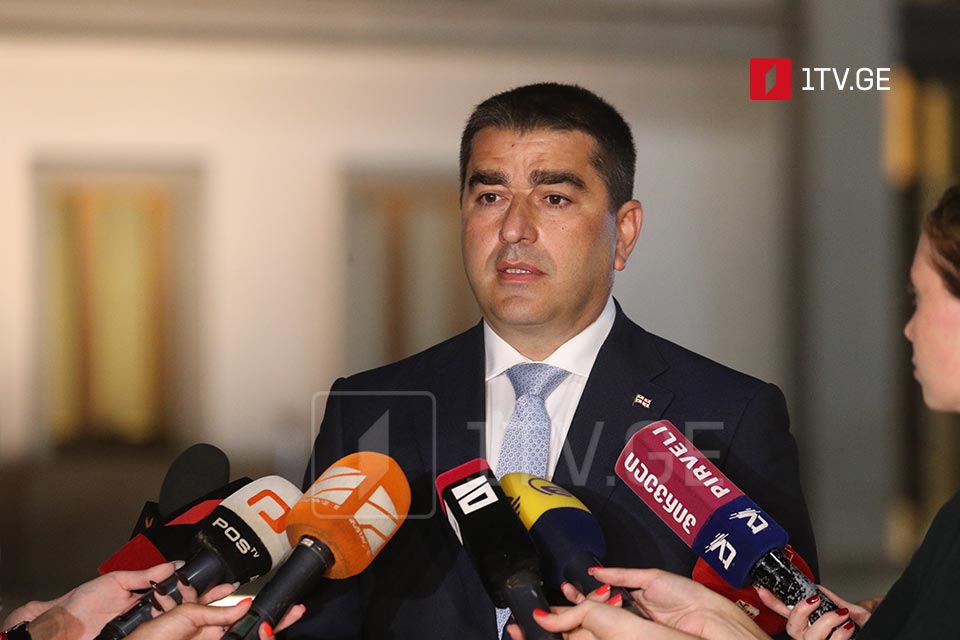
“Today marks one year since October 4, 2025—the day an attempt to violently overthrow the government in Georgia culminated in a storming of the Presidential Palace. A year later, court verdicts have been handed down, the organizers and participants of the assault are serving their sentences, and a large number of the perpetrators have admitted their guilt. One year is sufficient time to view that day not merely through the lens of emotion, but through a complete chain of facts,” Parliament Speaker Shalva Papuashvili writes on social media.
According to Papuashvili, the events of October 4 did not begin overnight. They were preceded by weeks of announced plans to overthrow the government, the romanticization of violent scenarios, and the political encouragement of radical groups.
“Against this backdrop, a few days before October 4, a European Commission spokesperson was asked directly about the announced gathering. The response was not a call to participate in the elections or a warning against violence, but rather direct support for a gathering announced with the aim of overthrowing the government (!).
We immediately stated publicly that this was an extremely irresponsible statement and that, when the overthrow of the government is announced in advance, such a political signal serves to embolden radicals. Unfortunately, just a few days later, exactly what we had warned about came to pass.
On October 4, participants in the gathering marched toward the Presidential Palace and attempted to storm it. It was only the clear and organized actions of our law enforcement officers that saved the country—doomed from the outside to bloodshed—from a return to the 1990s. It is particularly important here to recall one other circumstance.
For months prior to this, former President Salome Zourabichvili had been positioning herself as a center of alternative legitimacy. To reinforce this narrative, people went to ‘consult’ with her. Foreign politicians and diplomats would visit regularly, posing alongside her against the backdrop of the presidential standard.
Even then, we warned everyone: playing with state symbols and creating the illusion of a non-existent dual power structure is not merely harmless political theater. Such symbols can incite people to take real action.
That is why the Presidential Palace did not become a target by accident on October 4. Nor was it a coincidence that, following the failure, we saw no further ‘consultations’ between Zourabichvili and diplomats.
Yet, to this day, we have heard no condemnation from Brussels regarding the attack on the Presidential Palace, nor any clear disavowal of the perpetrators.
A year after the failed attempt to overthrow the government, it is strikingly clear that October 4 marked the defeat not only of a specific violent plot but also—once and for all—of the long-fostered notion that power in Georgia could be changed through street violence and foreign political support rather than through elections.
This is the primary lesson of October 4: Georgia’s fate is decided by the Georgian people—through elections, not by storming institutions.
Finally, one year later, I once again call upon Brussels to condemn the violent attack on the Presidential Palace on October 4, 2025, to renounce future political and financial support for radical groups, and to revoke the resolutions that undermine Georgia’s sovereignty,” Papuashvili writes.