


Speaker: They expect us to stand cap in hand not just to enter EU, but even post-accession; stop sorting nations into first and second-class tiers
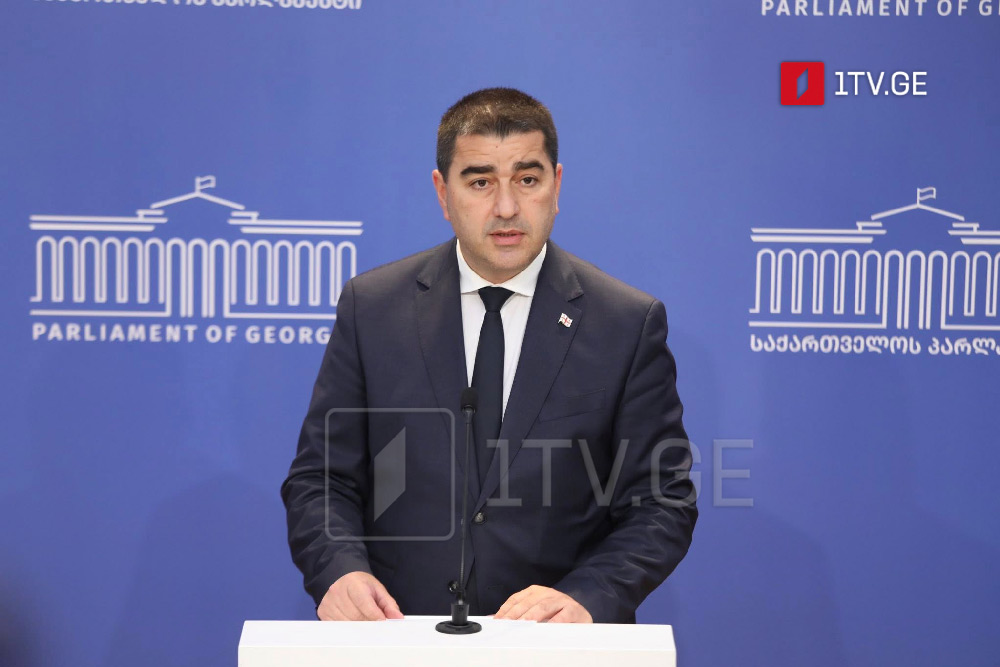
“I think this was an open secret that they have finally laid bare themselves: candidate countries, and in this instance, Georgia too, are viewed as second-class countries and nations that are not considered equals,” stated the Speaker of the Georgian Parliament, Shalva Papuashvili. He was commenting on a statement by the EU Commissioner for Enlargement, Marta Kos, who confirmed that veto rights would be restricted for new EU member states.
According to Papuashvili, Kos’s statement exposes a discriminatory approach by the European Union towards nations.
He further explained that, in reality, the Enlargement Commissioner’s remarks come as no surprise, as candidate countries were being gradually conditioned to accept the idea that, upon joining the EU, Georgia would be relegated to a second-class nation within the bloc.
“Regrettably, this attitude is the only thing we are seeing. If we look back at the entire history of our relations with the EU, it was a process of aspiring towards integration through the Neighbourhood Policy or the Eastern Partnership, formats invented simply to keep us at arm’s length, rather than granting us full membership. Four years ago, when the war in Ukraine broke out, the EU made a grand declaration. Everyone was given hope, including candidate countries that had been stuck with that status for years without any progress, that the EU would finally decide on enlargement and they would become members. Yet, Marta Kos’s statement just four years later demonstrates that membership will not be granted on equal terms. It seems they are already conditioning us to accept this.
This is a monumental revelation of what was actually intended all along, even over the last four years. We are now told that if a candidate country becomes a member, it will bear every single obligation of membership, but will not enjoy equal rights. I do not know whose head concocts such ideas: that one can have a discriminatory approach towards entire nations, that EU members can be carved up into first-class and second-class tiers. In the 21st century, we are hearing a flatly Orwellian approach directly from a European Commissioner: that all are equal, but some are more equal than others.
That is exactly what came out of Marta Kos’s mouth yesterday, and it was hardly news. We were being broken into this idea step by step. First, it was suggested by the German Chancellor regarding Ukraine, and you remember Ukraine’s reaction—that Ukraine has no intention of entering the EU as a second-class nation. And naturally so; I cannot think of any country, save for Moldova, that would willingly surrender all its privileges for others to make decisions on its behalf. Evidently, Moldova is signalling an intention to entirely dissolve its statehood, conceptualising this as its framework for EU integration.
Recently, we have repeatedly heard a phrase, including from Europeans and EU representatives: ‘no decision on Ukraine without Ukraine.’ Well, this new approach completely violates that very principle, including towards Ukraine. If Ukraine joins, decisions on Ukraine’s foreign, security, and financial policies within the EU framework will be made without Ukraine, without Georgia, without Serbia, without Montenegro, without anyone who is a new member. There is apparently to be a club of old members, whilst new members, as Marta Kos mentioned, are to be kept on a quasi-probationary period for 15 years before any alternative decision is made,” Shalva Papuashvili said.
Papuashvili urged the European Union to immediately cease discussing this concept and sorting nations into first and second class.
“It is interesting to see the position of the radicals [the opposition] on this matter, and what they will say publicly. You remember their claims that we must ‘stand cap in hand’ to gain EU membership. Now it turns out that we are expected to keep jumping through hoops not just to get into the European Union, but even after joining; that is what they have effectively told us by floating this idea. We call for only one thing: that they immediately cease even discussing this idea and sorting nations into first- and second-class tiers.
Merely airing this idea has already damaged relations, as the EU has effectively betrayed its true stance towards candidate states. If I am not mistaken, there are nine candidate countries, and it views them as second-class. You also frequently hear the other cliché, that ‘it takes two to tango’, implying that the European integration process requires the participation of both sides. But arithmetically, it does not just take two; it takes two who respect one another, rather than one looking down on the other with patronising arrogance.
I hope these discussions will be dropped. On the other hand, I believe the moment has come for candidate countries to raise their voices against this truly outrageous initiative, which amounts to the segregation of nations within the EU in the 21st century. When we applied for EU membership four years ago, we did not sign up to a deal where Georgia, upon accession, would have no voice and no real participation in foreign policy; where they would decide security policy or the EU’s financial and budgetary policy without us; where they would decide rights and new legal matters without us. Crucially, they would decide on amending EU treaties, inserting or removing whatever they please, without even consulting new members.
I do not know what else the Soviet Union was, if not this very approach, where there are great nations and small nations, and the great nations dominate the small ones. This is a very regrettable development. One would think it was a Freudian slip, were it not for the fact that we are being gradually, systematically conditioned, and are being conditioned right now, to accept the notion that, under EU membership, we will be a second-class nation within the European Union,” Papuashvili concluded.