


Speaker: Protecting human rights does not require justifying person’s conduct, we expect EU to condemn violence against police
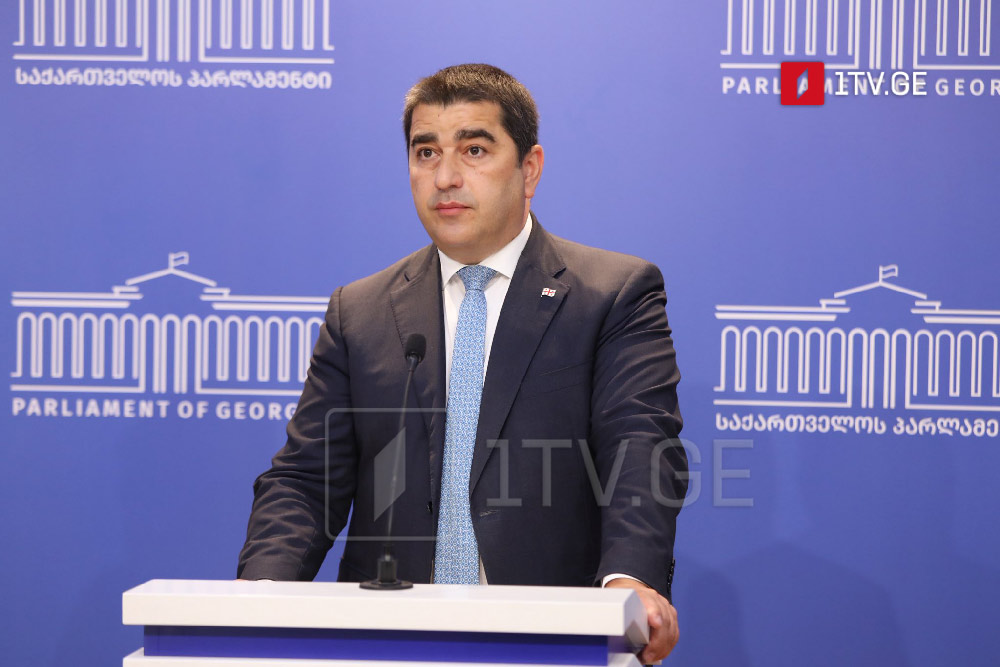
Last week, information was circulated that a concert by a musician who had insulted more than one million Georgian citizens over their political choices was planned to be held with EU funding, Georgian Parliament Speaker Shalva Papuashvili wrote on social media.
According to Papuashvili, the consequences of what he described as encouragement from outside Georgia can also be seen in a video posted by former President Mikheil Saakashvili, in which he insults and threatens the same people whom, according to Papuashvili, the EU Delegation had previously characterized the musician’s insults against as freedom of creative expression.
“Against the backdrop of Alexandre Kordzaia, also known as Kordz, and Mikheil Saakashvili both using the same abusive language, we must once again understand what we are dealing with.
Last week, information was circulated that a concert by a musician who had insulted more than one million Georgian citizens — women and men, elderly people and young people — because of their political choice was planned to be held with EU funding. The event was supposed to be hosted by Gori Art House, which calls those same people ‘slaves.’
This was followed by public outrage. Although part of the sect criticized this outrage, texts expressing remorse also emerged, saying that insulting people should not be a form of protest or self-expression and that they had not liked hearing such insults even when they were coming from people on their side.
Although they did not express this remorse at the time, delayed remorse is still something. If we have now reached the recognition that such insults are unacceptable and that political protest should have limits, this could have been followed by the next step.
The solution was simple and dignified: Kordzaia should have apologized to the public. He could at least have said that his emotions had got the better of him and that he had crossed a human boundary while protesting politically. The process of catharsis, unusual for the sect, seemed to be heading in that direction.
But precisely at that moment, the EU Delegation issued a statement effectively saying that insulting the majority of society constitutes freedom of creative expression (!)
The EU Delegation’s statement encouraged the author of the insults, while the sect, which had begun a process of catharsis, was once again led away from the path of truth. Instead of taking a step toward an apology, the author of the insults received political encouragement.
Remorse, responsibility and respect for human dignity — everything Georgian culture teaches us — were once again replaced by remaining fully committed to a mistaken position, dehumanization and aggression. Once again, it was confirmed that this is not a Georgian campaign, but rather one brought in from outside, trained and encouraged from abroad.
We see the result of this external encouragement in Saakashvili’s video from yesterday as well, in which the dictator sitting in prison insults and threatens the same society whose insult, previously, the EU Delegation declared to be freedom of creative expression. This is how uncondemned violence becomes a political symbol to be emulated.
We have already seen this in the cases of Mzia Amaghlobeli and Zviad Ratiani, when the failure to condemn and the political justification of Amaghlobeli’s attack on a police officer created an environment for further violence against police officers.
Protecting human rights does not require justifying a person’s actions. You can argue about the sentence while simultaneously condemning violence against a police officer. You can defend freedom of expression while simultaneously condemning insults against citizens. This is precisely the consistency we expect from the EU.
Justifying insults is heard by the next person who insults, while justifying violence is heard by the next perpetrator of violence. Both words and silence have political consequences and a political cost. The EU should understand this.
P.S. As I described previously, a sect needs dogmas, priests, saints and martyrs, as well as its own calendar and rituals. A pseudo-religion also needs a hymnographer, and Alexandre Kordzaia willingly assumed this role within the sect.
Entering was easy, while leaving is much more difficult.
Who knows, perhaps Kordzaia is no longer attracted to the role of the sect’s chief hymnographer and insulter of the people, but the sect does not want to give up its hymnographer. It is difficult to escape its claws, especially when ‘Europe’ itself has your back,” Papuashvili wrote.