


Speaker Papuashvili criticises Zelenskyy and Sandu for calling on Georgia to drop Constitutional Court petition, citing their own parties’ bans
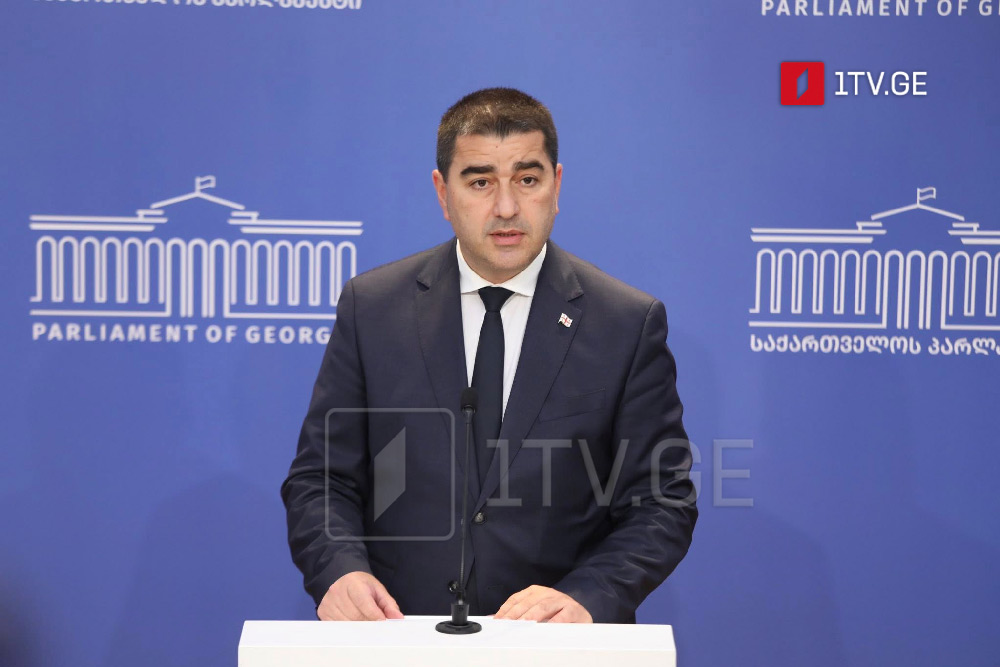
“Zelenskyy and Sandu, people who have banned parties in their own countries, are telling Georgia to withdraw its petition from the Constitutional Court,” Georgia’s Parliament Speaker Shalva Papuashvili has stated.
According to Papuashvili, this too reveals the profound hypocrisy of a process that was evidently coordinated from the outset.
Papuashvili was commenting on the document prepared on Georgia under the OSCE’s Moscow Mechanism, and the recommendations contained within it.
“One of the recommendations is that those Members of the Georgian Parliament who filed a lawsuit with the Constitutional Court to have several parties declared unconstitutional should withdraw that lawsuit. If one considers which countries supported this recommendation, it becomes clear: Ukraine, which has dissolved 22 parties in the past three years, and Moldova, which has dissolved three, including two just two days before an election. Now tell me: are we to take seriously the Ukrainian authorities, Zelenskyy and Sandu, people who have banned parties in their own countries, when they tell us to withdraw a lawsuit from the Constitutional Court?
I would also remind you that in Ukraine, this was done by the government, followed by a court ruling, while in Moldova, two days before the elections, the electoral commission was made to deregister two parties deemed undesirable. So when Zelenskyy and Sandu presume to lecture us about political parties, I think it is time to point out their own record. And this, too, shows just how staggeringly hypocritical this entire process is, a process that is plainly coordinated.
It has emerged that an individual with no professional background on Georgia whatsoever, with no expertise on the country, spent two days here and then, we are told, produced a hundred-page document within those same two days. It is hardly convincing that one person could be sufficiently competent, on everything from freedom of expression to higher education reform, to write a hundred-page document in a matter of days. We were then given this draft, to which a hundred-page response was submitted, observations and comments, on the preceding Tuesday and Thursday, whereupon an unchanged document appeared at the plenary session. To me, this suggests she had not even read the comments.
On the one hand, there is reason to suspect that this document is a compilation of the wishes and intentions held by the initiating countries regarding Georgia, and that this expert was used merely to give it some semblance of form. On the other hand, it has emerged that this individual is directly connected to the Polish government, she is a trusted person of the Polish government, funded by the Polish government, was put forward as a candidate to the United Nations by the Polish government, and is a member of the board of a research centre subordinate to the Polish Ministry of Foreign Affairs. She has received grants that clearly establish her connection to the Polish Ministry of Foreign Affairs, in other words, to the government itself,” Shalva Papuashvili has stated.
According to the Speaker of the Parliament, everyone is aware of the policy that the Polish government pursues towards the Georgian people.
“We also remember the statement made by Sikorski, the Foreign Minister who coordinates this individual’s activities, just a few months ago, when he declared that Saakashvili is a driving force of democracy. I would remind you that the same Polish government dispatched medical experts who attempted to covertly obtain samples from Mikheil Saakashvili. The context is this: a minority of OSCE member states, 23 out of 57, including precisely those countries that have distinguished themselves in recent times by their openly hostile policy towards Georgia, the Scandinavian countries, the Baltic states, and others who have declared outright hostility towards the Georgian people, chose to initiate this process.
Poland was the principal initiator and coordinator, and deliberately abstained from the vote so that its own expert could serve as rapporteur. This, too, is plainly coordinated; it was determined from the very beginning who would play the leading role, who would take charge, and which expert or individual would put their name to this act of defamation.
And thirdly, what is written inside the report, on the matter of political parties, for instance, with Ukraine and Moldova, which themselves ban parties, telling us not to appeal the courts: that too is not to be taken seriously,” Papuashvili stated.