


Speaker: If concerned about party bans, Lelo should ask Lomjaria, who drafted specific party ban petition
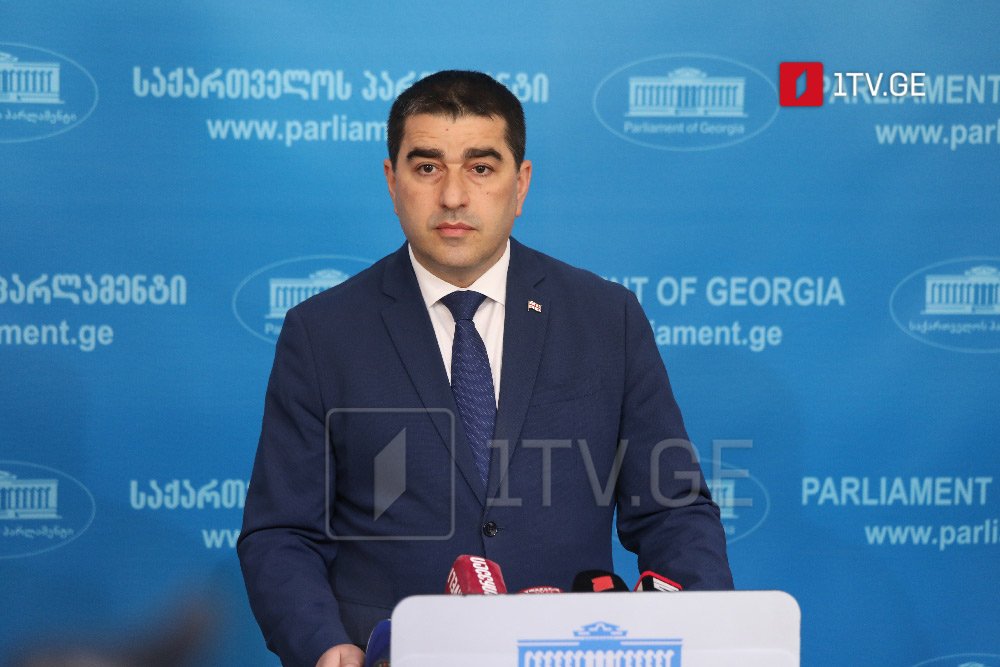
“It’s hypocrisy, lies, and another attempt to deceive the Georgian people when groups hired from abroad try to provide absurd legal interpretations. We observe this because we see the positions of specific donors and ambassadors behind it,” Georgian Parliament Speaker Shalva Papuashvili stated.
Papuashvili was asked about non-governmental organisations’ statements and criticism regarding the constitutionality of legislation on banning party activities.
“Regarding the constitutionality or unconstitutionality of banning party activities, this has always existed in our constitution and legislation. It exists in every country.
Secondly, archives are useful things; look in the archive and you’ll find the constitutional petition prepared by Nino Lomjaria when she was requesting that one specific party be declared unconstitutional. Since she herself couldn’t be the petitioner, she even sent the petition to opposition members in Parliament, asking them to submit it. So, the NGOs themselves had prepared a petition and were trying to work with the parties of that time to have them submit it.
Therefore, it’s hypocrisy, lies, and another attempt to deceive the Georgian people when groups hired from abroad try to provide absurd legal interpretations. We observe this because we see the positions of specific donors and ambassadors behind it,” Shalva Papuashvili stated.
According to Papuashvili, Georgian Dream’s constitutional petition is ready and legal refinements are underway.
“The petition is ready; its legal refinement is underway. We’ll have a majority meeting today where the petition will be discussed. I think it will be ready tomorrow,” Papuashvili stated.
Papuashvili was asked another question regarding the petition, whether it might lead to the abolition of parties.
“There exist parties which use this legal form to harm Georgia, to organise the change of government through undemocratic means. We’ve seen war propaganda, attempts to undermine territorial integrity and so forth. The constitution sets out the circumstances under which a party may be banned and declared unconstitutional,” Papuashvili answered.
“Therefore, our main target is that coalition, those political parties which are the main driving force behind anti-Georgian and anti-constitutional actions, who have the real capability to destabilise the situation in Georgia, organise anti-constitutional actions, and attempt to overthrow the government, which we’ve witnessed several times over the past 10-13 years since the United National Movement lost power. This is our main criterion.
I’ll say once again that we, including through recent legislative amendments, have created Western-style legislation based on the main principle of defensive democracy. This means that democracy must defend itself from the enemies of democracy who try to use democracy’s instruments against democracy.
That is, they use the party as a democratic institution to undermine and overthrow democracy itself. This is why every country operates by this principle. It’s common practice in any country. Several parties were recently banned in Moldova, previously in Ukraine; parties are banned in Germany, and the banning of non-political organisations is possible in Germany.
Let Lelo ask Nino Lomjaria if they’re interested in whether banning parties is a constitutional or unconstitutional instrument, and she’ll provide them with a consultation. A person who had herself drafted a petition and even provided Lelo with the draft, which was intended to have a specific party declared unconstitutional. The law on banning parties has been in force for as long as we’ve had a constitution. The law and constitution have provided for this for decades, and they’ve only just remembered now, when they themselves see the risk that they might be the object of it?
If you don’t believe us, surely you believe Nino Lomjaria; ask Lomjaria whether requesting the banning of parties in the Constitutional Court contradicts the constitution or not. Ask a person who was, amongst other things, the Public Defender at the moment when she drafted a petition to ban a specific party. She brought a ready petition to Lelo and other parties so they could submit it to the Constitutional Court. To put it more vividly, naturally, political orientation or the party’s views don’t matter; what matters is whether their actions contradict the constitution; that’s what’s decisive,” Shalva Papuashvili concluded.