


Speaker: External attempts to influence Georgia’s internal political choices constitute violation of sovereignty
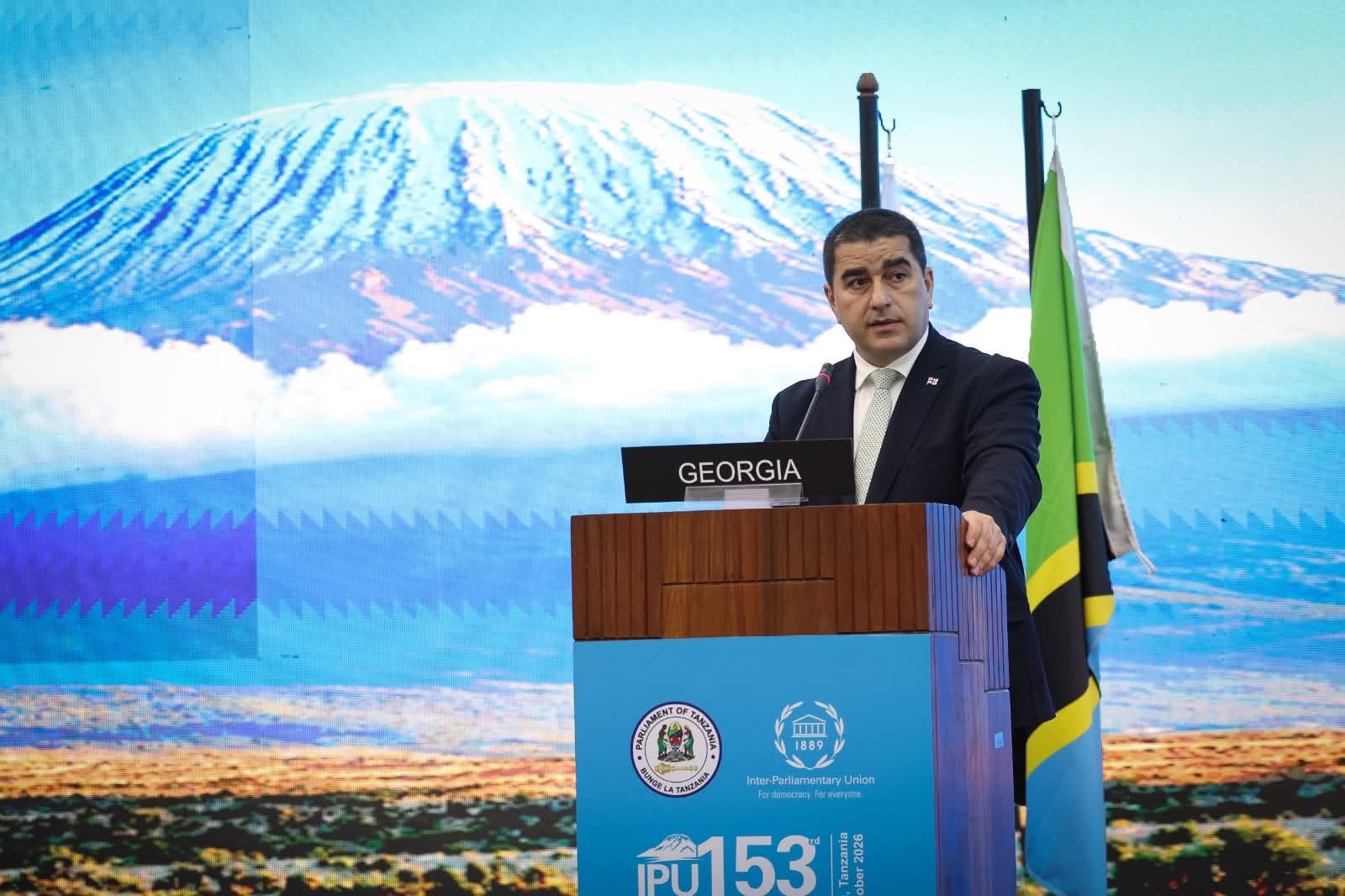
“Foreign interference is a significant and persistent threat to democratic security. At the same time, it is a systemic and growing challenge,” Georgian Parliament Speaker Shalva Papuashvili said in an address to the 153rd Assembly of the Inter-Parliamentary Union (IPU).
According to Papuashvili, when external actors seek to influence a country’s domestic political choices and bypass its institutions, this can no longer be considered cooperation. He said such actions constitute a violation of the fundamental principle of international law — state sovereignty.
“Amid an unprecedented erosion of the rules-based international order, foreign interference has become one of the fastest-growing and most concerning challenges facing societies worldwide. This is confirmed by the European Union’s latest report on the threats posed by foreign information manipulation and interference, which states that ‘foreign information manipulation and interference have reached a new level of operational complexity and global scale; attacks have become more frequent, intensified and more coordinated.’
The report also states that foreign interference ‘is not merely a communications challenge, but part of a broader strategy with tangible political and security consequences.’
The EU is correct in its assessment in this report. Foreign interference is a significant and persistent threat to democratic security. At the same time, it is a systemic and growing challenge.
The situation is further aggravated by the fact that foreign interference is gradually being normalized and presented as ‘engagement,’ ‘partnership’ or ‘support.’ However, events must be called by their proper name: when external actors seek to influence a country’s domestic political choices and bypass its institutions, this is no longer cooperation. It is a violation of the fundamental principle of international law — the sovereignty of states.
In essence, this is an issue of governance and accountability. A government should be accountable to its own people, act in accordance with national interests and not in the interests of foreign patrons or other external forces. A government under external pressure cannot be fully accountable to its citizens. This is precisely where the foundations of governance and accountability are undermined.
It is noteworthy that an increasing number of states, including countries that previously criticized legislation and regulations aimed at countering foreign interference in other countries, are now adopting such laws domestically. Australia, Canada, France, the United Kingdom, the United States and many other countries are tightening or adopting laws on transparency and foreign funding, as well as registration requirements. What was previously considered an exception is increasingly being viewed as a legitimate and necessary instrument of democratic defense.
The Paris Declaration on Aid Effectiveness reminds us that genuine partnership requires aid to strengthen national institutions and national ownership rather than replace them. Today, this important principle requires renewed attention beyond the development sector as well, because foreign interference is gradually replacing foreign assistance.
I would like to cite Georgia as an example. Given the serious security and political challenges associated with foreign funding, Georgia’s Law on Grants now requires government approval before foreign grants can be issued. This is complemented by the Law on Transparency of Foreign Influence, which requires organizations receiving a significant share of their funding from abroad to register and publicly disclose such funding.
Both laws are based on a simple principle: when foreign resources enter a country’s political or public life, citizens should have information about how those resources are being used. This is an expression of sovereignty and accountability, which is crucial for democratic resilience and good governance,” Papuashvili said.
According to the Parliament Speaker, external interference should give way to genuine partnership based on the consent of governments and the sovereignty of nations.
“Of course, it is particularly concerning that the scale of foreign interference is increasing. However, there is also hypocrisy here: some states that themselves interfere in the affairs of others simultaneously express concern over the erosion of the international order. Apparently, they forget that non-interference is one of the pillars of the international order.
At the same time, the practice of interference — regardless of how well-intentioned it may be — creates new risks of conflict, mistrust and instability.
The way forward is clear: interference must give way to genuine partnership based on the consent of governments and the sovereignty of nations. It is time for the international community to agree on a common international standard for foreign interference and transparency of foreign funding — a standard that would provide each member state with legitimate instruments to protect democratic processes and would be based on the shared principles of sovereignty, accountability and consent.
Only then will accountability, and with it legitimate democratic governance, be able to fully develop,” the Parliament Speaker said.