


Public demand to expel ambassadors to be counterproductive whilst Deep State-controlled EU bureaucracy decides on diplomatic appointments
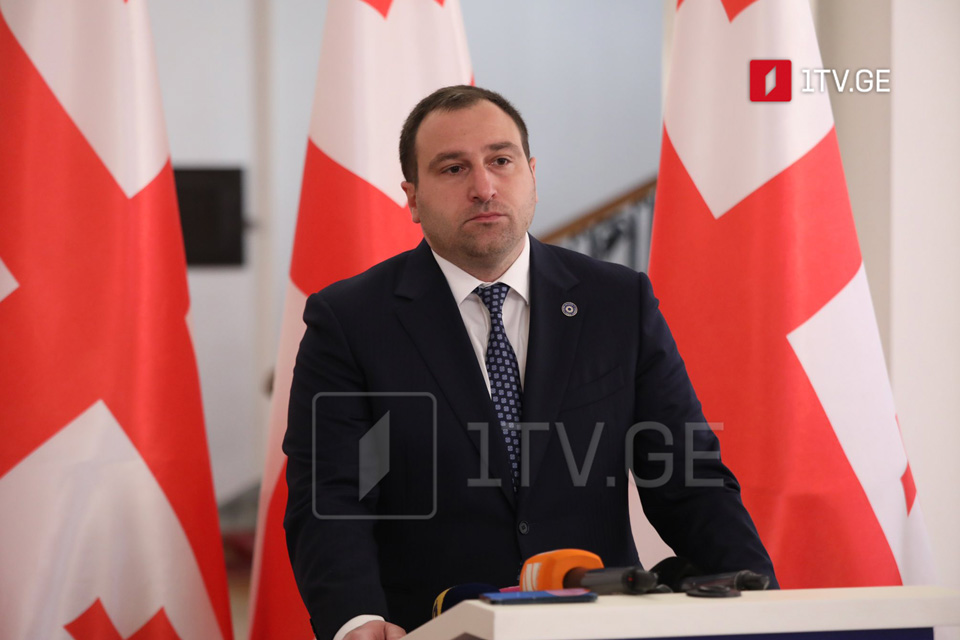
“The actions of Western ambassadors accredited to Georgia, including those from European and European Union member states, have exceeded all diplomatic boundaries and clearly constitute interference in the internal affairs of our state. Such undiplomatic and unfriendly conduct from representatives of nations we consider friends of Georgia is categorically unacceptable,” stated parliamentary majority leader, MP Irakli Kirtskhalia, at a briefing.
Despite this, according to Kirtskhalia, Georgian Dream is pursuing a policy of patience, and he explained why they are refraining from taking decisive action, including expelling ambassadors.
“We wish to address a matter of particular importance, a subject that has repeatedly caused justifiable public concern in our society. You will recall that in recent years, particularly since the outbreak of war in Ukraine, we have witnessed Western ambassadors accredited to Georgia, including those from European and EU member states, exceed all diplomatic boundaries through actions that clearly constitute interference in the internal affairs of our state.
We have also heard similar statements from foreign ministers and even the highest officials of individual European countries. Naturally, such undiplomatic and unfriendly conduct from representatives of states we consider friends of Georgia is categorically unacceptable to us. However, we wish to explain to the public, who are entirely justified in their outrage and are demanding decisive measures from Georgian Dream, why we are pursuing a policy of patience and refraining from taking firm decisions, including expelling various ambassadors.
To understand the behaviour of these ambassadors, let us begin with what Georgian society already knows well: today, numerous advanced European states, as well as the European Union, its structures, and EU bureaucracy, are under the influence of the Deep State, which creates serious problems and poses numerous threats not only to Georgia but to the populations and futures of these very countries, and indeed to the European Union as a whole.
Georgian authorities and citizens have experienced first-hand the consequences of campaigns waged against our country through the Deep State’s influence and instigation. We all remember well how we were denied EU candidate status despite deserving it more than any other candidate country; we remember how the opening of negotiations with the EU became a subject of political bargaining until the government took preventive steps to minimise EU bureaucracy’s pressure and speculation; we remember the absolutely unjust and absurd resolutions of the European Parliament aimed at crude interference in Georgia’s sovereignty, radicalising processes, and supporting local radical opposition in their attempts to overthrow the government through revolutionary means; we remember European Parliament resolutions in which compromised MEPs referred to the judicially convicted Mikheil Saakashvili as a political prisoner, demanding first his transfer abroad for treatment and subsequently his release, all whilst the Strasbourg Court of Human Rights (ECHR) established that there was no need to transfer Saakashvili abroad for treatment, that he had not been subjected to political persecution, and that he was serving an entirely just sentence. We remember the critical, unsubstantiated resolutions against Georgia from the Parliamentary Assembly of the Council of Europe (PACE), based on non-objective information. I should remind you that this is the organisation from which the government withdrew our delegation owing to their utterly unjust actions against our country.
Naturally, we recall the statements made by ambassadors and politicians from numerous EU member states who, quite explicitly, supported attempts to overthrow Georgia’s constitutional order. We also recall the efforts of EU bureaucrats to become directly involved in Georgia’s internal affairs, exemplified by MEPs taking part in anti-government protests on Rustaveli Avenue. We need hardly mention the imposition of sanctions on Georgian judges and politicians by individual EU countries for outrageous and absurd reasons. Unfortunately, this list could continue at length, all of which reflects the undiplomatic and unfriendly actions whose ultimate aim is crude interference in Georgia’s internal affairs and the country’s subordination to the Deep State.
We must also recall that we encountered similar undiplomatic actions and political pressure against Georgian Dream and Georgia’s government under the previous United States administration and its appointed ambassador. This is confirmed by the fact that following Donald Trump’s assumption of office in the United States, they were compelled to retire their ambassador accredited to Georgia. Despite the actions of the previous administration and the ambassador, Georgia upheld a policy of unilateral friendship towards the United States, and, as we can see, this has borne fruit.
Today, Donald Trump openly declares his fight against the Deep State and its structures within the United States. Accordingly, we expect that the considerable pause in our countries’ relations, which has already lasted some time, will soon end and the United States will establish the correct position towards Georgia,” Kirtskhalia stated.
According to Irakli Kirtskhalia, “the Georgian public’s demands to expel ambassadors would be counterproductive so long as Deep State-controlled EU bureaucracy decides on ambassadorial appointments.”
“Despite everything mentioned above, both Georgian and international society can clearly see that we continue professional relations with these ambassadors, countries, organisations, and institutions, and we are not taking the firm steps that a significant portion of our country’s population demands. Naturally, this policy of ours is based on a specific plan.
We have stated repeatedly that the influence of the Deep State is clearly felt in EU structures today, and many EU bureaucrats work precisely for them. Accordingly, given that we see how much Europe is struggling today, how great the Deep State’s influence is there, and how difficult a situation numerous EU countries and EU structures generally have been placed in, the conduct of specific ambassadors should not surprise us, because EU bureaucracy is staffed precisely by representatives of those countries whose ambassadors act so crudely and undiplomatically in Georgia.
Taking all of the above into account, it is evident that the Georgian public’s demands to expel ambassadors would be counterproductive so long as the Deep State-controlled EU bureaucracy decides on ambassadorial appointments.
It must also be noted that our state has built and developed relations with these countries over many years; accordingly, we shall not allow the Deep State-controlled EU bureaucracy to damage, through ambassadors’ undiplomatic actions, the achievements reached at the level of relations between states and peoples. Obviously, expelling a specific country’s ambassador would trigger a series of diplomatic moves that would negatively affect relations between Georgia and that specific country.
Therefore, proceeding from the understanding that sooner or later the Deep State’s influence in Europe will weaken, signs of which are gradually emerging in numerous countries and their populations, we remain in a regime of unilateral friendship, believing that today’s situation is temporary and that we must not under any circumstances allow ambassadors’ or EU bureaucrats’ statements and actions to strain our partnership and friendly relations with the European Union and European countries.
To put it more simply, we shall remain in a regime of unilateral friendship until Europe is freed from the Deep State’s influence. In parallel, we shall do everything to prevent Deep State influence from spreading to Georgia, because we already know well what consequences this brings for our country and people. We believe that precisely this approach will help us achieve the results for which we are striving,” stated Irakli Kirtskhalia.