


PM Kobakhidze expresses hope for change in EU, believing justice will guide European bureaucrats
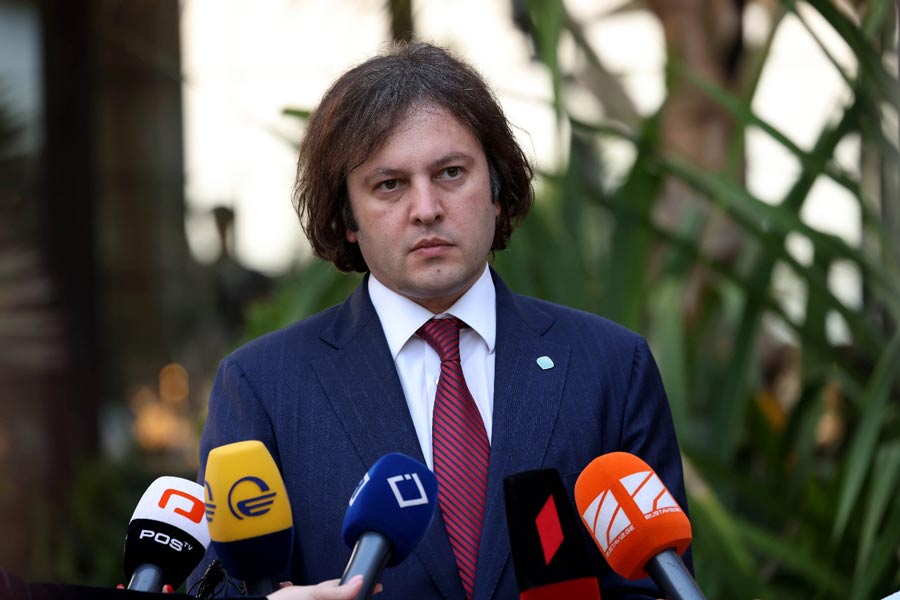
“We remain hopeful that the situation within the European Union will improve and that justice will, in future, serve as the guiding principle for the representatives of European bureaucracy. Currently, this is not the case. The recently published report is the best illustration of this,” Georgia’s Prime Minister Irakli Kobakhidze told journalists in Shanghai.
According to the Head of Government, Georgia wishes to become an EU member state by 2030, and he expresses hope that the situation in the European Union will change radically before then.
“It is deeply regrettable to witness such widespread injustice and the distortion of facts by the European bureaucracy. The European bureaucracy represents the European Union, and at such times danger threatens and damage is done not only to the reputation of the European bureaucracy, but also to the reputation of the European Union.
It is precisely the result of such actions that trust both towards the European bureaucracy and, more generally, the European Union is gradually declining in Georgia. We remain hopeful that the situation within the European Union will improve and that justice will, in future, serve as the guiding principle for the representatives of European bureaucracy. Currently, this is not the case. The recently published report is the best illustration of this.
The same applies when it comes to sanctions imposed on Russia, and Ukraine’s concerns expressed in this regard. We cannot recall Ukraine’s expressed concerns regarding Moldova or other candidate countries, which also did not join the sanctions. All of this signifies double standards and injustice, highlighting serious issues within European bureaucracy. I will reiterate that we hold different expectations regarding the eventual change of all these circumstances.
We aim to become an EU member state by 2030, and I hope that the situation within the European Union will undergo a radical change before then. Today, the actions of the European bureaucracy have descended to a level reminiscent of Soviet standards, which is deeply regrettable and unfortunate,” stated the Prime Minister.
Moreover, as Irakli Kobakhidze noted, “today’s European bureaucracy has a simple standard: if elections don’t return the collective ‘National Movement’ to power, such elections have no value for them. If the procedure for electing the Prosecutor General does not allow the collective ‘National Movement’ to restore influence over the Prosecutor’s Office, such an election procedure also has no value.”
According to Kobakhidze, the legislation concerning the courts is structured in a way that prevents the collective “National Movement” from regaining influence over the judiciary. For them, this legislation also holds little value.
“This is the general approach. These are the standards that operate. We remember well what happened when the United National Movement influenced the courts and the Prosecutor’s Office. It was precisely thanks to this influence that the United National Movement formed a bloody regime at the time, which the same European bureaucracy very firmly patronised. We do not want this to return to our country.
We hope that European authorities will, once and for all, withdraw their support for the collective ‘National Movement’ and any efforts to restore this political force to power, including in relation to the judiciary and the Prosecutor’s Office. The collective ‘National Movement’s’ influence must never again return to Georgia, neither over the courts, nor over the Prosecutor’s Office, nor over Parliament, nor over the Government.
“On the contrary, we are doing everything possible to remove this collective political force from our political system completely. Otherwise, no healthy, democratic system can develop in Georgia,” stated the Prime Minister.