


Parliament Speaker addresses 145th IPU Assembly
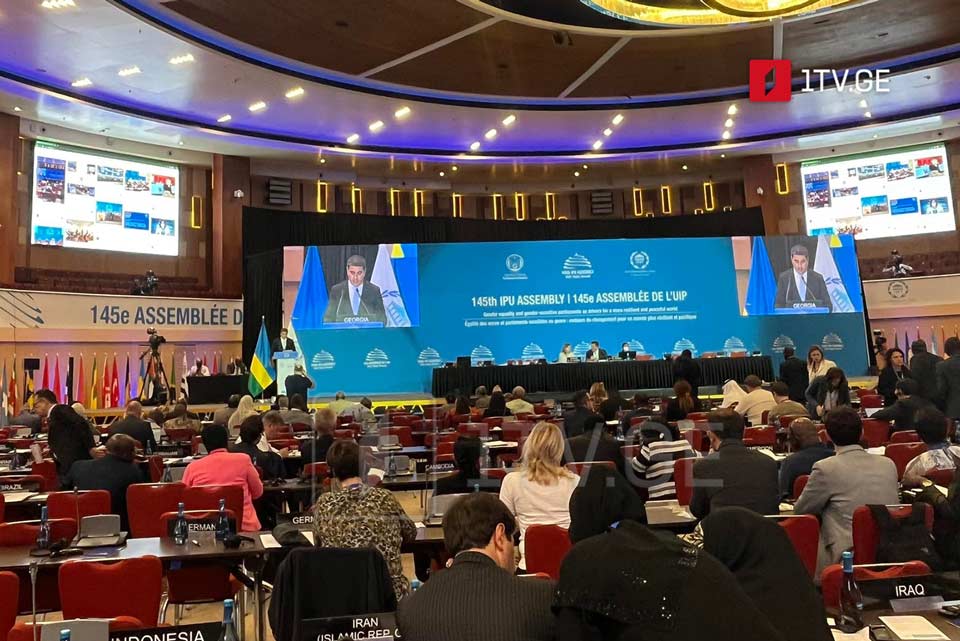
Gender-sensitive parliaments may be the drivers of change and make our communities more egalitarian and resilient, said Georgian Parliament Speaker Shalva Papuashvili at the 145th Inter-Parliamentary Union (IPU) conference in Rwanda.
“Parliaments can indeed make a substantial contribution to women’s empowerment – gender-sensitive parliaments can be the drivers of change and make our societies more equal and more resilient. Considering various contemporary crises, including armed conflicts, health crises and its social-economic consequences that especially affect women and girls, addressing issues of gender equality gains more relevance,” he said.
Georgia’s parliament Speaker discussed some initiatives the country has taken to promote gender equality and women’s empowerment.
“In 2014 Georgia adopted the Law on the Elimination of All Forms of Discrimination, a celebrated move in Georgia’s modern history towards better and further regulating the gender equality issue. Since the ratification of the Istanbul Convention in 2017, Georgia has worked on harmonizing national legislation: Georgia has strengthened its national institutional framework and created strong institutional mechanisms as well as introduced amendments to several laws, including the introduction of the criminal liability for stalking, a new definition of sexual harassment, clauses were enforced outlawing forced marriage, etc.
The principle of equality was enshrined in the Constitution of Georgia in 2017, shifting the emphasis towards combating structural inequalities and mandating the state to establish and implement special laws, policies and programs to ensure that women enjoy equality of opportunities.
In 2020, we made important changes to the Labor Code: the issue of paid leave due to pregnancy and childbirth was defined. Furthermore, the employer is now obliged to ensure equal pay for equal work performed by women and men. Perhaps the most significant step was the introduction of mandatory gender quotas to increase women’s political participation in 2020. Because of these legislative changes to the Electoral Code, the number of elected women almost doubled.
In order to achieve progress on gender equality, parliaments should be gender sensitive in their composition, structure, and everyday work. The Parliament of Georgia has adopted a method for assessing Parliament’s gender sensitivity. This assessment helped us determine our future priorities, including gender budgeting,” Papuashvili said.
The Parliament Speaker went on to say that Georgia’s efforts have intensified as the country inched closer to EU membership.
“In the frameworks of the EU membership process, the Gender Equality Council and Human Rights and Civil Integration Committee have worked jointly to amend and update the State Concept on Gender Equality as well as the law of Georgia on gender equality.
Parliamentary deliberations focus on significant legislative initiatives, including the introduction of the Gender Impact Assessment, widening the circle of individuals eligible for single-parent status and others. Moreover, as we pay great attention to women’s economic empowerment as well, we pledge to initiate and adopt the Women’s Economic Empowerment Concept,” he said.
Shalva Papuashvili stated that the Georgian parliament is willing to collaborate and share best practices with any interested partner parliament.