


PACE’s Edith Estrela urges Georgian government to change course and implement PACE recommendations
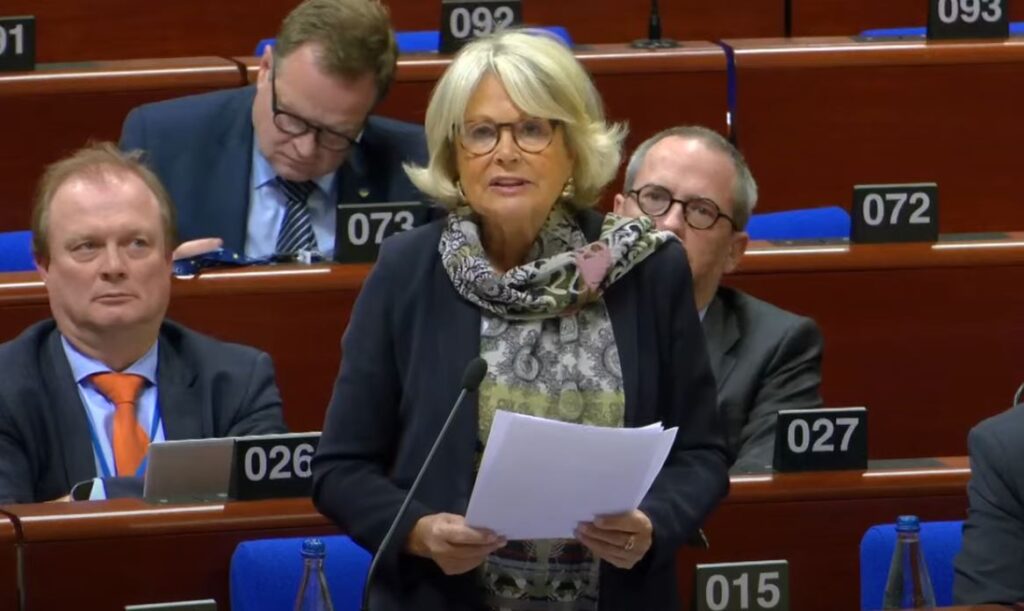
“Georgia is in the midst of a deep political crisis, marked by contested elections, democratic backing and confrontation between the ruling party and the opposition,” stated the rapporteur on Georgia, Edite Estrela, during the debates at the Parliamentary Assembly of the Council of Europe (PACE).
She expressed the view that the Georgian government shows little interest in dialogue and cooperation.
“The resolution we present to you addresses a crisis that can no longer be ignored. The situation in Georgia is of great concern. In the resolution, we, therefore, take stock of the developments that have taken place in Georgia since our last debate. We deeply regret that no progress has been made regarding our recommendations. On the contrary, the democratic backsliding has increased. Despite our repeated warnings, the political and social situation in Georgia has gotten worse. The authorities seem to be uninterested in dialogue and cooperation. They rejected cooperation with the Venice Commission and the Congress of Local and Regional Authorities. The Georgian authorities silenced opposition voices, put in prison journalists and civil society leaders, blocked the respected election observers, and undermined civil society with restrictive laws.
Laws such as the Foreign Agent Registration Act and the Law on Grants are strangling NGOs while freezing their bank accounts, leaving many unable to continue their work. These are not the measures of a government committed to democracy, but a government aiming to silence criticism. Thousands of public servants have reportedly been fired for their pro-European Union protest activity. But, perhaps, most alarming of all is the declared intention to ban opposition parties under the pretext of political investigation. If implemented, this would dismantle pluralism, silence all democratic alternatives, and move Georgia toward a one-party state.
These actions are incompatible with Georgia’s obligations as a member of the Council of Europe. They represent not only a betrayal of democratic values, but a direct challenge to the principles on which this organisation is built.
This deterioration needs to stop. The grave democratic backsliding needs to be reversed. The Assembly’s recommendations and demands need to be implemented without delay. Meanwhile, the international community has expressed concern, the European Union and others have raised alarms about human rights abuses, restrictions on civil society and erosion of democratic rules.
The Georgian government must reverse its course. It must restore fundamental freedoms, stop political persecution and re-engage with the Council of Europe in good faith.
Dialogue remains possible, but only based on respect for our shared values. By adopting this resolution, we stand not against Georgia, but with its people, with their right to democracy, pluralism, and hope for a European future,” Edite Estrela stated.