

NGOs release monitoring results of criminal cases against protesters
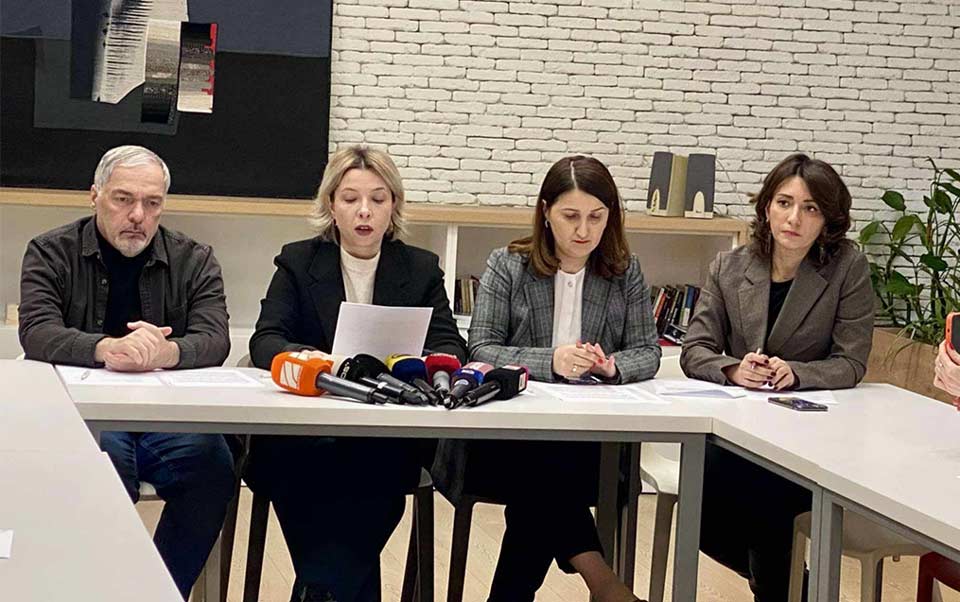
Representatives of non-governmental organizations (NGOs) have issued a joint statement regarding their monitoring of criminal cases involving protest participants.
The NGOs highlighted that many defendants in custody report mistreatment and pressure by the police. They also noted that the court is not making independent decisions, leading them to urge the Prosecutor’s Office of Georgia to petition the court to cancel the imprisonment of the defendants.
“As non-governmental organizations, we actively monitor the administration of justice in criminal cases in which protest participants are being prosecuted. We regularly provide information about identified trends and findings to local and international communities.
Detained Persons:
Based on publicly available sources and information at our disposal, more than 30 protest participants have been arrested under criminal law. Their ages start from 19. Among those detained are up to 10 students. The detainees also include a doctor, journalist, actors, and representatives from academic fields and political parties.
The court applied the most severe measure of restraint – detention – against all protest participants. Later, 2 persons, Aleko Elisashvili and one minor, were released on bail based on the prosecution’s request.
Meanwhile, not a single law enforcement officer who committed violence, inhuman treatment, and torture against hundreds of protest participants and journalists has been arrested. It’s also noteworthy that the prosecution and court released members of informal violent groups, who were committing violence against protesters in the streets, on bail.
Detention and Post-Detention Period:
Protest participants and their lawyers speak about numerous violations during investigative and procedural actions. They point to instances of illegal personal and residential searches, and cases of mistreatment by police during and after detention.
Some detainees speak about severe psychological pressure and physical assault following detention (for example, in the cases of Saba Skhvitaridze, Revaz Kiknadze, Nika Katsia, Aleko Elisashvili, and others).
Criminal Code Articles:
Criminal prosecution against protest participants is ongoing under Articles 225 (participation in group violence), 187 (damage or destruction of property), 3531 (attacking a police officer), 18-229 (preparation of explosion), 156 (persecution), 260.6 (possession of particularly large quantities of drugs). These articles carry sentences ranging from 4 to 6 years, 7 to 11 years, 8 to 20 years, and life imprisonment.
Notably, two protest participants were detained on charges of illegal possession of particularly large quantities of drugs. One detainee’s lawyer states that police illegally searched him coming from the protest without video surveillance or witnesses and planted drugs; while the second detainee speaks about both drug planting and degrading treatment and pressure after detention.
Trends Identified in Court Hearings:
The monitoring of criminal cases against protest participants revealed the following substantial violations of criminal law:
- Indictment Resolutions – The prosecution’s charges in cases where defendants are accused of group crimes are template-based and identical. Specifically, individual roles in committing crimes are not identified as no such evidence exists in the cases.
- Violations during Investigative and Procedural Actions – Part of the evidence used by the prosecution as grounds for charging protest participants was either not obtained legally or its legality and authenticity are questionable: a) In some cases, the place and time of detention indicated in arrest reports don’t match reality; b) In some cases, investigative actions were conducted under urgent necessity and/or at night when there was no legal basis for this; c) In some cases, detention terms were violated – some defendants were detained under criminal law immediately upon release from administrative detention, in the yard of the isolator.
- Demanding Detention for All Protesters – The prosecution requested the most severe measure of restraint – detention – against all protest participant defendants (while requesting bail for so-called “titushki”). The prosecution doesn’t justify why less severe measures (like bail or personal guarantee) could not achieve the goals of measures of restraint.
- Unfounded Prosecution Motions – In the vast majority of cases, prosecution motions for detention don’t meet evidentiary standards and don’t contain justification for detention. Motions are mostly template-based. They abstractly reference fear of severe punishment, flight risk, witness influence risks, but don’t indicate specific circumstances and evidence confirming these risks.
- Court Approval of All Motions – Despite unfounded motions from the prosecution, the court unconditionally approved all of them and ordered detention for all protest participants.
- Unfounded and Unreasonable Judicial Decisions – During oral justifications of decisions made at the court sessions, judges essentially repeated prosecution’s positions. Like prosecutors, judges do not point out specific circumstances that led to the imposition of detention and why it was not possible to apply a less severe measure to the detainees.
- Judge’s Bias Towards the Prosecution – In certain cases, judges clearly showed bias towards the prosecution through their questions and different approaches to the evidence obtained by the prosecution and the defense during court hearings.
- Violation of the Principle of Publicity of the Hearings – Most initial hearings were held in small courtrooms despite the fact that there was high public interest, the number of people wishing to attend them was high and the larger courtrooms were available. This violates the principle of publicity of the proceedings, since interested persons were restricted from attending the proceedings (e.g., in the case against actor Andro Chichinadze and others, the proceedings were held in a small hall, while there were many people wishing to attend).
Judges Handling Cases
The following judges are hearing the cases of protest participants with similar biased approaches: Tamar Mchedlishvili, Irakli Khuskivadze, Lela Maridashvili, David Mgeliashvili, Nana Shamatava, David Kurtanidze, Levan Kolbaia.
Request:
Existing practice clearly demonstrates that the court is administering political rather than fair and objective justice. Since multiple defendants in custody speak about police mistreatment (torture, inhuman, degrading treatment) and pressure; since multiple defendants in custody face pressure to give false testimony; since searches and seizures were conducted in violation of procedural guarantees; since the court doesn’t make independent decisions and is fully subordinate to the prosecution’s agenda: we call on the Prosecutor’s Office of Georgia to petition the court to cancel detention for defendants in custody,” the statement reads.