


National Environmental Agency issues initial assessment on Telavi flash floods
The National Environmental Agency (NEA) has published its preliminary assessment of the natural disaster in Telavi.
According to the agency, torrential rain in the early hours of July 12 caused the Telaviskhevi river to burst its banks, triggering a torrent of mud and debris that flooded several streets across the city.
“Data from the National Environmental Agency’s meteorological stations shows that rainfall at the Telavi station reached 57.3 mm, accounting for 85 per cent of the entire monthly norm for the area, while the Ikalto station recorded 40.1 mm.
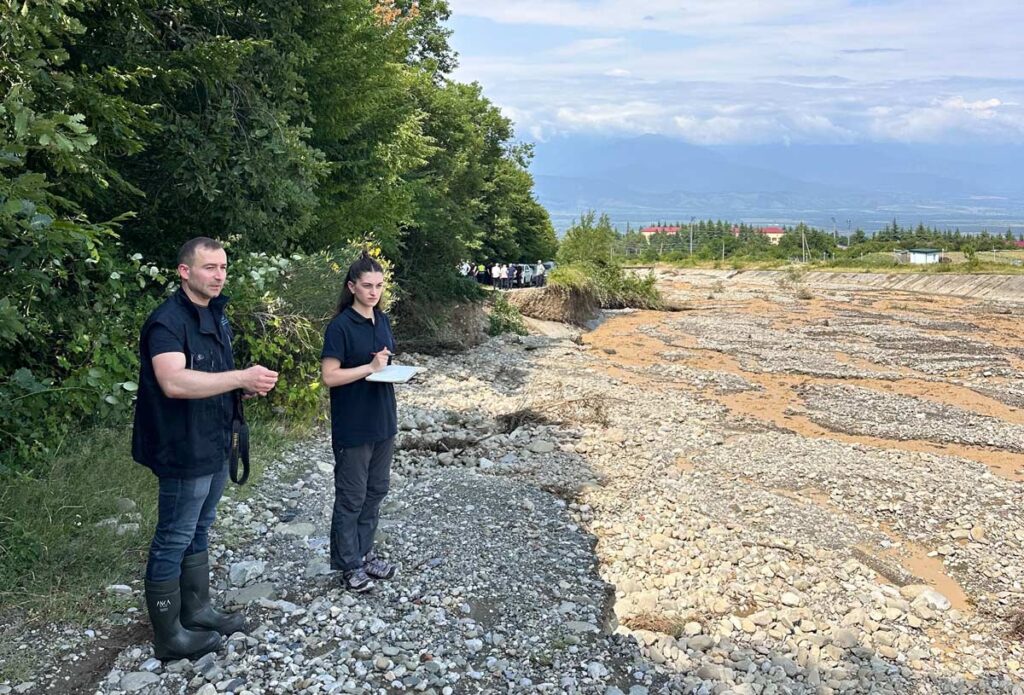
A team of geologists and hydrologists from the National Environmental Agency has been on the ground since this morning to evaluate the situation in Telavi.
According to the initial assessment, the intense atmospheric precipitation in Telavi Municipality triggered a sharp and aggressive activation of mudflow processes within the Telaviskhevi river basin.
The combination of solid debris and a critical mass of water formed a powerful torrent. Three debris-retention barriers located in the mid-section of the river valley (the so-called Kherkheulidze barriers) partially succeeded in filtering the surge: the first almost entirely contained large woody debris, the second caught smaller timber debris, and the third filtered out rock and gravel fractions. Nevertheless, due to the immense volume and energy of the torrent, the flow bypassed all three structures on the left flank, using an old dirt track as a temporary channel. This damaged riverbank protection structures and caused surface deformation along several sections of the road.
When the torrent reached the urban area, the river channel lacked the capacity to contain the surge, causing it to burst its banks and flood the surrounding area. The primary accumulation of mud and debris was recorded in the lower districts of Telavi, adjacent to specific infrastructure sites,” the National Environmental Agency stated.
Experts from the National Environmental Agency remain on-site to continue their detailed investigation of the disaster zone.