


Ministry of Health briefs business, employer and banking associations on amendments to labour migration law
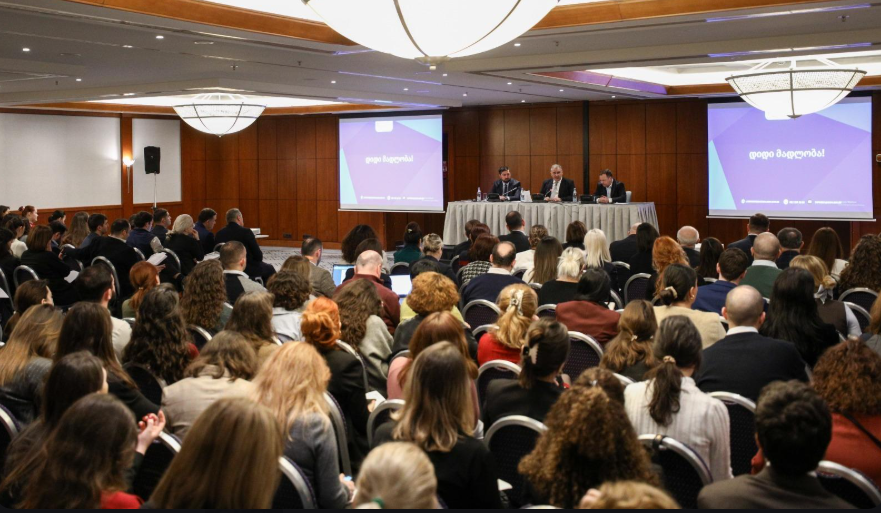
The State Employment Promotion Agency has briefed business, employer and banking associations on amendments to Georgia’s Law on Labour Migration, which will enter into force on March 1.
The event was opened by the Minister for Internally Displaced Persons from the Occupied Territories, Labour, Health and Social Affairs. Mikheil Sarjveladze stated that it is a priority of the state to care for the well-being of every citizen and to ensure and protect their right to employment.
As the Minister noted in his address, the introduction of certain mechanisms and their effective enforcement is of great importance in the pursuit of this goal.
According to the Ministry of Health, a presentation on the legislative amendments was delivered by Deputy Minister of Health Giorgi Tsagareishvili and Deputy Director of the State Employment Promotion Agency Giorgi Bunturi.
The Ministry of Health reported that the enforcement and technical aspects of the changes were examined in detail at the meeting, and the question of quotas was also discussed.
The Ministry noted that it is essential to bring migration matters within a defined regulatory framework to prevent illegal migration and employment, as well as the outflow of financial resources generated through economic activity from the country.
Representatives of the associations shared their views on the amendments, after which the meeting continued in a question-and-answer format.
The event was also attended by representatives of the Ministry of Health and other state bodies.
Under the amendments to Georgia’s Law on Labour Migration, foreign nationals wishing to work legally in Georgia, including remotely, will be required to obtain a work permit. The State Employment Promotion Agency will issue permits granting the right to work for foreign nationals, and applicants will be required to pay a fee to obtain such permits. The Work Permit will be issued for a specific position with a specific employer for a period of one year. In the case of self-employed foreign nationals, the work permit will be issued with reference to a specific field, sector and type of business activity. Work permits will not be issued to foreign nationals for work as tour guides or in taxi or courier services. It should be noted that transitional grace periods have been established in connection with the amendments: until January 1, 2027, for those already registered in the electronic labour migration system and in lawful employment; and a second grace period extending until May 1, 2026, for self-employed foreign nationals already carrying out employment or business activity in Georgia. Should a foreign national fail to comply with the requirements set out in the Law on Labour Migration, both the employee and the employer will be subject to fines, including financial penalties for self-employed foreign nationals.