


MEP Cristian Terheș: You can project peace through strength. But what about if you’re a small country, what do you do? Collaborating can bring peace
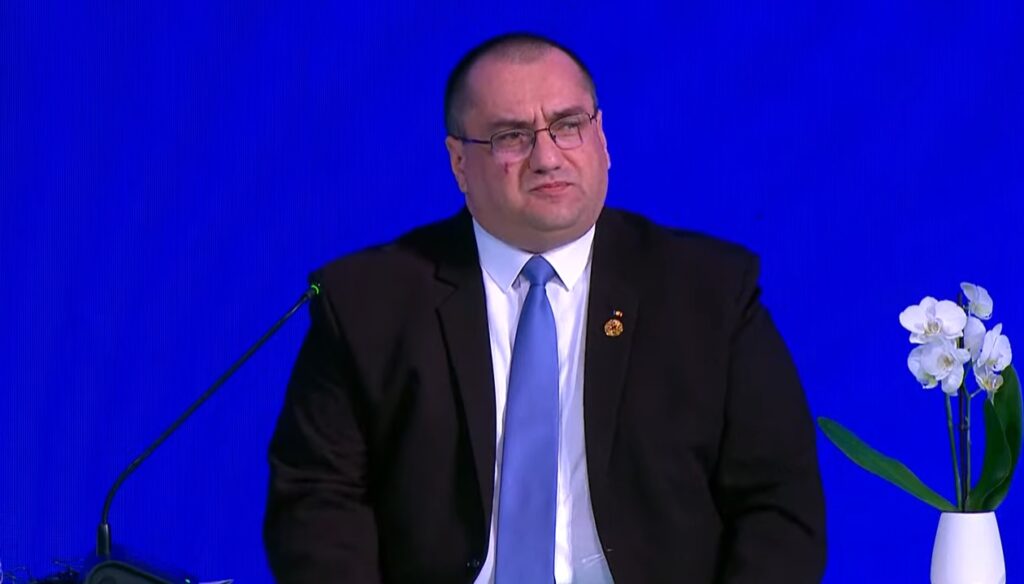
“Nowadays, many politicians and many statesmen are talking about peace through strength. It is good. If you are big enough, you can project peace through strength. But what about if you’re not, if you’re a small country? If you’re a country that doesn’t have access to the sea, that doesn’t have a huge army, what do you do? This is where the wisdom of politicians and of elected officials comes to realise the advantages and strains that every country has, that interconnecting and collaborating, and not fighting with another country, can bring peace through prosperity,” Romanian MEP Cristian Terheș stated during a panel discussion held within the framework of the Tbilisi Silk Road Forum.
During the discussion, Cristian Terheș was asked, “What does it mean for Romania to revitalise, rethink, and develop with a new framework for global trade?”
Terheș responded that representatives of government institutions and elected officials should share a common vision, pool their ideas, and seek ways not to compete, but to collaborate.
“Madam Maka, who I met multiple times in the Parliament. To answer that question, I think it is very important for every person, regardless of whether that person is in Georgia, in Romania, or in any other corner of the world, to realise the importance of elected officials.
Because at the end of the day, it is the elected official, not an NGO, not a think tank, but the elected official who goes and fights for his or her country. And that’s exactly what Georgia’s Foreign Minister did. That’s how we met in the European Parliament. Whenever she came, I met her. We discussed Georgia and what we can do to strengthen the relationship between the EU and Georgia. What challenges does Georgia have, and what can I and my colleagues do to help Georgia? And I wanna point this out, the importance of elected officials, because these are the people who can start a war, but they are the people who can bring peace.
We just saw in the previous panel three prime ministers – the Prime Minister of Georgia, Armenia, and Azerbaijan – two of them were firing each other a few years ago, and now, they were sitting right here, on this stage, almost, I’m not exaggerating, kissing each other, congratulating each other for the great achievement that they realise. And it is a great achievement because we live right now in a historical time.
You were asking me about Romania. We were unlucky, I would say, that after the Second World War, we were on the other side of the Iron Curtain. But what happened in the Western world and history is important here. After the Second World War, it was the politicians, the statesmen from France, Germany, Italy, and Belgium. Even though a few years before they were killing each other, decimating each other, they had the courage, the wisdom, and the humbleness, I would say, to sit around the same table and think, what can they do to bring back peace in Europe?
Millions of people were killed in Europe during the Second World War. France and Germany were destroying each other. But despite that ugly fact, by 1950, politicians from Germany and France were able to sit together and come up with this plan to bring peace through prosperity, which later on evolved into what we call today the European Union.
And prosperity is important in this context because you hear nowadays many politicians and many statesmen talking about peace through strength. It is good. If you are big enough, you can project peace through strength. But what about if you’re not, if you’re a small country? If you’re a country that doesn’t have access to the sea, that doesn’t have a huge army, what do you do? And this is the wisdom. This is where the wisdom of politicians and of elected officials comes to realise the advantages and strains that every country has, that interconnecting and collaborating, and not fighting with another country, can bring peace through prosperity.
Our history is not perfect. None of us is perfect, but today we are making, I would say, a better future. Because we allow all these people, all of our counterparts from different countries, to come up with their ideas on how these countries, big or small, connected to the sea or not, should interconnect, work together and bring peace through prosperity.
You ask me about Romania. Romanians, I would say, are 180 degrees on the other side of the Black Sea. If Georgia is a gateway to and from Central Asia and Asia. Romania, I would say, is the gateway to the European Union and the Schengen area. We are part of the Schengen area. If you bring any products from Central Asia or Asia to Europe through Romania, once you have cleared customs in Romania, then you can ship that good everywhere in Europe without customs. It’s a great achievement.
So it is up to us, I would say, statesmen, politicians, elected officials, to share our thoughts in formats like this, bring our ideas together and find ways how not to compete but to collaborate,” Cristian Terheș stated.