


Legal Affairs Committee approved amendments to Law on Grants in second reading
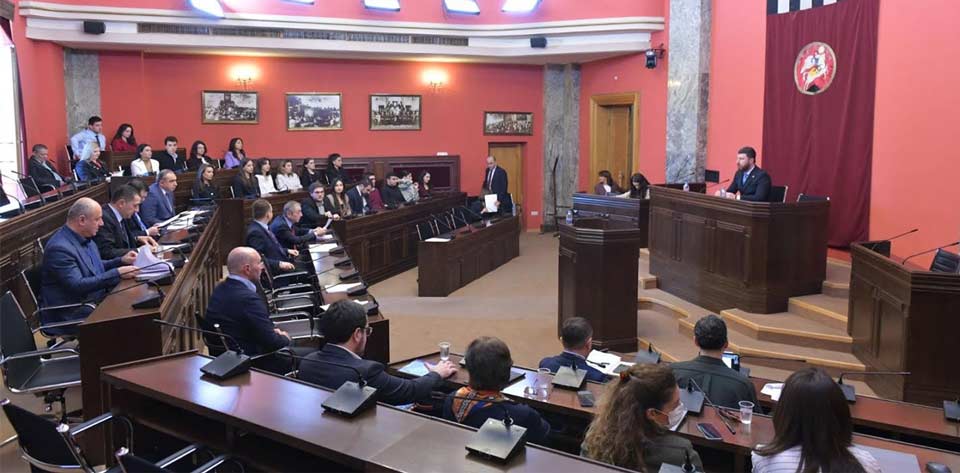
The Legal Affairs Committee considered and approved, in the second reading, amendments to the Law On Grants, together with related draft laws.
According to the rapporteur and Committee Chair Archil Gorduladze, amendments will be proposed to the section of the draft law that defines what constitutes a grant. Currently, the draft specifies that funds transferred by emigrants will not be considered as grants. The draft law now specifies that funds transferred by emigrants will not fall under this definition.
Under the draft law, a grant is defined as monetary or in-kind resources transferred by a subject provided for under the relevant article of the law, which are used or may be used, with the belief or intent of exerting influence on the Government of Georgia, state institutions, or any segment of society, for activities carried out or to be carried out aimed at shaping, implementing, or altering Georgia’s domestic or foreign policy. It also includes resources used or that may be used for activities deriving from the political or public interests of a foreign state authority or a foreign political party.
According to the draft law, a legal entity of another state whose activities substantially involve engagement on issues related to Georgia shall also be considered a grant recipient.
As Archil Gorduladze stated, legal entities registered abroad will be required to obtain prior consent from the Government of Georgia before receiving a grant.
He further noted that if a legal entity from another country, with a registered branch, representative office, or subdivision in Georgia, receives a grant without obtaining the necessary consent, it will be subject to liability.
“Foundations and various organisations are operating in Georgia, along with their respective foreign ‘parent companies’ and their representative offices and branches. If they receive funds, they too will be required to apply to the Government of Georgia for the appropriate consent. In this specific case, the liability is defined as administrative liability in the amount of double the received grant. In the case of other persons—namely, individuals and legal entities operating in Georgia who receive grants—criminal liability will apply,” he stated.
Under the draft law, persons who have received grants before the entry into force of the law will have one month after its enactment to apply to the Government of Georgia. The Government, in turn, will also have one month to issue a response—either consent or refusal.
“During this one month, such persons will be able to use the funds, for example, for utility payments and other obligations. If the Government does not grant consent, they will be obliged to cease using the received grant. Otherwise, they will incur criminal liability,” the Committee Chair noted.
According to Archil Gorduladze, amendments were also introduced to the draft law “On Amendments to the Criminal Code of Georgia.” Specifically, the draft now includes a provision establishing as an aggravating circumstance the commission of a crime motivated by non-recognition of Georgia’s constitutional order or its constitutional bodies.
“In such cases, when imposing imprisonment, the term of the sentence must exceed by at least one year the minimum term prescribed for the respective crime under the relevant part of the Code,” the rapporteur stated.
He further noted that the draft law adds a new article to the Criminal Code titled “Extremism Against the Constitutional Order.” This provision concerns systematic public calls by a citizen of Georgia or a stateless person with status in Georgia for mass violations of Georgian legislation, mass disobedience to state authorities, or the creation of alternative state bodies; the arbitrary, public, and systematic presentation of oneself or another person as a representative of the Georgian authorities; or other systematic acts by such a person, if any of the above actions are aimed at establishing a perception of illegitimacy of Georgia’s constitutional order or constitutional bodies and harm Georgia’s interests or create a real threat of such harm.
“For the aforementioned acts, we propose the following penalties: a fine, community service ranging from 400 to 600 hours, or imprisonment for up to three years. In the case of a legal entity, the penalty under this article shall be a fine or liquidation and a fine,” he noted.