


Kutaisi International University announces collaboration with European Organisation for Nuclear Research
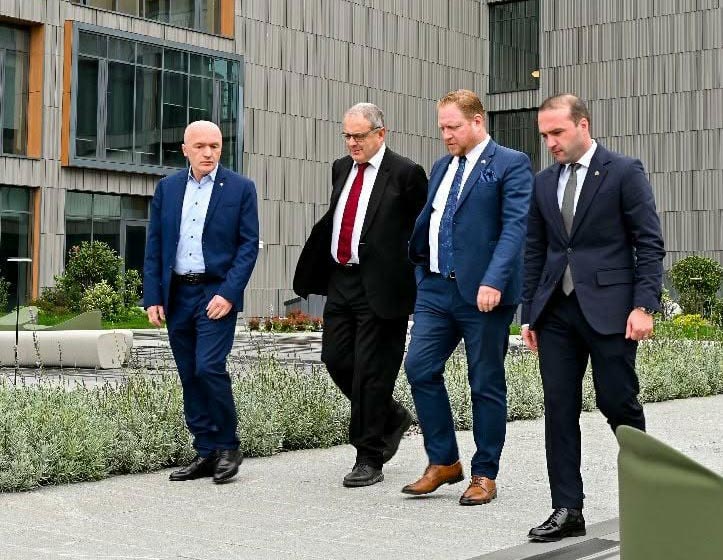
Kutaisi International University (KIU) recently hosted Professor Tiziano Camporesi from Boston University, a leading scientist involved in the CMS experiment at CERN’s Large Hadron Collider (LHC). The introductory working meeting was attended by Acting Rector Professor Paata Turava, KIU Chancellor Levan Kopaliani, and Vakhtang Tsagareli, Director of Kutaisi University City.
During the discussions, the parties explored opportunities for future collaboration aimed at strengthening both student educational programmes and research initiatives at KIU.
A significant focus was placed on the Hadron Therapy Centre, currently in the design phase at KIU. This facility will be equipped with particle cyclotron accelerators, serving both scientific research and medical applications.
The meeting was also attended by the Georgian government’s CERN liaison, Professor Zviad Tsamalaidze, Director of the Institute of Quantum Physics and Engineering Technologies at Georgian Technical University (GTU), Rector Professor David Gurgenidze, Vice-Rector Professor Tamar Lominadze, and Senate Speaker Professor Zaza Sopromadze.
As part of the collaboration with the European Organisation for Nuclear Research, known as CERN, KIU students will have the opportunity to participate in summer and administrative educational programmes. They will work alongside experimental and engineering teams on advanced technical projects, gaining hands-on experience. Georgian students will also have the opportunity to explore the world’s largest laboratory, participate in seminars and discussions, and gain both theoretical and practical knowledge in the fields of physics, engineering, and computational sciences.
Following the meeting, the guests toured the university campus and its state-of-the-art facilities, which include modern educational and residential buildings, conference centres, sports fields, and recreational areas.
CERN, the European Organisation for Nuclear Research, is the world’s largest laboratory dedicated to elementary particle physics. It offers scientists a unique complex of particle accelerators, providing invaluable opportunities for groundbreaking research in fundamental physics.