


Georgia’s President: We seek EU membership, preserving our centuries-old values and protecting national interests
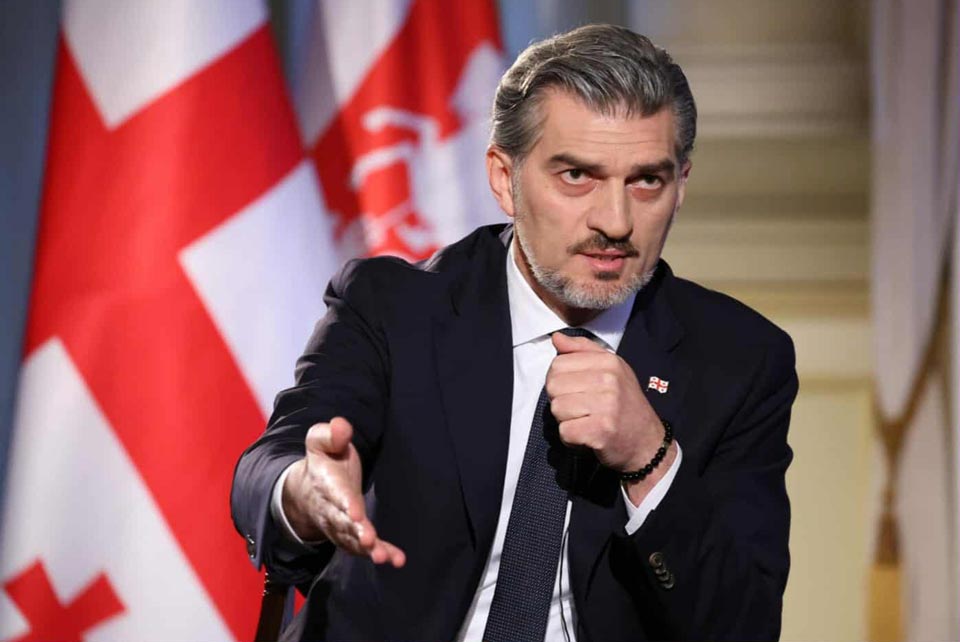
“We are fully acquainted, and our citizens are also informed, that we aspire to become members of the European Union, part of Europe. However, we wish to do so while upholding the values we have defended for centuries. We want our national interests to be explicitly safeguarded,” stated Mikheil Kavelashvili, the President of Georgia, during the programme “Vakho Khuzmiashvili’s Tavisupali Sivrtse.”
Kavelashvili responded to a question from the host regarding a statement made by the EU Ambassador, Paweł Herczyński, who noted that “the country cannot become a member of the European Union with the laws adopted in Georgia.”
“It will be a domestic matter to revise legislation, subject to partnership, dialogue, and careful assessment of which laws may contradict international standards. It is not a case of acting solely according to our wishes, especially in legal matters. When discussing the law, we must scrutinise in what ways it conflicts with international law. We are prepared for this; we continually express our readiness,” Kavelashvili emphasised.
Furthermore, the Georgian President pointed out that the message from the EU Ambassador does not align with the fundamental goals of the European Union, which was established to serve the interests of all its members. He stressed that Georgia must preserve its identity throughout this process.
“Our EU accession journey did not begin yesterday. There has been a steady aspiration to be part of Europe and belong to this community; it has been a deep-seated desire of our ancestors, spanning many generations. Our country has endured numerous storms to become a full-fledged member of Europe. This process has not halted. Yet, we are a 3,000-year-old nation that has faced many challenges over the centuries. We have gained considerable experience in safeguarding our identity while pursuing progress,” stated the Georgian President.
According to Kavelashvili, the situation within the EU itself is evolving, with forces, though currently small, that share the same values as Georgia’s government and the majority of its society.
“There are forces within the EU, currently small, but the situation is also changing there, which share the same values as us, including those of our current government and the majority of society,” said Mikheil Kavelashvili.
The President affirmed that the Georgian government is prepared for dialogue, partnership, and discussion on any issue.
“We have partners. For example, Hungary and Slovakia are examples of countries with similar perspectives. Recently, a political force in the Czech Republic also won elections based on this ideology and these values. Europe isn’t just about diversity and justice today. Human rights are central to its principles. We aspired to join this space so that these rights are respected and not violated. We hope that this process will evolve utterly. We are ready for dialogue, partnership, and discussion on any issue, and I emphasise this constantly.
However, their actions and attitude are also offensive. They are insulting the majority of Georgian citizens. It is a paradox, almost as if they are focusing on the Georgian people. During the elections, they violated this convention and outright interfered in the electoral process. They appeared to be targeting the Georgian population, most of whom support this government. Why are they insulting these people? Why do they assume that they cannot think, are not intelligent, or fail to see what is at stake and the interference at play?” said Mikheil Kavelashvili.
According to him, the actions of the German ambassador and others are undermining the process of integration into the European Union.
“Who is truly damaging the European values that our ancestors, public figures, and leaders aspired to achieve to become part of this community? Take, for instance, the behaviour of the German ambassador. Article 41 of the Vienna Convention explicitly states what an ambassador is obliged to do when deployed in another country. It is unambiguous. Yet, this individual, and not only he, is acting in direct contradiction to those provisions. When they are explicitly prohibited from interfering in a country’s internal affairs, they nonetheless assert greater rights to do so. This goes against the very process we have been working towards for centuries. Who is really causing harm in this situation? It is these individuals who are harming,” the President of Georgia stated.