


Georgian PM defends judicial independence against foreign pressure
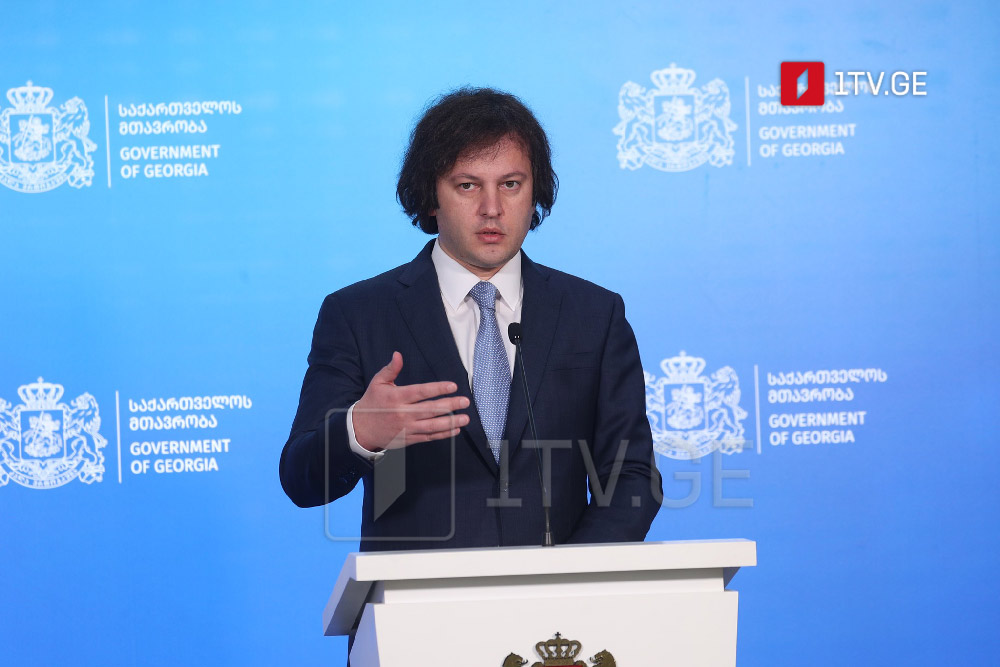
In a comprehensive address to judges and members of the High Council of Justice (HCoJ) at the Supreme Court, Prime Minister Irakli Kobakhidze declared that sanctions against Georgian judges represent “the most brutal attempt at political interference” and firmly stated that no one has undermined the independence of the Georgian judiciary since 2012, nor will anyone do so in the future.
The Prime Minister expressed deep concern about recent sanctions imposed by foreign governments against Georgian judges, characterizing these actions as fundamentally misaligned with democratic principles.
“Sanctions are the most brutal attempt at political interference. This attempt will not have any results, but in itself, it deserves very deep concern. This is a tragic event not for the judges against whom the sanctions apply, but for the countries and entities that are engaged in such cases,” Kobakhidze stated.
He specifically referenced recent British sanctions against two Georgian judges, describing the situation as “truly tragic” and incompatible with the legal traditions established by John Locke, whom he called “a famous English thinker and educator, and one of the founders of legal thinking in England.”
“In the country of John Locke, we are told today that there is reasonable suspicion that specific judges were involved in corrupt deals. No specifics, and to put it mildly, we are talking about reasonable suspicion,” Kobakhidze noted. “To put it bluntly, John Locke would probably be turning in his grave when he sees something like this from the British authorities.”
The Prime Minister emphasized that these sanctions are practically equivalent to criminal punishment in their severity, yet were imposed based on what he characterized as vague suspicions without concrete evidence.
Kobakhidze was particularly critical of international pressure for judicial vetting, which he described as a direct threat to judicial independence despite being “packaged under a beautiful name—integrity check.”
“In fact, they directly demanded that we give up the independence of the court,” he said. “Three foreigners were to decide who would remain in the judicial system and who would be appointed to replace the dismissed judge who had been appointed for life.”
According to the Prime Minister, such demands directly contradicted Georgia’s constitutional protections for judicial independence, including the principle of lifetime judicial appointments.
“Against the background of all this, three foreigners were to decide the fate of a judge appointed for life. Moreover, new judges were to be appointed. On this scale, they were demanding that we encroach on the independence of the court. Naturally, we did not even think of taking such a step,” he stated.
The Prime Minister highlighted that cases of alleged judicial impropriety have consistently been vindicated by the European Court of Human Rights in Strasbourg, demonstrating the fairness of Georgia’s judicial system.
“There were about ten high-profile cases in which specific parties, NGOs, and foreigners had specific political interests. All of these cases went to the Strasbourg court, and in all but one of them, Strasbourg determined that the decision of the Georgian judiciary was fair,” Kobakhidze noted.
He specifically referenced the Rustavi 2 case, where “nine judges of the Supreme Court were effectively declared enemies of the state” by critics. When this case reached the Strasbourg Court, Kobakhidze pointed out, the Georgian judges’ decision was upheld.
“Here too, it became clear that, in reality, we were not dealing with someone’s sincere emotions regarding the court’s decision, but rather an attempt to exert political pressure on the court, including external political pressure,” he said.
The Prime Minister recounted specific instances of what he described as direct interference in judicial independence, including a case involving Judge Chkhikvadze.
“A representative of a specific embassy came to the judge and asked him to report on a specific case, we are talking about a representative of the former U.S. administration,” Kobakhidze said. “A specific representative of the former administration met with a judge, and asked him to report on a specific case against the Constitution of our country.”
According to Kobakhidze, when the judge refused to comply, “a kind of sanction was imposed on the judge—his visit was cancelled,” which he described as “a kind of recognition that all this was also, visits are considered as an institution of influence on judges.”
The Prime Minister emphasized that the Strasbourg Court later confirmed the fairness of Judge Chkhikvadze’s original decision.
Kobakhidze presented statistical evidence of significant improvements in Georgia’s judicial system since his government took power in 2012, contrasting current practices with what he described as the previous era of “heavy political control and pressure on the judicial system.”
“Acquittals were 0.1% and less before 2012, which was the result of the general system. Today, the rate of acquittals is approximately 9-10%, which already corresponds to the general practice established in European countries,” he stated.
He also cited several other improvements: pre-trial and administrative detention rates have decreased threefold; the approval rate for investigative action petitions has decreased by half; the volume of fines has decreased fivefold; and bail rates have decreased by almost 50%.
“The culmination of all this is that several times fewer claims are filed with the Strasbourg Court,” Kobakhidze added. “All this is happening against the background that, in general, the legal culture in the country is growing.”
Despite ongoing attacks on Georgia’s judicial system, Kobakhidze asserted that public confidence remains strong, citing sociological research indicating that “in no survey over the past few years has trust in the judicial system fallen below 50%.”
“The majority of the population, according to all the surveys conducted in recent years, trusts the court, its independence, and this is, of course, fundamentally important for us,” he said.
Kobakhidze concluded by drawing a parallel between judicial independence and national sovereignty.
“The independence of the court is one of the main elements and attributes of the country’s independence and state sovereignty. Therefore, we must take care of the independence of the court in exactly the same way as we take care of the independence of our country and the sovereignty of our state,” the Prime Minister declared.
“The government is ready to provide maximum support to the judiciary. Be it in financial or material terms, we will have close cooperation on these issues and will approach each issue raised by the judiciary with maximum consideration. We will do everything to further strengthen the independence and efficiency of the court,” Irakli Kobakhidze concluded.