


Georgian Parliament Speaker slams EP for mimicking Russian occupation; Moscow denies 20% of our sovereignty, Brussels rejects the entire
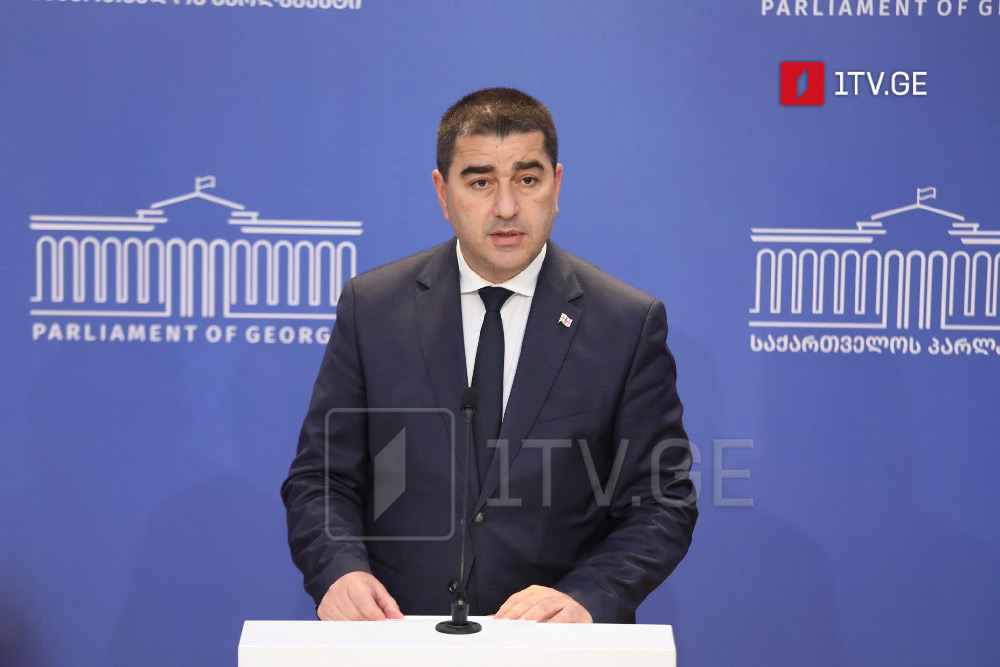
“The recent resolutions passed by the European Parliament and the Parliamentary Assembly of the Council of Europe have ultimately crossed the red lines drawn by the Georgian people, grossly violating Georgia’s sovereignty and the principles of national independence,” stated the Speaker of the Parliament of Georgia, Shalva Papuashvili.
According to him, “under the banner of the European Union and by exploiting the concept of European integration, the European Parliament has effectively written off the independence and sovereignty that the Georgian people fought and bled for, directly insulting the very idea of Georgian statehood.”
“With the report prepared by Rasa Juknevičienė, the European Parliament has effectively declared that the right to determine the legitimacy of Georgia’s government belongs not to the Georgian people, but to the political bureaucracy in Brussels; that it is up to them to decide who should govern Georgia and which administration is acceptable to them.
This constitutes a denial of the fundamental principles of democracy. Democracy is built upon the sovereign will of the people. Yet the European Parliament is effectively asserting that Georgia’s government should be validated by the trust of the EU’s political elite rather than the choice of the Georgian people. Rather than an alliance of equal partners, this approach reflects the logic of feudal vassalage, where sovereignty is treated not as an inherent right of the people but as a privilege bestowed from above.
Consequently, in its latest report, the European Parliament has practically aligned itself with Russia’s occupation policy. While Russia denies Georgia’s sovereignty over a fifth of the country’s territory, the European Parliament refuses to recognise Georgia’s sovereignty over its entire territory.
It is also unprecedented for the European Parliament to refer to Georgia’s former President, Salome Zourabichvili, who holds no state authority under the current Constitution and legislation, as the country’s legitimate representative, while branding the democratically elected Parliament, Government, and President as a ‘de facto regime’. Such an attitude shows utter disrespect towards the two million one hundred thousand voters who expressed their political will in the parliamentary elections,” Papuashvili stated.
As Papuashvili noted, the European Parliament’s resolution does not merely target Georgia’s democratic institutions.
“It directly strikes at the second historical pillar of the Georgian state, the Georgian Orthodox Church. Mentioning the Church in the context of Russian religious networks and influence operations marks the first open attack on the Georgian Church by an official European institution, offending the religious sentiments of millions of believers. Furthermore, this dangerous precedent creates the impression that the European Parliament, as in other instances, was used here first to test the waters for such attacks.
A simultaneous assault on the sovereignty of the Georgian state and the Georgian Church is, inherently, an attack on the very idea of Georgian statehood. When the European Commission and the ruling political forces of EU member states respond to such disinformation and political sabotage with either silence or support, they must understand that they cannot wash their hands of it and shift the blame entirely onto the widely resented European Parliament. Therefore, it is a matter of principle for us that the European Commission distances itself from the outset from this gross attack on the Georgian Church by the European Parliament,” Shalva Papuashvili stated.
According to the Speaker of the Parliament, the European Parliament’s latest resolution reaffirms that the EU bureaucracy must take tangible steps to restore dialogue with Georgia.
“To achieve this, the hostile rhetoric towards the Georgian people and the Georgian Church must stop; the disinformation campaign against Georgia’s democratically elected government must end; Georgia’s state sovereignty must be fully recognised, and the fundamental principles of international law must be strictly upheld. It is hypocritical for the European Parliament to condemn the violation of Ukraine’s sovereignty on the one hand, while attempting to decide the legitimacy of Georgia’s government instead of the Georgian people on the other. Such selective application of international law and the principles of self-determination demonstrates that the European Parliament rejects respect for the equality of states and the free will of peoples, dragging the world back to an era when the fate of nations was decided by metropoles rather than by the citizens of those countries themselves,” Shalva Papuashvili concluded.