


Georgian opposition divided on ex-president Zourabichvili’s coalition government proposal
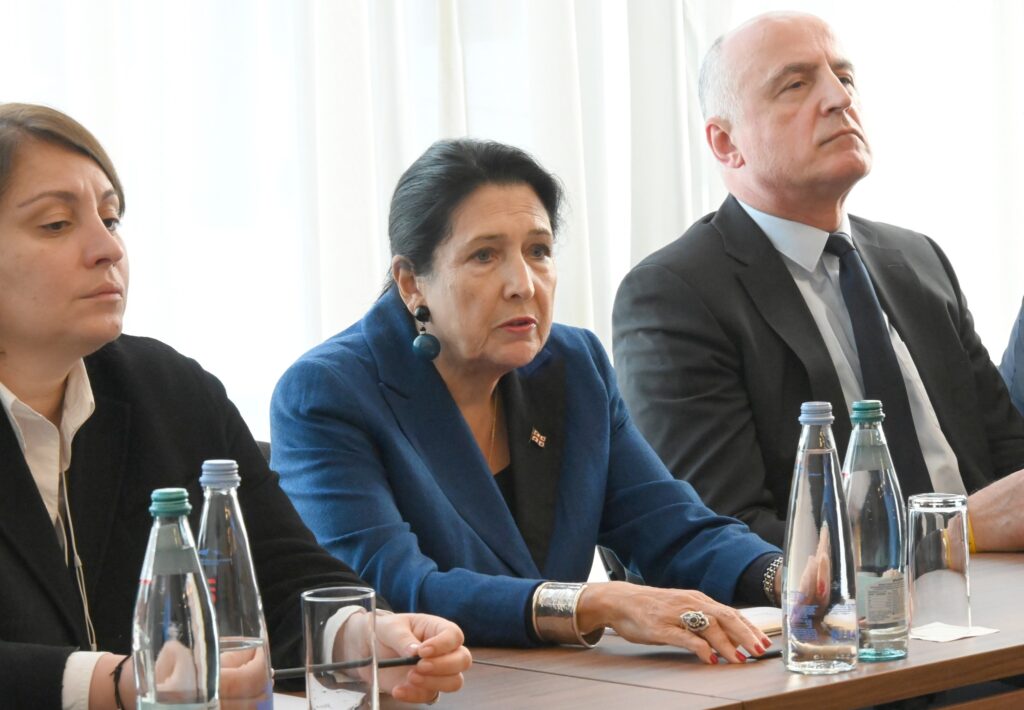
Former Georgian President Salome Zourabichvili’s proposal to prepare “not only for parliamentary elections but also for what comes after—the formation of a coalition government,” which she voiced yesterday following a meeting between the Resistance Platform and EU ambassadors, has sparked a wave of mixed reactions among Georgian opposition parties representatives, exposing strategic differences within the opposition landscape opposing the ruling Georgian Dream party.
The United National Movement Party (UNM), however, did not attend the meeting.
“We believe that given the current political reality, the issue of a coalition government should not even be on the table yet,” said UNM member Levan Sanikidze.
Sanikidze argued that discussing ministerial positions is premature while more fundamental issues remain unresolved.
“When we talk about a coalition government, it’s very important to consider what kind of elections we’re participating in, who is conducting these elections, under what rules, what kind of administration and electoral environment exists,” he explained.
“The Georgian people’s demands are much more comprehensive than discussing specific names and who will distribute positions,” Sanikidze added.
“While we understand the importance of a shadow cabinet, discussing infrastructure and agriculture ministers while over 50 political prisoners have families spending nights on Rustaveli Avenue, while the country is being severed from European civilization—this would be mocking our society.”
In contrast, Tazo Datunashvili from the Lelo party expressed strong support for the coalition concept.
“Georgia has been severely damaged in recent years due to Georgian Dream’s anti-state and anti-Georgian actions. The political crisis in this country will clearly be defused by new parliamentary elections,” he stated.
Datunashvili emphasized that a coalition government is “the only solution for rapid response to these issues and addressing all the problems and challenges facing the country.”
He added, “Coalition has no alternative, as recent decades have shown that coalition is inevitable in future governance. Some may not attend these meetings, but that doesn’t mean we cannot reach agreement on important and fundamental issues. This is politicians’ job—to talk, find compromise, and solve problems.”
Tamar Chergoleishvili, co-founder of the Federalist Party, wrote on social media supporting Zourabichvili’s approach, describing it as a “bottom-up process” that “builds on existing agreements and doesn’t impose anything from above.”
She praised the inclusivity of Zourabichvili’s initiative, noting that it “differs from all previous processes that revolved around the ego of some leader or donor, aimed at contraction rather than expansion.”
“How could a process succeed where our political team, which was visibly growing and expanding for everyone to see, couldn’t find a place? This is physically, engineeringly impossible,” Chergoleishvili wrote. “The broad wins over the narrow in this matter.”
Meanwhile, Girchi party leader Iago Khvichia criticized Zourabichvili, calling her “a troll who says one thing one moment and something else the next, further confusing an already disoriented opposition.”
While acknowledging that “there’s nothing wrong with the idea of a coalition government,” Khvichia argued that “when Zourabichvili talks about a coalition government after all her actions, various coalitions, charters, and whatnot, it comes across as unserious from her, no matter how serious the idea of a coalition government may be.”
Following Wednesday’s meeting between the Resistance Platform and EU ambassadors, former President Zourabichvili remarked: “We must be prepared not only for parliamentary elections but also for what comes after—the establishment of a coalition government.”