


Deputy Economy Minister: Middle Corridor must function as single system; Georgia is now pivotal link
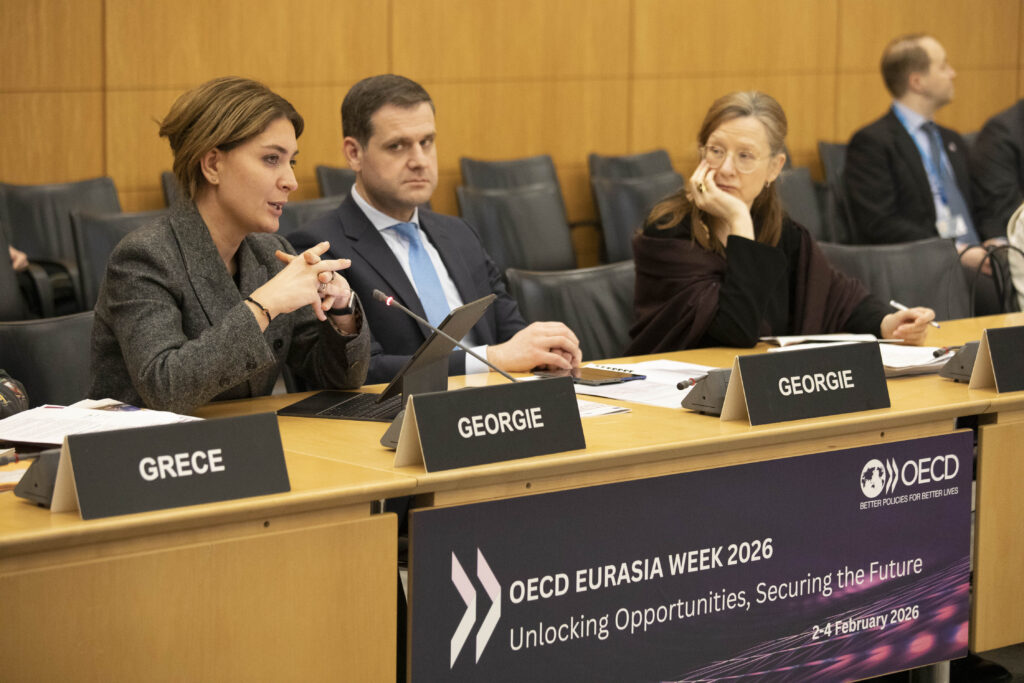
Tamar Ioseliani, Deputy Minister of Economy and Sustainable Development, addressed the plenary session of the Organisation for Economic Cooperation and Development’s Eurasia Week (OECD Eurasia Week). The session was held in Paris, France.
In her address, Tamar Ioseliani spoke about the growing importance of the Trans-Caspian International Transport Route and the strengthening of Georgia’s role as a significant regional player.
According to the Deputy Minister, the Trans-Caspian International Transport Route, also known as the Middle Corridor, is no longer merely an alternative route; it has become a vital link.
“Today, it is increasingly perceived as a strategic component of sustainable supply chains, economic security, and robust connections between Europe and Asia. Georgia is not a transit periphery of the corridor, but rather a pivotal link that is transforming its geographical location into an economic advantage and making efforts to position the Black Sea as a reliable gateway between Central Asia and the European Union,” Tamar Ioseliani noted.
Tamar Ioseliani also spoke about large-scale infrastructure projects that are strengthening Georgia’s function within the corridor, noting that the Government has made significant investments in the country’s transport infrastructure to reinforce its role.
According to Ioseliani, in line with the Government’s vision for the development of transport and logistics, Georgia’s total investment in essential transport and logistics infrastructure is set to reach 7 billion US dollars.
According to the Deputy Minister, the volume of freight traffic through Georgia and the Middle Corridor is growing, which confirms the corridor’s relevance.
“In 2025, Georgia’s ports recorded significant growth in container shipments; container turnover increased by 20% compared to 2024. In addition, the volume of rail container shipments is 14 per cent higher. Particularly notable is the 33% increase in container flows along the Middle Corridor, highlighting Georgia’s growing significance as a key transit hub. Our goal is to transform this momentum into sustained growth by establishing a transport system that is efficient, compatible, and fully integrated into regional and European supply chains,” Tamar Ioseliani stated.
The Deputy Minister drew attention to the synchronisation of customs and other procedures amongst the corridor’s participating countries, noting that Georgia is actively working to strengthen digitalisation of the corridor and other forms of cooperation.
According to Tamar Ioseliani, the creation of the Middle Corridor Multimodal Joint Venture demonstrates a shift towards coordinated services, predictable scheduling, and competitive tariffs, precisely what global carriers expect.
“Georgia’s message is clear: the Middle Corridor must function as a single system, physically connected, digitally synchronised, and institutionally coordinated. Georgia is turning this vision into reality and is consistently establishing itself as Eurasia’s reliable connectivity hub,” Tamar Ioseliani noted.
The plenary session was dedicated to the development opportunities of the Trans-Caspian Transport Corridor and regional connectivity issues. The session also discussed the OECD study “Enhancing the Competitiveness of the Trans-Caspian Transport Corridor in Central Asia”.
Genadi Arveladze, Deputy Minister of Economy and Sustainable Development, is also participating in OECD Eurasia Week.