


Constitutional Court rejects Lelo’s request to seek Strasbourg’s advisory opinion on party ban case
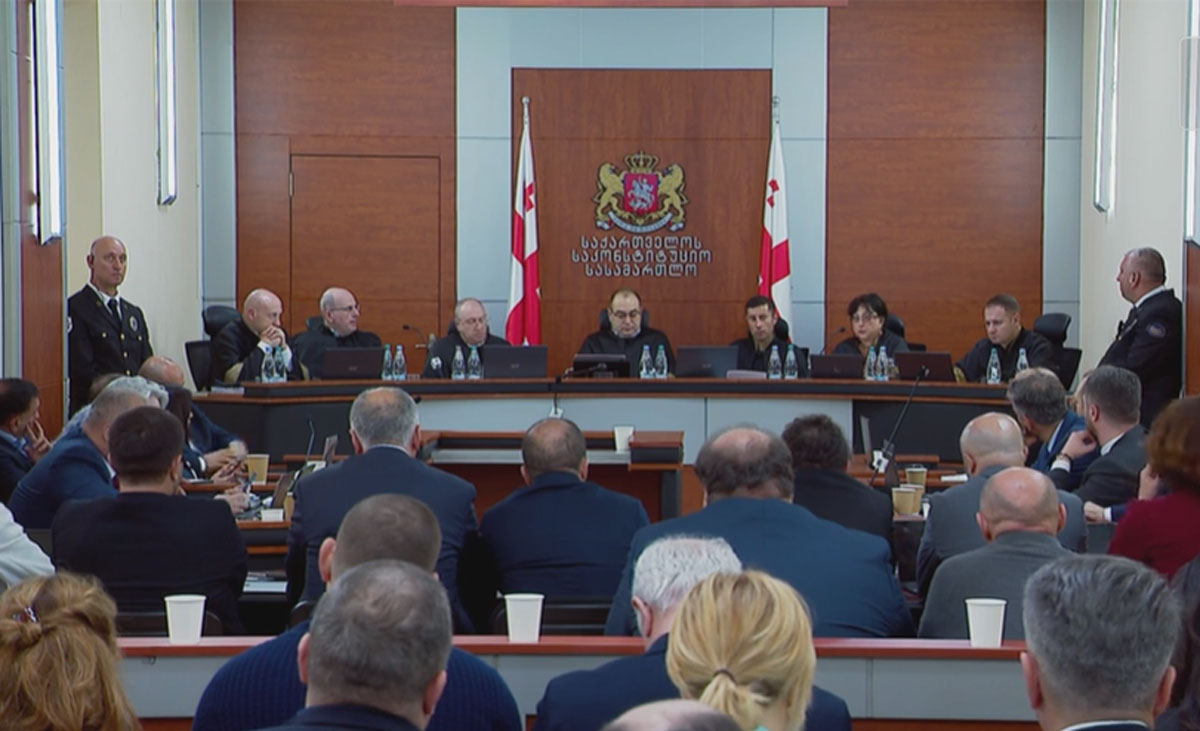
The Constitutional Court of Georgia has rejected a motion by the Lelo – Strong Georgia coalition to request an advisory opinion from the European Court of Human Rights (ECHR).
Giorgi Sioridze, a representative for Lelo, argued that obtaining an advisory opinion from the Strasbourg court for such a landmark case would have been highly significant in establishing potential standards regarding convention rights.
As the Lelo representative explained, the motion was grounded in the fact that no global precedent exists for banning five political parties simultaneously through a single lawsuit.
“If you request an advisory opinion, the key question will be this: when joint proceedings are brought against different respondents who face different, and unclear, constitutional charges, what standard should apply? It would be important to have Strasbourg’s advisory opinion in a landmark case. Let us ask what standards may apply in relation to Convention rights,” Sioridze said.
The Constitutional Court Plenum deliberated in the courtroom and rejected the motion. Presiding judge Revaz Nadaraia explained the reasons.
“The motion is based on the claim that they do not trust Georgia’s Constitutional Court and that criteria need to be established, criteria that already exist. Criteria exist by which the Constitutional Court must guide its actions. A party simply declaring ‘I don’t trust the Constitutional Court’, particularly on procedural matters, is entirely unsubstantiated.
We understand that, objectively, the case is important and the first of its kind, but sending it to the European Court of Human Rights for an opinion on that basis is wholly unjustified. The Organic Law on the Constitutional Court does indeed provide for this regarding rights set out in Chapter Two of the Constitution of Georgia. As for the procedural side, for a national court to ask the European Court of Human Rights whether five parties can be joined as respondents would be rather awkward,” Nadaraia said.
Judge Eva Gotsiridze also explained the court’s refusal. She said the main reason was that questions can only be referred if Strasbourg’s case law doesn’t offer a clear answer. According to her, the Grand Chamber will only accept a request if there is real uncertainty in its rulings, a process she knows well given her familiarity with the court’s general approach.
“The right to request an advisory opinion under Protocol No. 16 to the Convention clearly exists. The Constitutional Court, together with the Supreme Court, is indeed one of the highest courts that may ask Strasbourg about questions of interpretation and application of the Convention. Under this procedure, the Grand Chamber issues an advisory, non-binding opinion. But we need to know exactly what this procedure means and what its limits are.
First of all, it is a misconception to think that we can just put forward any general, theoretical question and the Grand Chamber will write an academic study for us, offering guidance on party bans, proportionality, or any other legal matter. The Strasbourg Court always deliberates in the context of each specific case. Protocol No. 16 to the Convention explicitly stipulates that a matter must be of essential relevance to that particular case, and that the specific circumstances of the case itself must be referred to Strasbourg. That, however, is a separate issue.
The primary foundation of the Constitutional Court’s refusal is that a request may only be lodged on matters where the case-law of the Strasbourg Court offers no clear answer. I shall not conceal that my colleagues and I are accustomed to carrying out our duties with utmost diligence and responsibility. I have personally reviewed every Strasbourg Court judgment concerning the banning of political parties. I personally know very well, and I am sure my colleagues do too, the general approach the Strasbourg Court takes. That includes what freedom of expression means, what the grounds for restricting it may be, and the danger that would warrant a ban. It also includes how facts are attributed, and what the duty to distance oneself from a statement entails. On top of that, there is the question of when one party member acquires a duty to distance themselves from another member’s statements, and when statements by a party’s supporters can or cannot be attributed to the party itself. All of these issues are well established in the case law. At this stage, I have no questions.
In other words, we should ask about matters having no clear answer, and at present I have no question that is unclear to me. What’s more, even if something were unclear to us and we did ask Strasbourg, the Grand Chamber would have to be satisfied that there is genuine uncertainty in its case law on the very question we had raised, and that greater clarity in this case would be justified. Only then would the Grand Chamber accept the request.
I’ll go further. Protocol No. 16 has been a subject of my professional interest, and I have studied it thoroughly. I know every request made: the Grand Chamber’s opinions on requests from the Armenian Constitutional Court, the Armenian Court of Cassation and the French Court of Cassation. I know when Strasbourg accepts a request and when it does not. Regarding the case before us, I cannot think of a single question we could put to Strasbourg that the court would accept as unanswered in its case law. Not only is there extensive practice and settled jurisprudence on this specific topic—evident in every relevant case—but Strasbourg also employs a range of other concepts. By applying them together, even an average lawyer can work out how this issue would be decided.
I’ll also give you my personal view. I have serious doubts about this jurisdiction, which was introduced in parallel with, and by analogy to, the Luxembourg jurisdiction. There it made more sense, because the EU is subject to common regulations; we have no such situation here. In effect, a national court of last instance asks an international court what decision it should take in a specific case. My personal view is that this undermines judicial independence and even infringes sovereignty. At the time, I even criticised the government for ratifying this protocol. What’s more, they barely managed to gather the ten countries needed to sign it, and many large Western European countries, such as Germany and the United Kingdom, have not joined. In effect, only small Eastern European countries have joined this protocol,” Judge Gotsiridze said.
Gotsiridze also noted that a Grand Chamber advisory opinion is purely advisory, and the court is not obliged to follow it.
“You also suggested this was needed for the sake of trust. A Grand Chamber advisory opinion is not, and cannot be, binding; it is advisory. Now imagine that it accepts the request and gives us an opinion, and the court is not obliged to follow it. If the court doesn’t follow it, what happens? There will be uproar: ‘Look, Strasbourg said this and our Constitutional Court ignored it.’ Would that build trust or damage it further? And if the court did follow it, the other side would say: ‘It didn’t act on its own judgement; it’s following someone else’s opinion.’ Either way, it would have a very negative effect. That is my personal view.
The main argument is that you can only refer a question to which there is no clear and precise answer, and Strasbourg itself must be satisfied that there really is no clear answer and that further clarification is needed in the specific case,” Gotsiridze said.
The Constitutional Court is on the second day of its hearing of Georgian Dream’s constitutional lawsuit seeking to declare unconstitutional and ban the activities of the National Movement, the Coalition for Change, Strong Georgia – Lelo, the Federalists and Gakharia for Georgia.
The hearing is currently in recess.