


CEC Chair calls upon voters to be active, to vote, and to exercise their right to elect
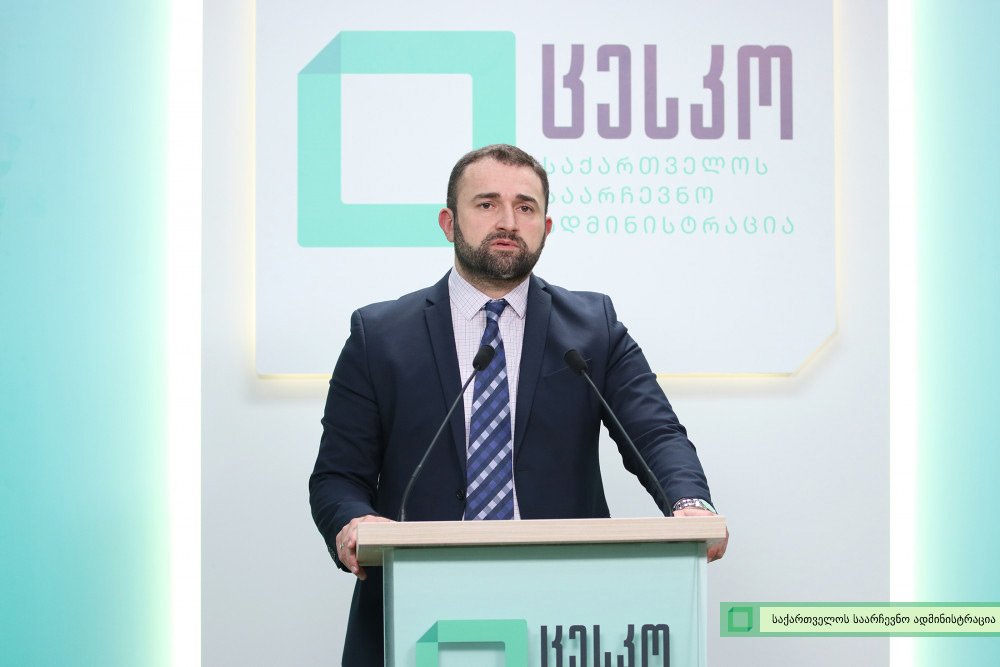
According to CEC Chairman Giorgi Kalandarishvili, tomorrow, on October 4, Georgian citizens will elect 2,058 members to 64 municipal Sakrebulos (city assemblies) through both proportional and single-mandate systems, as well as 64 mayors in the regular elections for municipal representative bodies and self-governing city/community mayors.
Giorgi Kalandarishvili stated at a briefing held at the CEC that the electoral process will be observed by representatives from 28 international and 27 local organisations, whilst the proceedings will also be covered by nearly a thousand representatives from 73 media outlets.
“Among the registered international organisations are representatives from various countries’ embassies, as well as international organisations and electoral administrations from 21 countries, including Bulgaria, Albania, Bosnia and Herzegovina, Hungary, Slovakia, Montenegro, Turkiye, and Moldova.
It should be noted that throughout today, working meetings will be held with electoral administrations and international organisations from various countries, during which I shall personally provide participants with information regarding any matters of interest to them concerning the elections,” Kalandarishvili noted.
According to his statement, 12 political parties are registered for the October 4 elections.
“Nine mayoral candidates are registered in Tbilisi. All 12 political associations have submitted party lists for the Tbilisi Sakrebulo (City Assembly) elections. Apart from Tbilisi, a total of 112 mayoral candidates are registered across the remaining 63 municipalities, including four candidates nominated by initiative groups.
As for candidates registered in local majoritarian electoral districts, a total of 2,228 candidates are registered, including 32 candidates nominated by initiative groups. In Tbilisi alone, there are 160 candidates.
Nationwide, 3,061 polling stations have been opened, of which voting will be conducted electronically at 2,284 stations and traditionally at 777 stations. These include 10 polling stations established in exceptional circumstances, which have been opened in penitentiary institutions.
All polling stations are ready to receive voters. The voting process will begin at 08:00. Voters must bring a valid Georgian citizen’s identity card or passport. Voting closes at 20:00; however, voters queuing at that time will be able to cast their votes. For this purpose, one of the commission members, at the instruction of the precinct election commission chairman, will register those in the queue, and they will be able to participate in the voting.
From an administrative perspective, municipal elections are amongst the most complex and challenging elections to conduct. Accordingly, the electoral administration has been actively preparing throughout the entire year to hold the elections to a high professional standard and in accordance with international standards, having undertaken numerous large-scale activities across various areas.
It is precisely on the basis of the work carried out and the results of simulated voting that I can confidently say that the administration is fully prepared for tomorrow. I would like to express my gratitude to all electoral administrators and everyone involved, from public agencies to various stakeholders such as political parties, the media, non-governmental organisations, and others, for their support and dedication throughout the preparation process for these most important elections.
The Central Election Commission calls upon district and precinct election commissions to facilitate the crucial process of election observation and coverage, with scrupulous adherence to the procedures established by law. Furthermore, it urges observer organisations to respect the legislation, refraining from interfering in the functions and activities of the commissions, thereby supporting the conduct of the electoral process in a peaceful and professional manner. The electoral administration will act within the framework of the law and, in cases of interference or obstruction of its activities, will immediately resort to the mechanisms established by law.
Elections are a collective endeavour, and that is precisely why I call upon voters first and foremost to be active, to come out and vote, and to exercise their right to choose. I also call upon all involved stakeholders, including registered political parties, local non-governmental organisations, international entities, and the media, to support the conduct of the electoral process in a peaceful and free environment. Your active participation is vital to ensuring transparency and integrity throughout the election.
Detailed information about polling stations, activities, operations, and relevant statistics will be published on the CEC website and shared with media representatives for dissemination.
The Central Election Commission is prepared to administer the elections in compliance with legislation, transparently, and to a high professional standard. First and foremost, I would like to emphasise that these are the first municipal elections in which the electoral administration will utilise electronic technologies on a large scale, greatly enhancing the speed and simplicity of procedures while ensuring greater transparency.
The total number of voters for the October 4 municipal elections is 3,513,818. A total of 3,130,348 voters will participate in the elections using electronic technologies.
It is worth noting that this year, for the first time, up to 47,000 young people will have the opportunity to participate in elections. To inform them, the Central Election Commission has undertaken a wide range of informational activities.
A total of 60,754 voters have applied to the electoral administration with requests for mobile ballot boxes.
The elections will be administered by up to 34,000 electoral administrators.
At polling stations where voting is conducted using electronic means, the voter will be given one ballot paper divided into three columns. Along with the ballot paper, the registrar will provide the voter with a special framed envelope of the appropriate format. In this case, a voter who comes to an electronic polling station should not mark the number of their preferred electoral subject with a circle, but rather must colour in/mark with a special marker the inner space of the circle before only one electoral subject/candidate of their choice in each column, and using the special framed envelope, place the ballot in the vote-counting device under the slot cover. The slot cover is being used at elections for the first time this year.
The vote-counting device operates automatically, and immediately after voting concludes, once all mandatory procedures have been completed, it prints a summary of the preliminary results, which is then transmitted to the CEC via a tablet. This, of course, means that the time taken to publish preliminary results will be significantly shortened. It is expected that, within 1-2 hours of the close of voting, thanks to the process of receiving and consolidating information, we will be able to present the first preliminary data to the public. It should be noted that the transmitted data will be accessible to any interested party on the website results.cec.gov.ge.
Furthermore, to ensure transparency and reliability, provision has been made for manual counting of ballots. During the counting of ballots, commission members will sort valid and invalid ballots and compare the result obtained with the device’s data.
At the remaining polling stations, voting will proceed according to the previously established procedure. However, at these locations, ballot papers will be scanned and digitised, then uploaded to a secure platform, making them accessible to all interested parties.
I wish to emphasise here that the electronic devices are not connected to the internet, and consequently, there is no risk of cyber interference. Naturally, voting is secret. Modified (so-called cut-out) booths have been installed at all polling stations. I remind you that photography and video recording in the booth are prohibited. Moreover, there is no link between the voter and the ballot, just as there is no link between the verification device and the ballot, which is another prerequisite for ensuring secrecy.
It is also important to note that, based on the experience of the electoral administration and the vendor company, the probability of any device malfunctioning is minimal. However, such eventualities are anticipated and adequately insured against. The most important thing is that, under no circumstances, will the voting be disrupted.
Throughout the day, the CEC contact hub will operate at 2 51 00 51. The media centre will also operate continuously, providing the media and all parties involved in the electoral process with ongoing access to information on matters of interest to them.
We call upon all parties involved to observe the legislation scrupulously and to support the conduct of elections in a peaceful atmosphere,” declared Giorgi Kalandarishvili.