


Turkish FM: Significance of trilateral cooperation extends beyond shared interests; this mechanism guarantees regional peace and stability
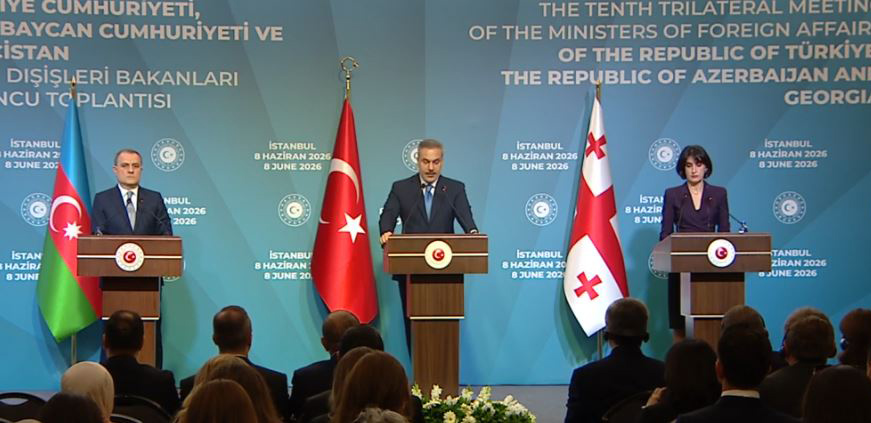
“During our meeting, the Foreign Ministers of Türkiye, Georgia, and Azerbaijan discussed stability and peace across the South Caucasus, noting that this cooperation is both stable and constructive,” stated Turkish Foreign Minister Hakan Fidan during a press conference in Istanbul, held as part of the tenth trilateral meeting of the Foreign Ministers of Georgia, Türkiye, and Azerbaijan.
According to the Turkish Foreign Minister, the significance of the trilateral cooperation format is not limited merely to shared interests; he noted that they view this mechanism as one of the primary guarantors of peace and stability in the region.
“This mechanism has functioned uninterrupted for nearly 14 years. Over the years, this relationship has brought numerous benefits to our nations, ranging from enhanced political dialogue and economic integration to cooperation in transport, energy security, trade, and people-to-people ties. This platform has provided us with the foundation to take a broad spectrum of strategic steps.
The significance of this cooperation is not confined solely to the shared interests of our three countries. We also view this mechanism as a guarantor of peace, stability, and sustainable prosperity in the South Caucasus. Today, we are again thoroughly discussing the issues on our countries’ agendas and holding consultations regarding regional and global developments.
We are currently living through a rare period where geopolitical upheavals and turning points are occurring simultaneously worldwide, amid rising economic uncertainty. In this context, all of this is highly significant. In fact, achieving an energy supply that has become highly efficient and, crucially, cost-effective is a major milestone. We are not merely talking about the transportation of energy resources, but rather about the energy security that was brought about by our efforts, particularly regarding connectivity between Europe and Asia.
I am referring to the Middle Corridor, which forms the backbone of our entire strategic cooperation. A paramount issue is the railway in particular, which has achieved exceptional operational capacity. We recently celebrated the opening of this entirely magnificent, strategic route. During the meeting, we spoke about stability and peace across the South Caucasus, noting that this cooperation is stable and constructive. At present, we fully understand that all of this is essential for developing the projects and managing the complex matters that we are currently advancing through joint efforts,” Hakan Fidan stated.
He further noted that Türkiye welcomes the progress of the peace process between Armenia and Azerbaijan.
“This cooperation also opens up a highly interesting window of opportunity for relations between Armenia and Azerbaijan, and a peace agreement of this nature will presumably be signed between the two parties in the near future. The developments in Armenia are, in fact, quite close to Türkiye’s interests in cooperation; the consolidation of peace is a direct result of this relationship. Tangible results in terms of consolidating peace are already visible, and this, in turn, has a tremendous impact on the economy. We will spare no effort to develop this direction.
Within this framework, we also discussed the peace talks in which the United States is involved. We all hope that peace will soon be achieved in this region.
Naturally, we also want Iran to achieve a permanent and lasting peace. In such a pivotal period, Türkiye is committed to continuing its diplomatic efforts. On the other hand, all of this contributes to establishing peace in our region. This is a necessity we believe in to bring lasting peace to the region, and we are sparing no effort to achieve it. Furthermore, it is essential to fully grasp the very essence of the conflict when conducting a diplomatic process. The parties must take into account the overall situation and the circumstances that align with each country’s interests. In this regard, the example of the Sea of Azov is quite telling,” Hakan Fidan said.
The source material was prepared based on simultaneous interpretation.