


TI Georgia’s Eka Gigauri addresses French National Assembly Friendship Group: Do not leave Georgians standing alone against a regime; we will continue the fight
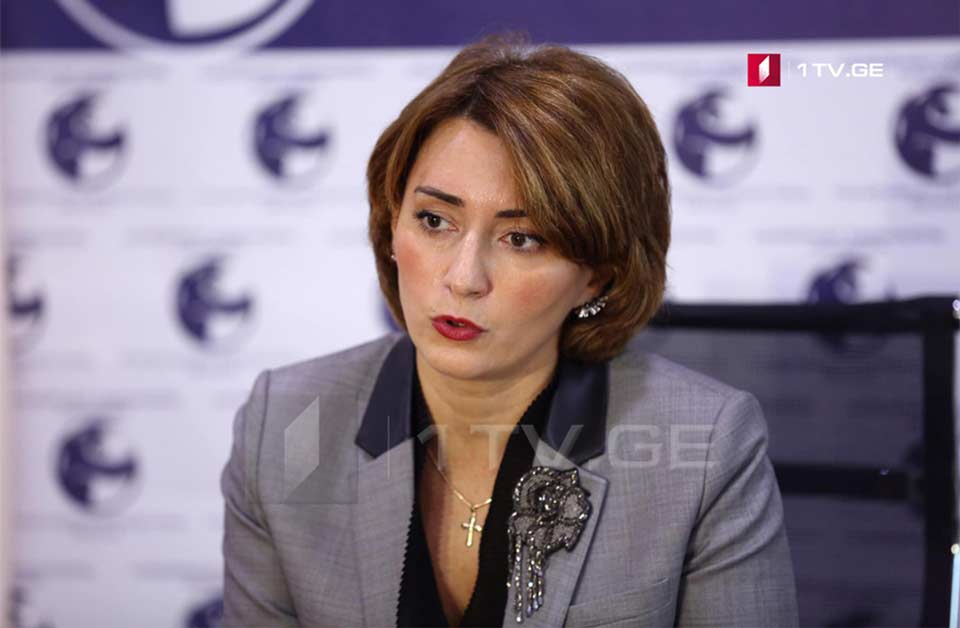
“In Georgia, institutions exist in name only, having lost their constitutional function: parliament no longer oversees the government; the judiciary no longer protects citizens from political violence; the Prosecutor’s Office no longer investigates alleged crimes and corruption linked to the authorities; and the security service is used to target political opponents, non-governmental organisations, and the media,” Eka Gigauri, Director of Transparency International Georgia, delivered these remarks during a discussion on Georgia organised by the France-Georgia Friendship Group at the French National Assembly.
As Gigauri noted, such a governance model makes it significantly easier for the ruling elite to retain power.
“Thank you very much for discussing the issue of Georgia here inside the French National Assembly. I represent Transparency International Georgia, an organisation that for nearly 30 years has investigated corruption, defended citizens, journalists, and activists, and monitored elections.
Today, I wish to speak not merely about individual acts of corruption, but about how corruption in Georgia has morphed into a system of governance, and what it shares with the Russian model of governance. I want to highlight how the prevailing corruption in Georgia serves Russia’s interests and dismantles our statehood.
As far back as 2020, Transparency International Georgia concluded that corruption in the country had taken the form of state capture. This represents the most severe form of systemic corruption, where influential figures shape policy, laws, and economic rules to serve their private interests, whilst public institutions serve these private political interests rather than the public. Under such a system, it becomes far easier for the ruling elite to maintain its grip on power. Elections may be held formally, and institutions may formally exist, but they are reduced to a mere facade. This same system makes it easy to conduct propaganda, mislead one’s own population, and alter the country’s foreign policy course, as we are, unfortunately, witnessing in Georgia today.
It is precisely this system that operates in Georgia today: a single informal centre of power controls the government, parliament, courts, Prosecutor’s Office, security services, regulatory bodies, and a significant portion of economic resources. There is virtually no institution left in Georgia capable of resisting the will of Georgian Dream and its founder. Bidzina Ivanishvili needs no public office to exert influence over the state. His power relies on appointing loyalists, distributing state and public financial resources and assets, relying on officials enriched by corruption and implicated in other crimes, controlling people through intimidation, and ensuring impunity for his inner circle.
Consequently, institutions in Georgia exist on paper, but they have surrendered their constitutional function: parliament no longer holds the government to account; the courts no longer protect individuals from political violence; the prosecution service no longer investigates alleged crimes and corruption linked to those in power; and the security service is weaponised against political opponents, NGOs, and the press,” Gigauri stated.
She further noted that the Constitutional Court, the very body tasked with safeguarding the constitution, human rights, and political pluralism, has also been captured.
“The Constitutional Court is currently reviewing a request by the ruling party to ban several primary opposition political groups. If these parties are banned, individuals affiliated with them will likewise be prohibited from engaging in political activity. Thus, the Constitutional Court risks being used not to defend the constitution, but to legitimise single-party rule.
Over the last five years, our research has documented more than 300 instances of high-level elite corruption involving senior officials. In the vast majority of these cases, no effective investigation was ever carried out. A select few grow wealthy, whilst the public remains impoverished year after year.
State property, public funds, and procurement systems are weaponised to reward political loyalty. Companies connected to the authorities secure contracts, gain access to resources and state assets, and subsequently, these business figures or their associates donate funds back to the ruling party. In this way, citizens’ money is converted into economic and political power for the ruling elite. As a result, the ruling party possesses approximately three, and at times four or five, times more financial resources than the entire opposition combined. State institutions fail to respond to these corrupt schemes. This is no longer mere corruption; it is the deployment of state resources to maintain the ruling party’s political and financial monopoly. It bears all the hallmarks of a classic kleptocracy.
The linchpin of this system is a captured judicial system. The prosecution service and the courts act in tandem whenever the target is a political opponent of the government, a journalist, an activist, or a representative of civil society. You can torture a protester, impose exorbitant fines without evidence, imprison someone for critical statements, or use chemical agents against them—and as a senior official, you will face no punishment whatsoever. What system does this remind you of? Undoubtedly, Russia’s.
The direct consequence of captured institutions and a compromised judiciary is the presence of political prisoners in Georgia. Transparency International Georgia conducted an individual review of cases involving individuals detained in connection with protests and identified 91 people as political prisoners in accordance with Council of Europe criteria. Among them are journalist Mzia Amaglobeli, politician and my friend Elene Khoshtaria, as well as actors, doctors, students, business owners, and other citizens. These are Georgian patriots: upright, law-abiding citizens. Their only ‘crime’ is their love for Georgia.
The election administration has been captured as well. While elections are formally conducted by the Central Election Commission, in practice, the process is managed by an informal network built around the State Security Service. The methods of this system involve pressuring voters,” Gigauri said in her address.
According to Gigauri, critical media outlets are being financially suffocated, fined, and threatened with the loss of their broadcasting licences, whilst the adoption of so-called “Russian laws” has triggered unprecedented pressure on the civil sector.
“Intimidation and harassment, the illegal harvesting of personal data, vote-buying, the mobilisation of public sector workers, and the misuse of administrative resources—state capture cannot succeed without crushing critical media and civil society. Critical media outlets are being financially strangled, fined, and threatened with licence revocation. Meanwhile, the passage of so-called ‘Russian laws’ has unleashed unprecedented pressure on the civil sector, including the freezing of organisations’ bank accounts, the seizure of personal data, and the threat of criminal prosecution.
My own professional work has been targeted in two separate investigations. Formally, I hold witness status, but in Georgia, we know all too well how swiftly a witness can be converted into a defendant. Owing to the legislation passed by the government and multifaceted pressure, we were forced to close all five offices of Transparency International Georgia within the country. The physical spaces of our organisation have closed, but our work and our fight for Georgia’s democratic future have not ceased.
In Georgia, we now have hundreds of officials and affiliated individuals subject to sanctions or visa and travel restrictions. These include ministers, parliamentarians, judges, prosecutors, and senior officials from the police and security services. Bidzina Ivanishvili himself has been sanctioned by the United States for advancing Russian interests on Georgian territory.
Furthermore, two major pro-government television channels, Imedi and POSTV, have been sanctioned by the United Kingdom for disseminating deliberate disinformation linked to Russia’s war against Ukraine. This demonstrates that their propaganda serves not merely as a tool for domestic political control, but also advances Russia’s information and strategic interests.
Why do I call this a Russian model of governance? Because this model is rooted in the informal power of an oligarch, the dismantling of independent institutions, the weaponisation of the courts and prosecution service, the destruction of critical media, the labelling of civil society as ‘foreign agents’, the painting of the West as an enemy, and the fusion of corruption and political loyalty into a single system.
This is strategic corruption, when corruption ceases to be merely a vehicle for self-enrichment and is instead leveraged to alter a country’s foreign policy trajectory. It is not necessary for every single decision to stem from a written command from Moscow. It is enough that the entire model of governance weakens Georgia, destroys its democratic institutions, pushes it away from the European Union, and deepens its dependence on Russia. That is precisely the Kremlin’s strategic interest,” Gigauri noted.
In Gigauri’s assessment, the struggle taking place in Georgia is therefore not merely a domestic political confrontation, but a battle between European democracy and the Russian authoritarian model.
“Despite unprecedented pressure, the Georgian people stand firm in their struggle. They no longer rely on a single state institution, but the unprecedented solidarity and engagement we have shown over the years will not be in vain, of that I am certain. First and foremost, I see the path forward in continuing the fight of the Georgian people. We do not shift responsibility onto others. We are fighting for our homeland. However, this is simultaneously a fight against Russia and a fight for democracy; a matter that demands we join forces with our friendly nations.
Therefore, we require a clear policy from our European partners towards the Russian oligarchic regime operating in Georgia: an immediate demand for the release of political prisoners; targeted sanctions against the architects of state capture, violence, and political persecution, along with their financial networks; and making cooperation with the Georgian government conditional upon clear, measurable democratic benchmarks.
The vast majority of Georgian citizens have made their European choice. People continue to defend this choice despite the risks of arrest, violence, and job loss. Our plea is simple: do not leave Georgian citizens standing alone against a regime that harnesses state capture, corruption, and repression to serve Russia’s strategic aims. We will continue our fight. We believe that strength lies in unity,” Eka Gigauri concluded.
Responding to Eka Gigauri’s address, the Prime Minister of Georgia, Irakli Kobakhidze, remarked: “Eka Gigauri is another foreign agent; she herself is entrenched in her position through Soviet methods and is in no position to lecture anyone on what is right or democratic.”