


Speaker: We stand with civilised world in remembering Holocaust as humanity’s darkest hour of XX century
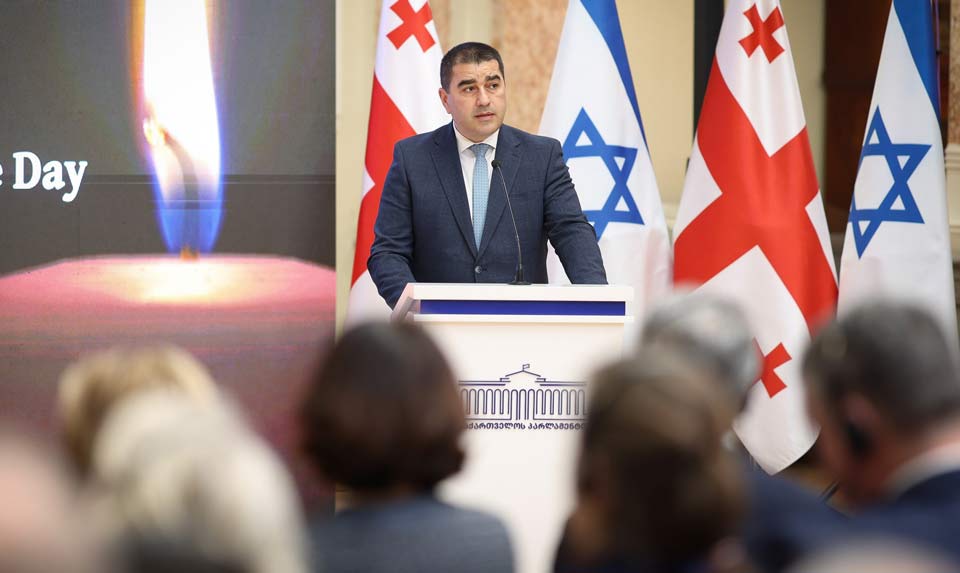
“Today, we mark Holocaust Remembrance Day and join the entire civilised world, for whom this day represents the criminal peak of what occurred in humanity during the twentieth century, Georgian Parliament Speaker Shalva Papuashvili stated, speaking at an event dedicated to Holocaust Remembrance Day.
He stated that the extermination of six million Jews is an indelible tragedy that shook Europe and forever burdened humanity’s collective consciousness.
“This is a memory of innocent people who became targets for extermination solely because they belonged to a particular ethnic group. It was a denial of humanity, a devaluation of life, and an attempt at civilisation’s self-destruction. No political conjuncture can conceal the pain inflicted upon the Jewish people, families, and civilisation. This is precisely why we mark the memory of those killed in genocide every year and recall both the victims and the scale, as well as the circumstances that permitted such a tragedy to occur with such cruelty.
We live in a rapidly changing and dynamic world. Generations change, memory changes too, and daily life covers the wounds of the past; history contracts, lessons are given to oblivion, and new generations struggle to comprehend the past meaningfully. Tragedy is diminished to a single word or phrase, stripping it of its depth and volume, and turning it into a tool to serve current political agendas.
This is precisely why Holocaust Remembrance Day must not be merely a symbolic gesture. It must be a moment of loud reminder and clear declaration, when we accurately describe and state what happened, why it happened, what allowed this evil, and what consequences it brought to humanity, using precise names.
Speaking about past victims is important today as well, because we clearly see a whole series of events that remind us of that era when arrogance, hatred, violence, vengeance, and the demonisation of difference produced a methodical and refined machine for the destruction of an entire people, which required seas of blood to stop.
The Georgian contribution was significant in defeating this evil. We take pride not only in the victory that fascism’s defeat brought us, but also in our national consciousness, which tolerates difference, hosts all manner of guests, and shows compassion towards the weak and oppressed. This is the value foundation that preserved a human face for Georgian society even in history’s most difficult periods. In this context, we must recall that the 26-century tradition of Georgian-Jewish relations was granted the status of intangible cultural heritage of national significance six years ago. This relationship counts many more centuries and will continue always, as long as this world exists. This is our loud and confirmed declaration. We are clear and direct when it comes to values, humanism, traditions, and ideals. We discuss this domestically and call for the same awareness internationally, as regression is evident everywhere. We must remember that it was precisely silence, muteness, and quietude that were the main preconditions that made the Holocaust possible,” Shalva Papuashvili stated.
As Papuashvili noted, there can be no soundness to strife, loathing, and hatred, and there can be no justification for its instigators.
“We must not tolerate any manifestation of hatred, we must not normalise it, and we must not believe that loathing brings any good. There can be no soundness to strife, loathing, and hatred, and there can be no justification for its instigators, sowers, and manipulators.
This is precisely why we must draw unequivocal red lines between what is acceptable and what is not — because it starts small and grows into something global. A tiny weed is sown, only for a thistle bush to take root; a spark ignites, and a conflagration ensues.
The Holocaust is precisely the most grave and tragic reminder of this path. No final solution can be achieved through division, violence, war, and misfortune. War begets war, violence begets violence. This is exactly why civilisation must continually stand for peace, strive for balance and harmony, and foster relationships rooted in mutual respect and tolerance of differences. It is essential to recognise the boundaries between what is permissible and what is not. This, in essence, is our primary message today,” stated Papuashvili.