


Speaker Papuashvili says Brussels has no interest in research, analysis, or facts; whatever Rasa Juknevičienė says is the truth
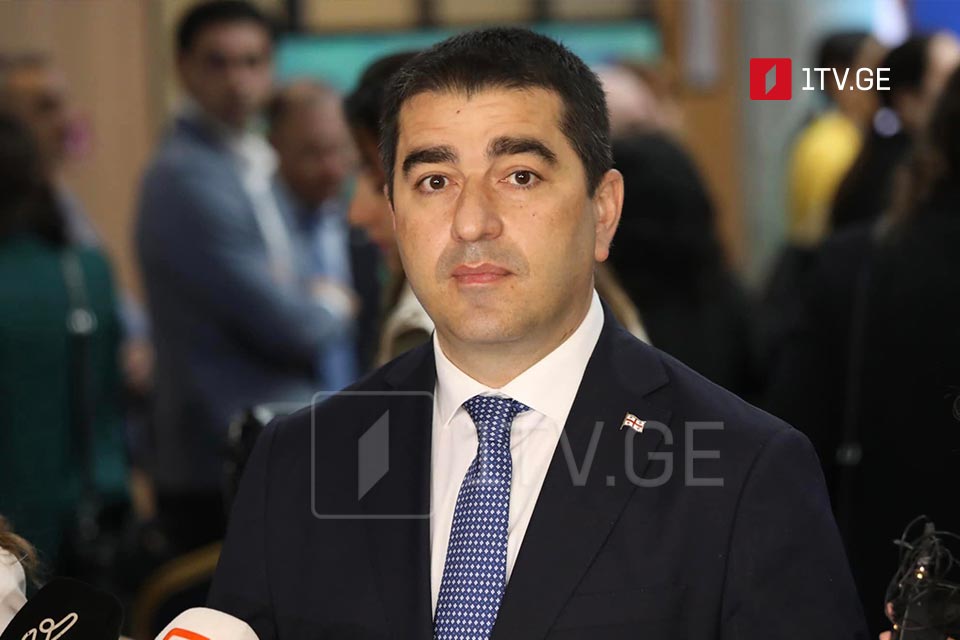
“I no longer understand why they bother with research, or indeed why we bother asking questions, because we can plainly see that Brussels has no interest in research, analysis, or facts. They know that whatever Rasa Juknevičienė says is the truth, and that is that. We are in a new era, in which someone will call black white, and say: I have an atomic bomb, therefore I will call black white, and you must repeat after me that white is black,” declared Speaker of the Georgian Parliament Shalva Papuashvili.
In his view, fair, facts-based dialogue no longer exists.
“What we are witnessing is power politics, deployed with ever greater frequency by Brussels, particularly under the foreign policy leadership it currently finds itself in. This is exactly what was referred to as the ‘Estonianisation’ of the EU, a term mentioned in the White House. The EU Ambassador’s lodestar is Rasa Juknevičienė’s political agenda, and we are watching it being enacted before our eyes. Forget it, there is not the slightest prospect of today’s Brussels taking any step grounded in objective analysis. These are coldly calculated political plans, in which we are nothing more than an instrument. Their sole interest in Georgia is how they can use us to damage Russia. In Brussels’s eyes, the people of Georgia have been reduced to a tool to be wielded against another country. Their attitude is: if Georgia gets hurt in the process, so be it. The EU Ambassador told us as much a few weeks ago. The EU Ambassador has no concern whatsoever for what becomes of Georgia. On May 9, they spent a considerable sum of money. They celebrated in a pavilion. Nothing concerns them beyond gaudy sweets and colourful photo opportunities. Nothing, except the anti-government rally they staged in the very heart of Tbilisi on May 9, without uttering a single word about the Victory that the 9th of May commemorates,” Papuashvili declared.
It will be recalled that the RESILIO-ACCESS Monitor project of the European Policy Institute published an assessment of rule-of-law resilience across EU candidate countries. Compared with other candidates, Georgia and Montenegro received the highest ratings. The study covered ten candidate countries: Albania, Bosnia and Herzegovina, Kosovo, Montenegro, North Macedonia, Serbia, Ukraine, Moldova, Georgia, and Turkey. Countries were assessed according to the following indicators: absence of corruption, the capacity to control corruption; regulatory enforcement, the ability to implement laws effectively, with Montenegro and Georgia scoring closest to the EU average in this category. Additionally, the assessment focused on the effectiveness of the criminal justice system, defined by its ability to deliver legal protection to citizens and businesses. The assessment draws on data covering the period 2014–2024.