


Speaker Papuashvili: Rising dialogue with EU and candidate states reveals blurred vision from Brussels on enlargement
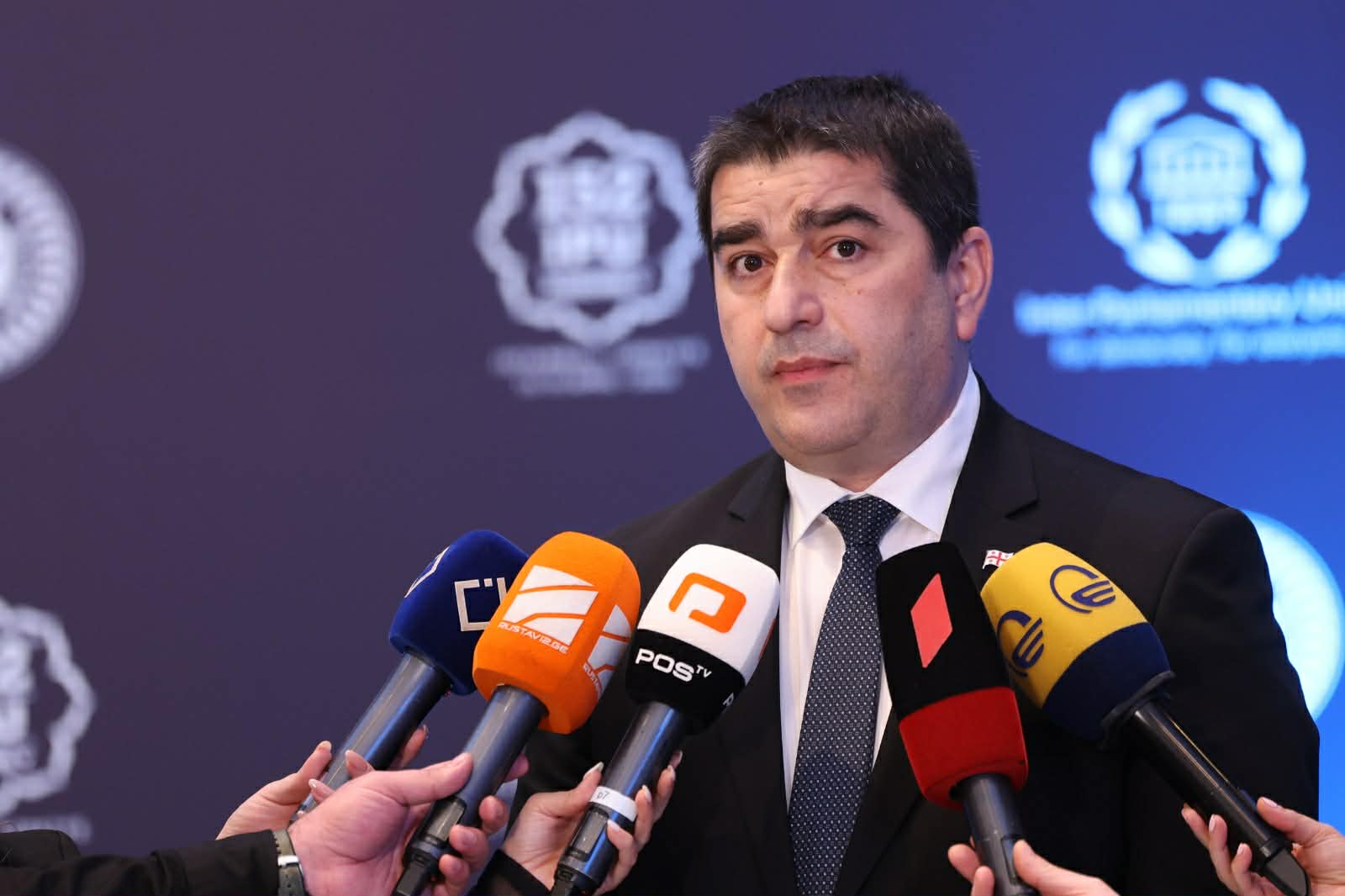
“The more frequently I communicate with representatives of both EU member states and fellow candidate nations, the more ambiguous it becomes as to exactly where Brussels currently stands on the path to EU enlargement,” the Speaker of the Parliament of Georgia, Shalva Papuashvili, told journalists.
According to the Speaker, all EU candidate countries face remarkably similar hurdles, making solidarity among them vital.
Shalva Papuashvili suggested that there is an ongoing attempt by the EU to impose novel pre-conditions along the enlargement path; criteria that could prove entirely unacceptable to the candidate nations.
“One gets the distinct impression that the grand promises made back in 2022, just three days after the outbreak of the war, when the EU claimed to have re-evaluated its geopolitical role and pivoted to an enlargement strategy, are now viewed by certain member states as having been premature. There is now a clear attempt either to backpedal on those promises or to introduce new conditions for enlargement that may be wholly unacceptable to candidate countries.
Consequently, there is nothing novel about the barriers and complications Georgia is experiencing. Indeed, the past two days have confirmed to me that virtually all candidate nations face the same systemic challenges. On some occasions, individual member states exploit personal political agendas to target specific countries; on other occasions, Brussels imposes arbitrary conditions. Crucially, these do not derive from standard accession protocols or the Copenhagen criteria, but represent newly fabricated requirements designed to serve the political interests of specific nations.
We must stand united in this regard. In this dynamic, we do not operate on equal terms, given that every single EU member state holds a veto and can unilaterally block any forward momentum. This is why our unity and information-sharing are so critical,” the Speaker stated.
To illustrate his point, Papuashvili pointed to current back-ups in the Balkans.
“To give an example, Serbia is currently awaiting a decision on opening the so-called ‘third cluster’ in its accession negotiations. The European Commission has issued a positive assessment; its sixth consecutive endorsement, in fact. Yet, as reported in the media, the Netherlands is opposing the opening of this cluster, despite the European Commission itself confirming that Serbia’s reforms merit moving forward with this phase of negotiations. Similarly, certain Baltic states are blocking this step purely because Serbia has not imposed sanctions on Russia.
The entire accession process is riddled with such instances. It is therefore vital that candidate nations exchange information, lend each other a helping hand, and stand shoulder to shoulder,” Shalva Papuashvili concluded.