


Speaker: Mzia Amaglobeli Is prisoner of Brussels’ dishonesty and those ambassadors who urged her not to admit crime
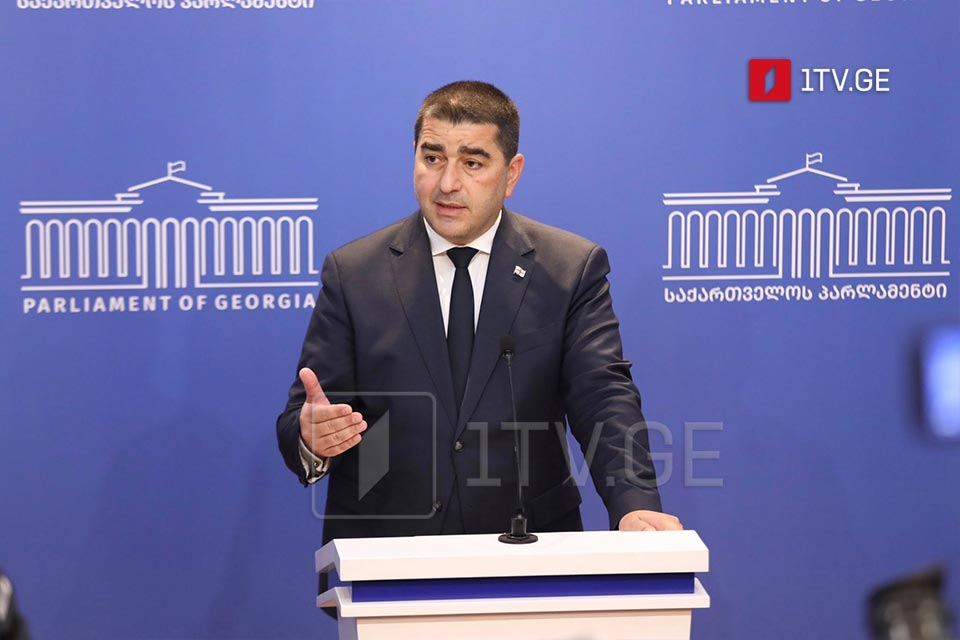
Georgian Parliament Speaker Shalva Papuasvili has accused the European Union of encouraging violent crimes committed on October 4, saying that no Brussels representative has publicly condemned the violent assault on the presidential palace to date.
According to Papuasvili, the people who remain in prison are “prisoners of the dishonesty” of Brussels and Georgia’s domestic opposition.
“We have said this before, but I think we should speak about it even more openly and more often. EU funds were used for violent protests in Georgia. We know for certain that the campaign involving Molotov cocktails was financed with EU money. We also know for certain — and the head of ISFED has acknowledged this — that equipment intended to help protesters resist police was financed with EU money and distributed among protesters,” Papuasvili said.
He claimed that the actions of protesters were also encouraged by Brussels.
“These people went onto the barricades, including at the encouragement of Brussels. You remember the October 4 attempt to overthrow the government, when the official spokesperson of Brussels publicly expressed support, several days before October 4, for the already announced rally aimed at overthrowing the government. This was an official expression of support,” Papuasvili said.
According to him, this amounted to a “virtual green light” for protesters to attack the residence of the President of Georgia.
“I remind you that to this day, not a single representative of Brussels — neither the EU ambassador nor any representative of any country — has publicly condemned the violent assault on the presidential palace on October 4,” he said.
Papuasvili said violent crimes were committed as a result and that people were imprisoned after being encouraged to take part in the confrontation and later “abandoned” in prison.
“Those remaining approximately 70 people who are still in prison today are precisely prisoners of this dishonesty — they have yet to understand that it is better to trust their own country than a foreign state. Those who remain imprisoned are prisoners of the dishonesty of domestic and external forces, including Brussels,” Papuasvili said.
Papuasvili also addressed the case of journalist Mzia Amaghlobeli, saying that international criticism was no longer focused on whether she had committed a crime, but rather on the proportionality of her sentence.
“The fact that she committed a crime is a fact. Look at all the statements being made recently, including by the EU and other institutions. Nowhere is it being said that she did not commit a crime; the discussion is about whether the punishment was proportionate and sufficiently strict. No one is saying anymore that she is innocent,” he said.
Papuasvili argued that Georgian authorities had shown a “humane and adequate” approach toward people who acknowledged their wrongdoing and cooperated with investigators or courts.
“This has been confirmed. Where there was a willingness to reach a plea agreement and an admission of guilt, the Prosecutor’s Office took reciprocal steps and those people are now free. Where there was an appeal to the President for a pardon accompanied by an admission of guilt, the President took reciprocal steps and those people are now free,” he said.
According to Papuasvili, those who remain in prison are people who have refused to acknowledge their wrongdoing.
“No one is saying anymore that Mzia Amaghlobeli did not commit a crime. What prevents them from acknowledging that a violent attack on a police officer is a crime?” he said.
Papuasvili described Amaghlobeli as a “prisoner of the dishonesty of the opposition and Brussels,” adding that she received the minimum sentence that could have been imposed by the court.
“The only way to receive a lower sentence would have been through a plea agreement, and that is both the law and the practice. A plea agreement was offered to Mzia Amaghlobeli. Only one thing was required: for Mzia Amaghlobeli to say what everyone, including the EU and its supporters, is saying today — that this was a crime,” Papuasvili said.
He claimed that the presence of foreign ambassadors at Amaghlobeli’s court hearings had discouraged her from acknowledging guilt.
“She needed to say that this was a crime, that this conduct was wrong. But by having ambassadors sit in on the court proceedings, Mzia Amaghlobeli became a prisoner of the dishonesty of those ambassadors who sat there, looked her in the eye and signaled to her not to admit the crime, to remain in prison,” Papuasvili said.
Papuasvili also criticized what he described as “unjustified awards” given to Amaghlobeli, including by the European Parliament, arguing that such actions encouraged her not to acknowledge the offense.
“Ask any ambassador, ask the EU ambassador: is this a crime? Look at the statements made in various EU formats concerning Mzia Amaghlobeli and see whether any of them say that she is innocent,” Papuasvili said.