


Speaker: Changes to Georgian Parliament’s accreditation system will be more advanced than those of European Parliament
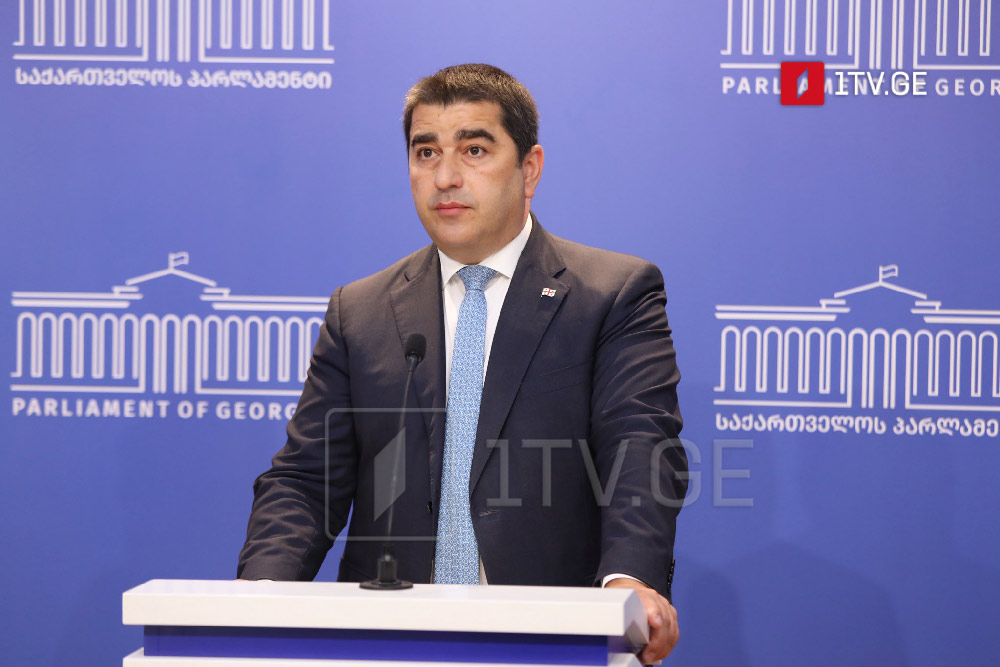
“Changes are to be made to the accreditation system; we will bring the Georgian Parliament’s accreditation system into closer alignment with the European model, and in cases of repeated rule violations, there will be provision for accreditation to be suspended for a period of up to one year,” stated the Speaker of the Parliament of Georgia, Shalva Papuashvili, in remarks to journalists.
Papuashvili noted that the Georgian Parliament’s revamped accreditation system will be more advanced than the European Parliament’s one.
“As you will recall, at the time of certain decisions taken by the European Parliament, I said that we would study the accreditation system in place there. Certain aspects were deemed worth adopting for the Georgian Parliament to bring its accreditation system into closer alignment with European practices.
Today, certain changes will be introduced to the accreditation system. As things currently stand in the Georgian Parliament, a first violation of accreditation rules results in a one-month suspension; a repeat violation results in a six-month suspension. Having examined the European Parliament’s system, we noted that there is provision for a suspension of up to one year. Accordingly, we will bring the Georgian Parliament’s accreditation system into line with that of the European Parliament: a first violation will carry a one-month suspension, whilst a second violation may result in a suspension of up to one year.
As you know, sanctions for accreditation violations in the Georgian Parliament—whether lasting one month or six months—have previously been applied solely against individual journalists. We observed that in the European Parliament, sanctions may be applied against both an individual journalist and an entire media outlet. We will therefore align our system with the European model in this respect as well. Taking into account the gravity and frequency of violations, it will similarly be possible here to revoke the accreditation of an entire media outlet for a period of up to one year. These are, in essence, the two elements we identified from the European Parliament’s practice and which we naturally wish to adopt.
In this regard, the Parliament’s accreditation system will move closer to the European model, but will nonetheless remain more progressive than the European Parliament’s one. During a recent incident at the European Parliament, we observed a stipulation that a journalist had failed to obtain prior consent before conducting an interview. To this day, we have no such prior-consent requirement, and we do not intend to import that particular practice from the European Parliament: namely, the requirement to obtain a Member of Parliament’s advance permission before recording an interview with them. At any rate, we will not, for the time being, be adopting that more stringent European Parliament approach into the Georgian Parliament’s accreditation system,” said Papuashvili.