


Shalva Papuashvili condemns foreign political spending in Georgia, calls for respect for Georgian sovereignty
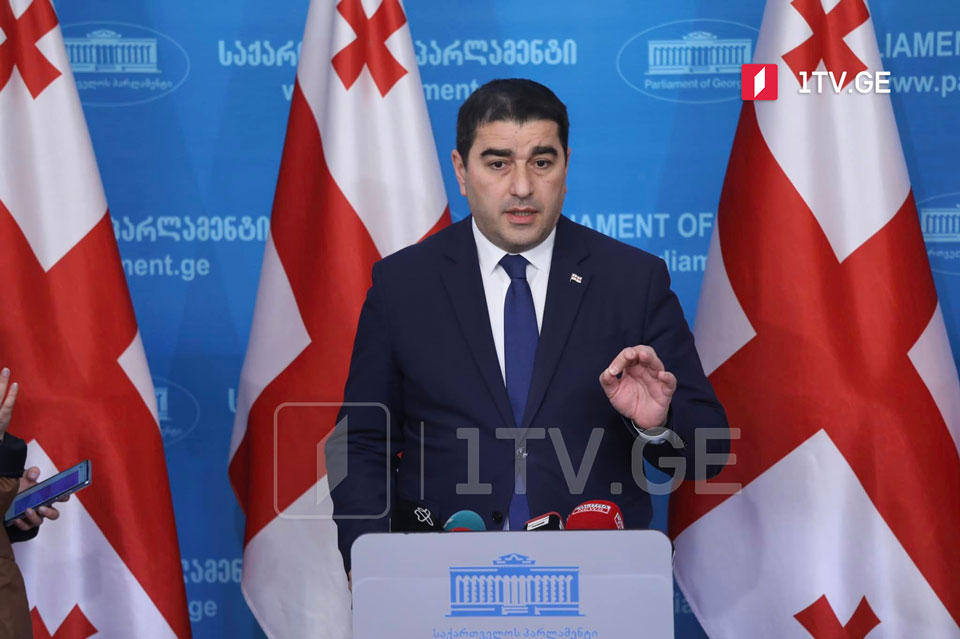
“The main principle on the grants issue is that if they’re spending money of a political nature in Georgia, kindly ask the Georgian people. We are not anyone’s colony for them to arrange everything as they see fit,” stated the Speaker of Parliament, Shalva Papuashvili.
According to him, it’s akin to kicking down someone’s door and then starting to talk about rearranging the furniture.
“Who authorised the financing of political activities here without the consent of the Georgian people? Ask the Georgian populace whether this is beneficial for them. A clear example of harmful funding is the so-called Molotov cocktail campaign, financed by the European Union. When the EU spends money to incite violence and then celebrates and promotes it as a good deed, what expectations can we have that anything will be done in Georgia’s best interests?” Shalva Papuashvili stated.
According to him, the new administration of the United States has acknowledged that foreign funding and grants were being used to gain political control over other countries, to create levers of political influence.
“We are aware, and this has been acknowledged by the new United States administration, which uncovered a system that previously existed in America: foreign funding and grants were being used to influence other countries politically, creating levers of influence. That is why they shut down USAID, halted foreign funding, and discontinued financing Radio Liberty’s propaganda and Voice of America. It has been recognised that these funds were, among other things, utilised to sway the Georgian people, society, and government.
If we accept the reality that these organisations are being exploited to advance the interests of their funders, we must also ensure there is no revolving door. Individuals should not move from NGOs into political parties and then attempt to enter government. There should be a so-called cooling-off period, as is standard in international practice. For example, when someone works in politics or the public sector and wishes to move to a position at the European Bank for Reconstruction and Development, a two-year pause is typically required. This cooling-off period aims to prevent the new role from being used to benefit the previous employment.
A prime example is Sergi Kapanadze, who was one of the leaders of the United National Movement’s repression apparatus. After losing the 2012 elections, he transitioned into an NGO, presented to us as civil society, and was involved in various activities funded with millions of dollars. Wherever there was government or opposition, Sergi Kapanadze was seated as a supposedly neutral figure, but this was merely a smokescreen for society.
In 2016, he returned to politics, became a Member of Parliament, and resumed his political career. By 2020, he re-entered the NGO sector, once again functioning as part of a non-governmental organisation,” declared Shalva Papuashvili.
According to the Speaker of Parliament, he himself has never been in the NGO sector.
“I have never been involved in an NGO, nor has Irakli Kobakhidze. It is a fact that grant funding is being used to exert a harmful influence on Georgia, as we observe daily. In June 2022, we saw NGOs gather outside Parliament, attempting to overthrow the government. Do you remember what they demanded then? That Parliament dismiss the government and establish a new one where one-third would be the government, one-third the opposition, and one-third NGOs,” stated Shalva Papuashvili.