


PM: Ivanishvili bolstered state institutions before 2008, but the regime failed to appreciate his contribution
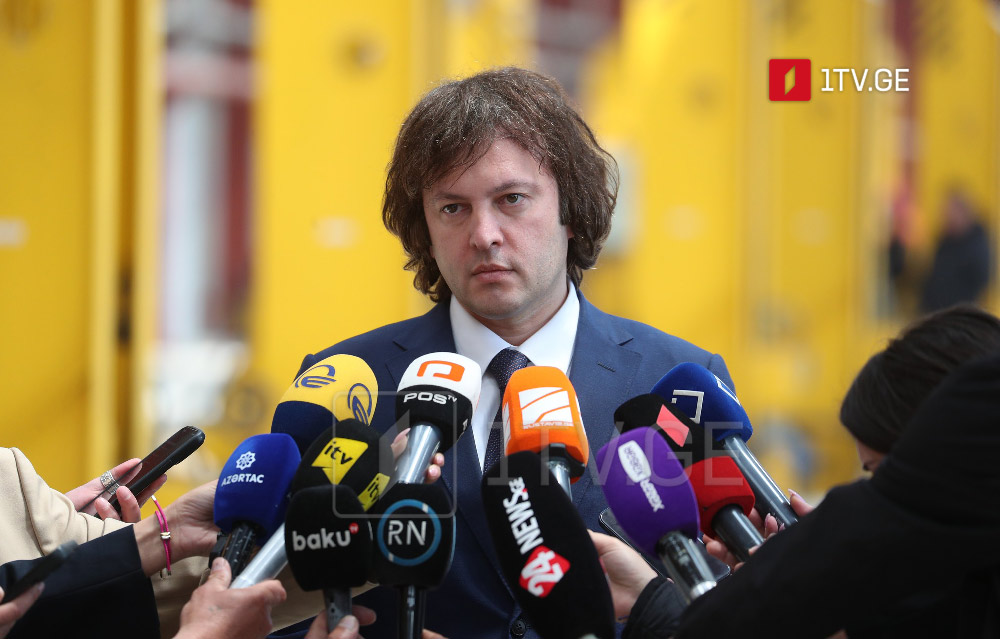
“Before 2008, Bidzina Ivanishvili dedicated substantial resources toward strengthening Georgia’s army and police while helping curb public sector corruption, yet his contributions were squandered and unappreciated by the regime of the day,” Prime Minister Irakli Kobakhidze told journalists today.
Responding to recent remarks by opposition figure Nika Gvaramia, Kobakhidze dismissed attacks on Ivanishvili’s early financial assistance to the state, stressing that subsidising public servants and military equipment was an effort to fortify national institutions rather than support a political party.
“Bidzina Ivanishvili not only funded major philanthropic endeavours, but even directly subsidised the salaries of public servants. In light of this, commenting on such shameful, cheap political declarations feels utterly pointless,” Kobakhidze stated.
“Up until 2008, Ivanishvili actively assisted the state by reinforcing the capacity of both the armed forces and the police force, while contributing directly to preventing public sector corruption. His commitment was to reinforcing state institutions, a contribution the regime of the time failed to appreciate.
That regime subsequently rigged the elections on a massive scale, triggered a war, and oversaw a catalogue of abuses from 2008 onwards, compelling Ivanishvili to completely distance himself from the authorities. Before that, he was directly involved in consolidating state institutions, particularly the military, the police, and the civil service. He made an invaluable contribution to strengthening those institutions, a contribution that those mired in corruption proved incapable of valuing,” Kobakhidze added.
The Prime Minister went on to say that supplying uniforms to an ill-equipped military could hardly be categorised as political patronage for the former ruling party.
“When the army lacked basic clothing, and Bidzina Ivanishvili ensured our soldiers were provided with proper uniforms, that was not assistance to the United National Movement. Nor was it political aid when he paid salary supplements to civil servants facing corruption risks; that was a direct investment in state capacity,” the Prime Minister concluded.