


Parliament Speaker warns weaponising international bodies for narrow political gain undermines global peace and stability
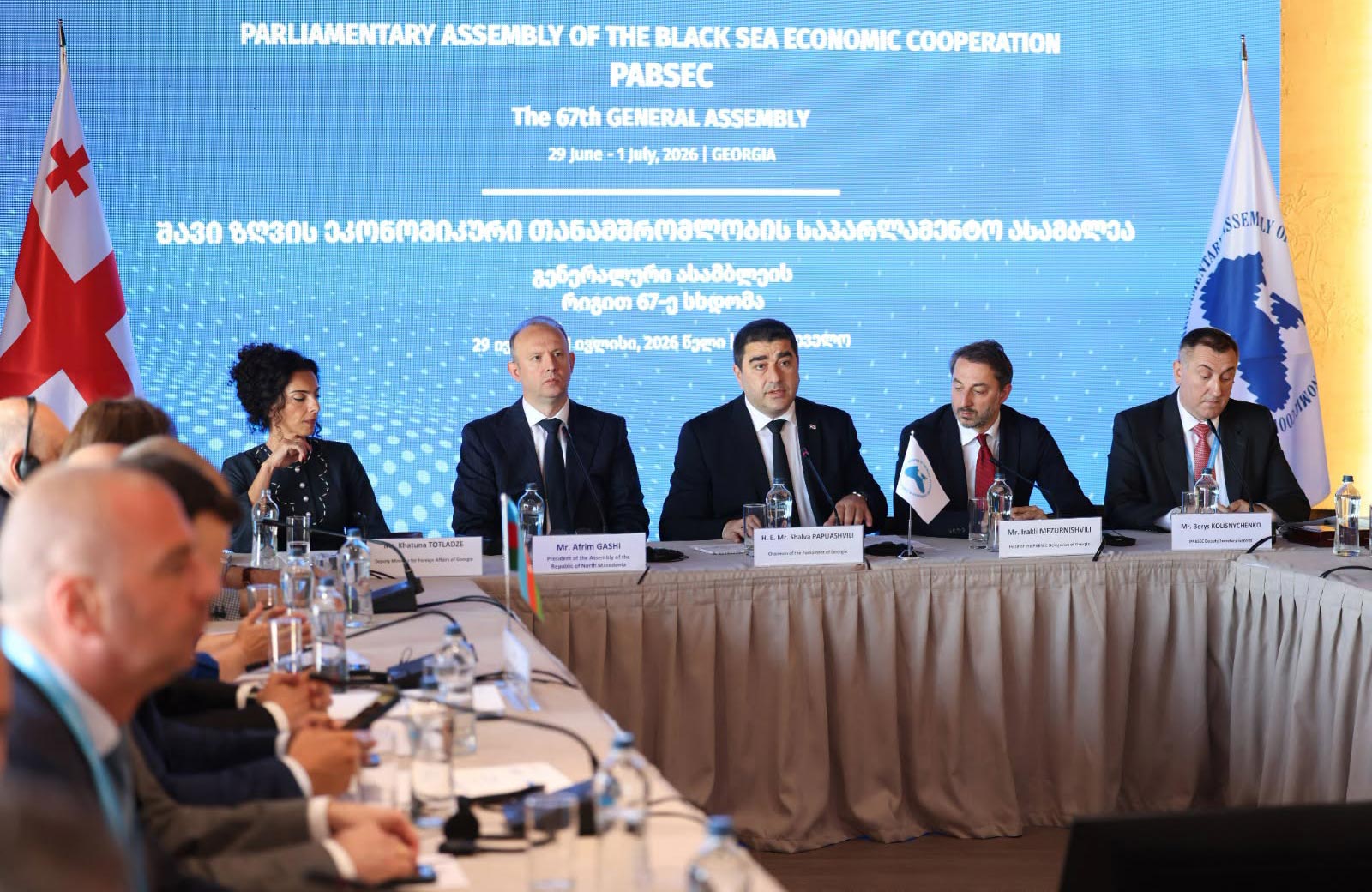
“The Parliamentary Assembly of the Black Sea Economic Cooperation (PABSEC) has always served as an important regional pillar of inter-parliamentary cooperation. Today, its role is more relevant than ever. The Black Sea region stands at a critical juncture. Ongoing geopolitical developments, growing economic uncertainty, and emerging technological transformations are reshaping our region and the wider international order,” the Speaker of the Parliament of Georgia, Shalva Papuashvili, stated during his address at the 67th Plenary Session of PABSEC.
Papuashvili noted that parliamentary assemblies are uniquely sensitive to the political preferences of their citizens and electorates, leaving them better informed about the true priorities of the public.
“As global organisations fail to deliver on peace, cooperation, and stability, regional forums such as PABSEC acquire a unique opportunity to unite us in defending our common pragmatic interests, which our parliaments express on behalf of our people. Parliamentary assemblies are particularly sensitive to the political preferences of their citizens and electorate, and are thus more attuned to the priorities set out by the population.
We value each other’s peace and security more than outsiders do, especially in times of considerable geopolitical turbulence caused by the Russian invasion of Ukraine over four years ago. This conflict has directly affected the wider Black Sea region, making it one of the hotbeds of world politics.
Even in these difficult times, geopolitics should serve our people’s economic interests, not the other way around. Therefore, PABSEC should keep a sharp focus on facilitating economic exchange, trade, connectivity, and, in other words, on people’s welfare. The wise founders of BSEC and ultimately PABSEC made the economy the cornerstone of our organisation’s mission, as is evident from the organisation’s title.
International forces that instrumentalise international organisations for their narrow political interests put geopolitics before people, damaging peace, security, and stability. This is precisely what causes economic stagnation—ignoring people’s needs for the sake of geopolitical games. Such games also widen the gap between the elites and the people, ultimately leading to a loss of popular support for adventurous leaders and their governments, whilst feeding radicalisation as a primary basis for political polarisation,” Shalva Papuashvili has stated.