


PACE’s Sabina Ćudić: Georgian government has failed to maintain meaningful dialogue with Council of Europe
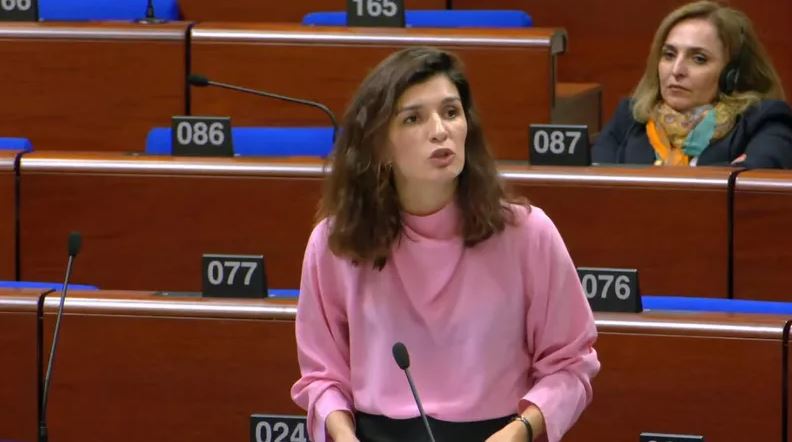
“The Georgian government has failed to maintain a meaningful dialogue with the Council of Europe,” Sabina Ćudić, the Parliamentary Assembly of the Council of Europe (PACE) co-rapporteur on Georgia, has stated.
“One of the primary indicators used to assess any country’s progress and the functioning of its democratic institutions within our organisation is an analysis of how it cooperates with the core bodies of the Council of Europe, specifically the Parliamentary Assembly, the Venice Commission, the European Court of Human Rights, and, of course, the Committee of Ministers. Taking the work of all these bodies into account, it is evident that the Georgian government has failed to maintain a meaningful dialogue with the Council of Europe.
The space in which civil society can operate is shrinking rapidly, so much so that its very existence is under threat. The ongoing crackdown on civil society organisations, their leaders, and the independent media must stop.
In line with the recommendations of the Venice Commission, the so-called Transparency Law and the Law on Grants, which collectively threaten the survival of civil society, cannot be amended or improved; they must be repealed entirely. Furthermore, both the European Committee for the Prevention of Torture and the Council of Europe Commissioner for Human Rights have pointed out that not a single credible investigation has been launched into police brutality, violence, or the violation of demonstrators’ rights. Similarly, there have been no investigations into the numerous reports concerning the torture and ill-treatment of demonstrators during arrest and detention,” Ćudić stated.
According to the co-rapporteur, the authorities’ response to the concerns and criticisms raised by Council of Europe bodies has become “increasingly dismissive and confrontational.”
“In its decision regarding the execution of the European Court of Human Rights judgment in the case of Makharashvili and Others v. Georgia, the Committee of Ministers urged Georgia to bring its legislation on freedom of assembly into compliance with the Convention, and to guarantee an environment where civil society could operate effectively. In response, the General Secretary of Georgian Dream stated that it is unacceptable for anyone to lecture or wag a finger at the Georgian people.
This stands in stark contrast to what Georgian Dream representatives told us, as rapporteurs, during our visit to Georgia last year, when they assured us that they would ensure that the judgments of the European Court of Human Rights were respected and implemented. What we heard then is in complete contradiction to what is actually happening in the country today.
Similarly, in response to the Council of Europe Commissioner for Human Rights’ report last week, representatives of the ruling majority dismissed it as vague, confusing, and groundless. In our latest resolution, the Assembly called upon the relevant bodies of the Council of Europe and its member states to utilise all available mechanisms under the Convention to ensure Georgia fully adheres to all standards and obligations arising from its membership. This call recently received full backing from the European Parliament. In its resolution on the 2025 European Commission report, the European Parliament welcomed our October 2025 resolution, which urges Council of Europe bodies to deploy all available mechanisms, including procedures under Article 52 of the European Convention on Human Rights and inter-state applications under Article 33, to ensure Georgia fulfills its obligations. The resolution also calls on EU and Council of Europe member states to consider putting these recommendations into practice.
We hope that this vital recommendation, which clearly reflects the strong alignment between the work of the Council of Europe and the European Parliament, will see concrete follow-up and action from our institutions and member states in the near future. We remain committed to an open, yet results-oriented dialogue with the Georgian authorities, as well as with other social and political forces in the country. However, we emphasise, as we always have, that such a dialogue is only possible based on the shared understanding that membership of the Council of Europe is a privilege that brings not only rights, but obligations,” Sabina Ćudić concluded.