


PACE adopts resolution on Georgia
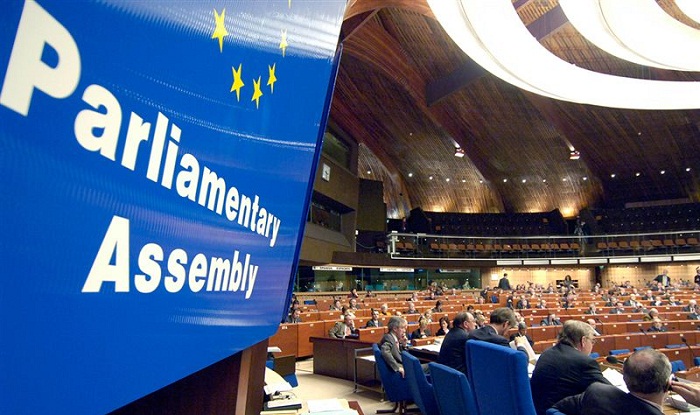
The Parliamentary Assembly of the Council of Europe (PACE) has adopted a resolution concerning Georgia. The resolution was supported by 83 members of the Assembly, with five voting against and four abstaining.
Three amendments were integrated into the draft text approved by the Parliamentary Assembly.
According to the adopted text: “The Parliamentary Assembly fully reiterates its Resolution 2561 (2024) ‘Challenges to democracy in Georgia’, Resolution 2585 (2025) ‘Challenge, on substantive grounds, of the still unratified credentials of the parliamentary delegation of Georgia’, Resolution 2600 (2025) ‘The situation in Georgia and follow-up to Resolution 2585 (2025)’ and Resolution 2624 (2025) ‘Uphold democracy and the rule of law in Georgia’ in which it expressed serious concerns about the democratic breakdown and deep political and social crisis in Georgia.
Regrettably, since the adoption of Resolution 2624 (2025), democratic backsliding has continued unabated, as has the crackdown on civil society, political opposition and dissent. None of the urgent recommendations of the Assembly has been addressed. The continuing breakdown of democracy in Georgia and the lack of any response to the recommendations of the Assembly to address this raise serious doubts about the authorities’ willingness to abide by Georgia’s membership obligations and accession commitments to the Council of Europe.”
The resolution notes that “the Assembly remains committed to an open and results-oriented dialogue with the Georgian authorities as well as all other political and social forces in the country.”
The Assembly emphasises that such a dialogue should be based on the shared understanding that membership of the Council of Europe is a privilege that comes with rights and obligations. The principles and standards of the Organisation, as well as the obligations stemming from its membership and the imperative need to fully honour these obligations, cannot be put into question or negotiated.
The initiative to ban practically all democratic opposition parties in Georgia and the criminal prosecution of their leadership on politically motivated and trumped-up charges is unacceptable. The Assembly reiterates that, if pursued, this course of action would effectively establish a one-party dictatorship in Georgia, which violates essential democratic principles and is incompatible with Council of Europe membership. It insists that the Georgian authorities repeal without delay their appeal to the Constitutional Court to ban the democratic opposition parties and to end the unjustified and politically motivated prosecution of their leadership.
As a result of the relentless crackdown on the democratic opposition, civil society and the independent media, as well as the extreme social and political polarisation in the country, the conditions for holding genuinely democratic elections currently do not exist in Georgia. The Assembly therefore reiterates its call on the Georgian authorities to initiate as a priority an open and inclusive political process involving all political forces and civil stakeholders, to re-establish a genuinely free and democratic political environment in the country, in line with the clear expectations and ambitions of Georgian society.
The continued relentless crackdown on freedom of expression and freedom of assembly, including through repressive legislation and the abuse of politically motivated legal proceedings against civil society, independent media, opposition forces and individual protesters, should end at once. Politically motivated prosecutions with no other objective than to silence dissenting voices raise the spectre of the existence of political prisoners and are incompatible with a democratic society and Georgia’s membership obligations to the Council of Europe. The Assembly recalls in this respect, as a guideline, its Resolution 1900 (2012) ‘The definition of political prisoner’. In this context, it deeply deplores the politically motivated and disproportional sentences of opposition leaders and others, including Nika Melia and Elene Khoshtaria, on clearly trumped-up charges.
The Assembly calls upon the Georgian authorities to fully repeal the recently adopted repressive legislation, in particular the controversial amendments to the Criminal Code, the Law on Political Unions of Citizens as well as the Code of Administrative Offences. It reiterates its recommendation that the Code of Administrative Offences be replaced by an entirely new law to be developed in close consultation with the Council of Europe to ensure its compliance with European norms and standards, including the European Convention on Human Rights.
The Assembly reiterates that a dynamic and pluralistic civil society is essential for a well-functioning democracy. Civil society plays a pivotal role in a country’s democratic development and is a vital source of democratic expertise. The Assembly deplores the increasingly shrinking space in which civil society can operate, which threatens its very existence. This trend must be reversed. The Assembly also condemns the continued assault on civil society organisations and their leadership, as well as independent media, including through the abuse of controversial legislation. As a first step, the Law on Transparency of Foreign Influence and the Law on the Registration of Foreign Agents (GEOFARA), along with the recent amendments to the Law on Grants, should be repealed, in line with the recommendations of the European Commission for Democracy through Law (Venice Commission).
The Assembly is concerned about the impact of the recent education reforms on academic freedom in Georgia. The independence of academia should be ensured. In addition, in order to dispel understandable corruption concerns, the Assembly calls on the authorities to establish a transparent and independent mechanism to govern the privatisation of any university assets that may have become surplus as a result of the new ‘One City – One Faculty’ reform.
The Assembly deplores that, despite its many calls to the contrary, no credible investigations have been conducted into police brutality and other human rights abuses committed during demonstrations, nor into the many reports of torture and ill-treatment of demonstrators during their arrest and detention. It takes note of the recent report of the European Committee for the Prevention of Torture and Inhuman or Degrading Treatment or Punishment (CPT) on its periodic visits to Georgia from 18 to 29 November 2024 and from 21 to 22 January 2025. It shares the serious concerns expressed in it. It is particularly concerned about the reports that prohibited chemical agents have been used for the dispersal of the protest in Tbilisi. A credible, independent and effective investigation into these allegations needs to be urgently established,” the resolution states.
Furthermore, the Assembly calls upon the Georgian authorities to “fully implement the general measures demanded by the European Court of Human Rights in its judgments in the Tsaava and Others v. Georgia, Mekvabishvili v. Georgia, Makharashvili and Others v. Georgia, A.D. and Others v. Georgia, and Identoba and Others v. Georgia cases, as well as in all other 77 judgments by the Court that are pending satisfactory execution.”
The Assembly highlights the report of the expert appointed under the Organisation for Security and Co-operation in Europe (OSCE) Moscow Mechanism, which was invoked by 24 OSCE participating States. It fully shares its findings and conclusions, which coincide with this and previous resolutions on the democratic backsliding in Georgia, and urges the Georgian authorities to fully implement its recommendations.
The Assembly condemns the recent transnational repression against Azerbaijani journalist Afgan Sadigov, who was deported from Georgia under an accelerated procedure on 5 April 2026, despite an interim measure issued by the European Court of Human Rights prohibiting his removal to Azerbaijan. This was followed by a temporary suspension of the criminal case against him, which, according to the explanation provided by the Georgian government, served as the basis for formally halting the extradition process and fast-tracking his deportation to Azerbaijan. Nevertheless, he was re-arrested in Azerbaijan on 8 June 2026 on the same grounds.
The Assembly reiterates its call to the relevant bodies of the Council of Europe to use all available means, including those under Article 52 of the European Convention on Human Rights, and its invitation to all Council of Europe member States to consider the use of interstate applications to the European Court on Human Rights under Article 33 of the Convention, to ensure that Georgia fully honour all the standards and obligations stemming from Council of Europe membership. It regrets that to date no use has been made of these mechanisms provided for by the European Convention on Human Rights,” the resolution concludes.