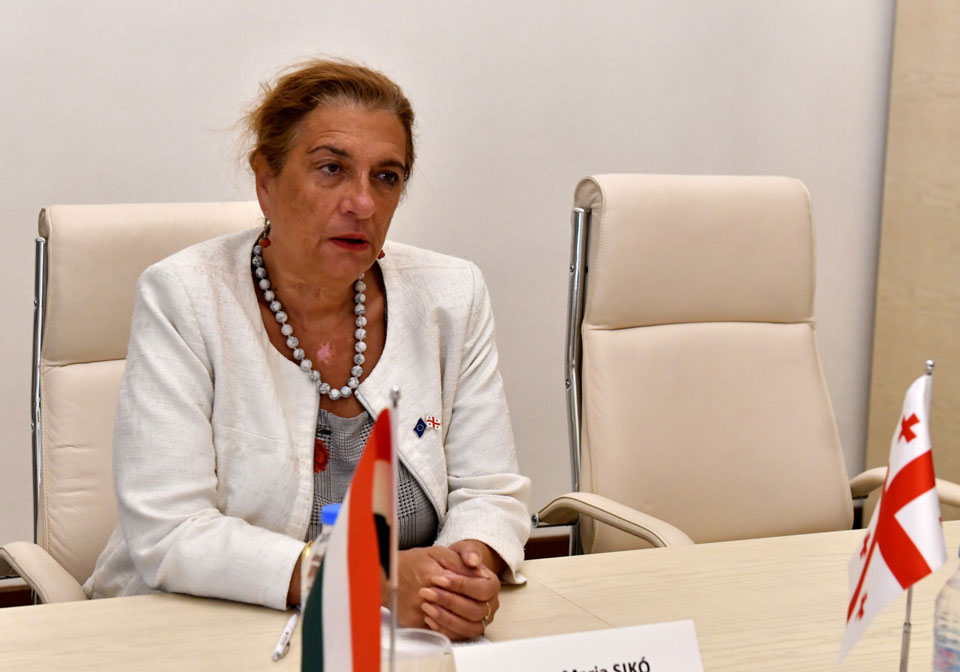
Hungarian Ambassador to Georgia Anna Maria Siko addressed the Parliament’s Foreign Relations Committee, saying, “George is not just the strategic partner of Hungary in the South Caucasus region, but it’s a key player in our Eastern Opening Policy.”
In her speech, the Ambassador explained that “Eastern Opening Policy for Hungary means that yes, we are in the center of Europe, yes, we think we are the center of the world, like you think yours is center of the world, but we realize that the center is very small and there are a lot of things around it.”
Speaking of the strategic partnership, Anna Maria Siko noted that since 2022, when nations signed the first strategic partnership agreement, “we have gone from strength to strength.”
“We have had many bilateral meetings at the ministerial level. Then we decided to have an intergovernmental summit, which first happened here in Georgia in 2020. We signed 11 MOUs and some before with the various ministries. We started to work together on various international projects. And of course, we also decided that we would work together with the economy.
Our policies [are] to strongly maintain our European heritage, our Christian values, our Hungarian traditions, and to be in the world with the unique identity that we have, but to have our doors, our minds, and our ears open in all directions.”
We might not agree with everybody, but we might not agree with everybody in any direction. In many directions, other countries don’t necessarily agree with us, but as true Democrats, we think everyone should have a say and should have an equal say. And this is what we stand for.
We resolutely support the territorial integrity and sovereignty of Georgia. We resolutely support the territorial integrity and European aspirations of Georgia. It is up to you how you want to get closer to Europe, and we’ll support you in the way you choose.
If you ask friendly nations like Hungary for support, you get; if you want advice, you get but decision and the way is up to you when you have to walk on it and take responsibility for it.
In international organizations, we have been co-authors of most of your initiatives, whether to do with the occupied territories and the minorities rights there, whether to do with your European aspirations, or even to do with participating in international affairs.
Regarding the immediate area around us, with the Russian-Ukrainian war that was going to be a short affair, but it has dragged out for over three years. We have said from day one that the only solution is peace. The only way we can talk is peace. The longer we arrive at a situation where we can talk about peace, the more difficult it’ll be.
When my Prime Minister first came out with it, then, as usual, he was ‘the devil of war.’ It was the wrong answer to everything. How can you talk about peace when war was necessary? And the source, if you look around now, just like to do with migration, just like to do with the rights of the family as opposed to the rights of sexual minorities and general traditional Christian values. What we were saying first, and we are condemned for, we still stay now, but it seems that after 2, 3, 4, 5, 6, 10, whatever years, others echo what Hungary has to say.
The prime minister has a saying that we may not be right now, but we will be proved right in the future. You just have to wait. This is the case with peace as well, and I will quote him because he said that at the end, there will be peace no matter how long the war is, even a hundred-year war, after a hundred years, ended in peace. So why don’t we see this, that peace is what we really want to achieve? Therefore, we also agree with you that we have to, at all costs, stay out of the military side of this trouble. We do just like yourselves. The biggest humanitarian help to Ukraine that we have ever done. We had more than 1.4 million Ukrainians cross the border, and all of them got first help, and many of them stayed in Hungary, and there there’s 120 schools where Ukrainian children study in Hungary. They get health covered, they have housing and a lot of other facilities,” she asserted.
Anna Maria Siko noted that Hungary has “some issues” with Ukraine, and there is an opinion poll referendum about its European aspirations.
“Our prime minister will be talking about that tomorrow. But if his mandate is to say that first, Ukraine has to end the war, find a peace, find a peace with realities, find a peace within itself and also find the peace with the ethnic minorities that live in the territory of Ukraine, until they do that, we cannot really support their membership because they would just bring the problems into the EU rather than any other solutions,” she stated.