


Georgia’s FM: We exemplify how Brussels generates misconceptions and subsequently crafts policies around them
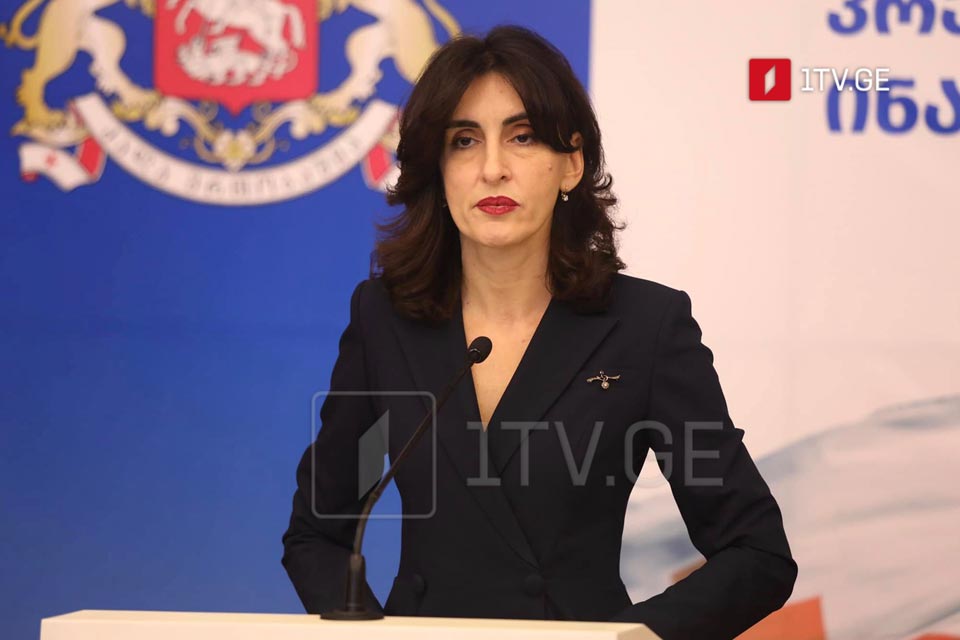
“We are the prime example of how Brussels creates misconceptions and subsequently implements policies based on these misconceptions,” stated Foreign Minister Maka Botchorishvili during an appearance on Georgian Public Broadcaster’s Topic of the Day program.
“Georgia serves as a prime example of this phenomenon. Let us be clear and call things by their rightful names—there was a deliberate effort to change the government in Georgia. Who orchestrated this and where it was planned are different questions, but it is evident that the EU and its instruments have been employed in this process. This is a standard approach, particularly in the context of our country’s European integration, which is both a matter of national interest and of great significance. However, someone has decided to exploit this issue to manipulate our country,” Botchorishvili declared.
When the host asked about Western leaders’ statements that consider such remarks from the Georgian government as anti-Western rhetoric, Botchorishvili responded that everything pointing toward the truth and indicating Georgia’s national interests has been labelled as anti-Western rhetoric.
“We have never claimed that EU membership is not in our national interest. On the contrary, we have consistently asserted that EU membership is indeed a national priority for us. We firmly believe that this goal can only be achieved through dialogue.
Today, we must address the issue of how Brussels’ bureaucracy has chosen not to engage with a democratically elected government, mistakenly viewing this as a potential tool for change in our country.
Elections have taken place, and we have a functioning government. If we are to discuss Georgia’s prospects of EU membership, that conversation cannot occur without engaging with the government that represents its voters and its people—what we understand as democracy.
Therefore, if Brussels continues to overlook the democratic government, this process will be harmed, and any assertions of genuine goodwill toward Georgia would be both inappropriate and misguided,” Botchorishvili stated.
She noted that fortunately, today, Georgia has a government whose primary starting point is the country’s national interest, which is the country’s security and stability, to achieve EU integration.
“EU integration, as we know, requires significant economic development and reforms. These reforms are not inexpensive; they are quite costly. For Georgia to reach the standards of Germany or France today demands considerable financial resources, robust reforms, and substantial economic progress. Simply put, that is the reality.
Without stability and peace, we cannot achieve any of this or provide our citizens with a better quality of life—which is precisely why we are drawn to Europe and why we are eager to pursue that path. Of course, this requires careful, stable development and policy. Fortunately, Georgia currently has a government that cannot be easily manipulated or coerced into action through threats,” Botchorishvili stated.
The Foreign Minister observed that the Georgian government was advised that a train was passing by and that if they missed it, their opportunity would never arise again. However, today we can see how advantageous it would have been for Georgia to be on the same train as Ukraine’s current government.
“We have acted appropriately thus far, taking many positive steps despite the criticism and challenges we currently face in our relationships. Nevertheless, we have succeeded in preserving the most essential element—stability and security in our country, which indeed faced a significant threat,” Maka Botchorishvili concluded.